Thursday Aug 13, 2026
Thursday Aug 13, 2026
Wednesday, 12 August 2026 06:08 - - {{hitsCtrl.values.hits}}

Industry and Entrepreneurship Development Deputy Minister Chathuranga Abeysinghe
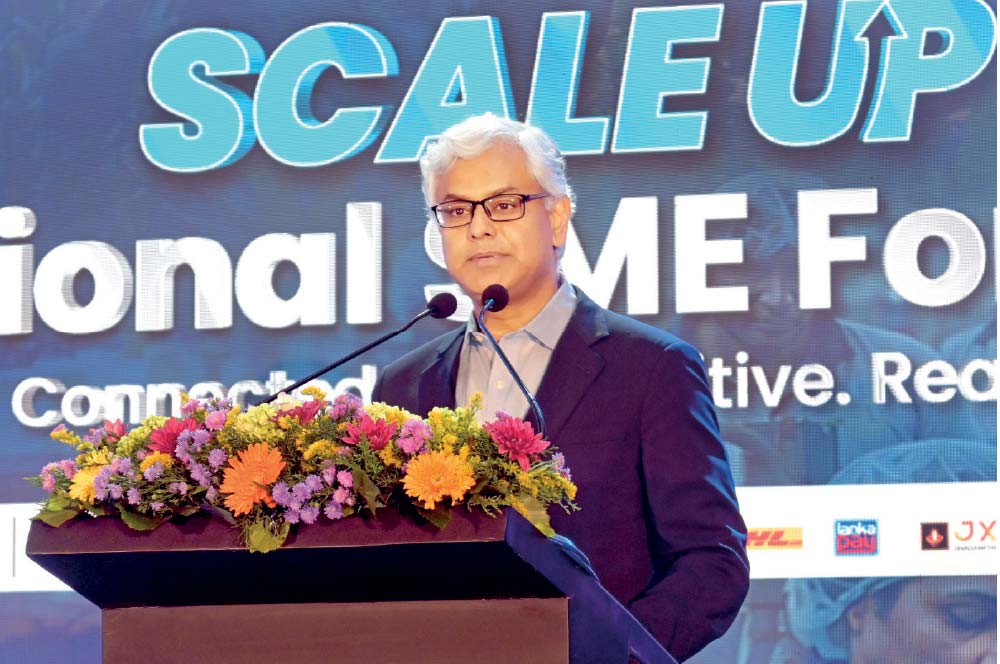
Ceylon Chamber Chairperson Krishan Balendra
By Nisthar Cassim
The Government yesterday urged over a million Small and Medium Enterprises (SMEs) to scale up to go global especially via exports to better harness growth opportunities.
The call came from Industry and Entrepreneurship Development Deputy Minister Chathuranga Abeysinghe during his remarks at the National SME Forum Scale Up 2.0 organised by The Ceylon Chamber of Commerce’s Centre for SMEs at the Taj Samudra, Colombo.
Under the theme «Connected. Competitive. Ready to Grow» the forum brought together the SME ecosystem to unlock new pathways to markets, finance, partnerships and sustainable business success. The inaugural event was held last year. The Forum included match-making, advisory and networking opportunities for the SMEs.
“We see the contribution from the SME sector will be pivotal, and it is very important for this Government and Sri Lanka. We believe in the SME sector as a mode of redistribution of wealth. The only and the most important solution is growing entrepreneurs and growing SME sectors,” the Deputy Minister Abeysinghe emphasised.
Via his keynote and a fireside with award winning small and medium enterprise and entrepreneur Selyna Peiris who is the Co-Chair, Entrepreneurship and SME Steering Committee of the Ceylon Chamber, Deputy Minister Abeysinghe was emphatic on the need for a new and more practical path for SMEs.
Primarily he called for a mindset change among SMEs cautioning them that a domestic-market focussed approach may not be sustainable or profitable given the size and removal of certain para-tariffs on imports in the future. Instead, Abeysinghe urged the SMEs to scale up to be globally competitive by improved productivity, quality, technology, partnerships, equity and less on debt capital, aspiring to be a Public Listed Company, good corporate governance and best and sustainable practices.
«To boost exports we also need to have trade agreements which are win-win. This means some tariff and non-tariff barriers must be lifted. Any protection received so far in supplying to the domestic market may not be there in the future. The bigger opportunity is to serve global markets hence venture into exports, value addition and join the global supply chain,» Abeysinghe reasoned. He listed creative industries, IT, sustainable agriculture among sectors that have global potential.
The importance of streamlining their enterprises with best practices was also stressed. Among Deputy Minister›s advice were SMEs must start paying taxes, put an end to maintaining two sets of accounts, shore up their equity by bringing investors from outside and eventually list on the Colombo Stock Exchange which provides an opportunity to improve corporate governance as global investors and partners prefer to work with such companies.
“You will get assessed by Inland Revenue. You will get checked on transfer pricing. You will get checked on imports. You will get checked on your bills. You will get checked on your finances. That›s going to happen. So if you ever feel like the stock market is going to expose you, I don›t think that›s the right mindset to be because anyway it›s going to happen. It is better to list and be compliant,@ the Deputy Minister explained.
Ceylon Chamber Chairperson Krishan Balendra said SMEs are not viewed as a separate segment of the economy. “They are an integral part of our broader work and vision for private sector growth. Whether it is policy advocacy, market access, stakeholder engagement, we are committed to ensuring that SMEs are fully integrated into these efforts,” Balendra added.
He said one of the unique strengths of the Ceylon Chamber was the diversity and scale of its membership. This gives us a natural platform to create stronger linkages between SMEs and larger enterprises, helping businesses connect to supply chains, value chains, new markets, and emerging opportunities.
“We believe that creating these connections is essential if we are to help SMEs move from survival to growth and from growth to scale. We are also working closely with various government institutions, development agencies, and industry bodies to ensure that SME concerns are heard and that support mechanisms are better coordinated, more accessible, and more impactful,@ Balendra added.
Ceylon Chamber Secretary General and CEO Shiran Fernando, shared an update on the progress since Scale Up 1.0, including developments arising from the discussions and insights from the SME survey conducted at the time. Visa - Sri Lanka and the Maldives Country Manager Avanthi Colombage also delivered a special address.
Discussions examined how SMEs can access new domestic and export markets, connect with larger companies and supply chains, and meet the standards, testing and certification requirements increasingly expected by customers and business partners. The forum also addressed the challenges businesses face as they move into their next stage of growth, including access to finance, investment readiness, governance, taxation and strategies for building more structured and scalable enterprises.
- Pix by Lasantha Kumara


