Friday Oct 02, 2026
Friday Oct 02, 2026
Thursday, 18 June 2026 00:00 - - {{hitsCtrl.values.hits}}
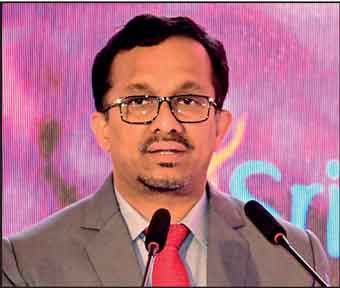 |
| Industry and Entrepreneurship Development Minister Sunil Handunneththi |
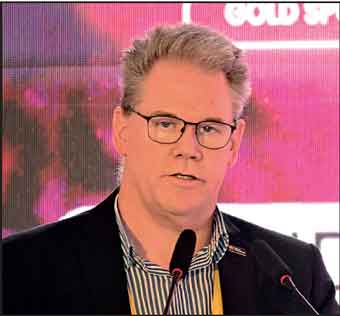 |
| Mineral Technologies Managing Director Andrew Foster |
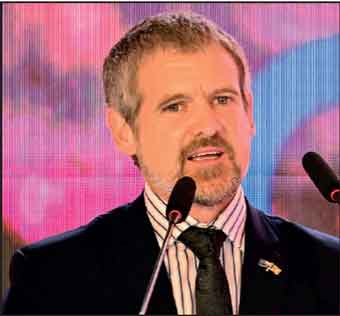 |
| Australian High Commissioner Matthew Duckworth |
By Devan Daniel
Global and local mineral sands experts, public officials, investors, and industry leaders converged in Colombo yesterday to examine how Sri Lanka can unlock greater value from its mineral resources through processing, technology, and investment rather than continued reliance on raw mineral exports.
The Mineral Sands Technical Conference 2026, hosted by The Ceylon Chamber of Commerce in partnership with Australia’s Mineral Technologies, brought together specialists from Sri Lanka, Australia, India, and South Africa to share technical expertise and international experience on building a globally competitive mineral sands industry while maintaining environmental stewardship and community benefits.
The discussions come at a time when demand for critical minerals used in the electric vehicles, renewable energy systems, advanced manufacturing, aerospace, and defence industries is reshaping global supply chains and creating new opportunities for resource-rich countries able to move beyond raw material exports into higher-value processing and manufacturing.
Industry and Entrepreneurship Development Minister Sunil Handunneththi said the Government’s new minerals policy was aimed at transforming Sri Lanka from a supplier of raw mineral resources into a competitive mineral processing hub supported by research, innovation, and skilled employment.
“Unfortunately, in the previous decade, Sri Lanka was unable to fully realise the maximum benefits of its mineral resources due to limited long-term strategic work and insufficient value-added industrial expansion,” he said. “Our mission is to transform Sri Lanka into a competitive leader in mineral processing, supporting industries, research, innovation, and skilled employment generation.”
The Minister said the Government’s strategy would focus on strengthening exploration, mining, processing, and value addition while ensuring environmental sustainability, transparency, and good governance.
The renewed focus reflects growing recognition of the strategic importance of Sri Lanka’s mineral resource base.
Industry assessments indicate the country possesses around 604 million tonnes of mineral sands alongside significant deposits of graphite, phosphate, quartz, and other industrial minerals, although experts noted that the country’s resource potential remains underexplored due to the absence of a comprehensive islandwide geophysical survey.
Sri Lanka’s mineral sands contain ilmenite, rutile, zircon, and monazite. The latter hosts rare earth elements such as neodymium and praseodymium, which are increasingly critical for electric vehicle motors, wind turbines, and advanced electronics manufacturing.
Sri Lanka’s mineral export potential is estimated at $ 778 million under the International Trade Centre’s Export Potential Map. A recent Pathfinder Foundation report estimated that the country’s longer-term mineral export opportunity could approach $ 2 billion if investment in downstream processing, value addition, and mineral-based manufacturing can be successfully developed.
Mineral Technologies Managing Director Andrew Foster said Sri Lanka was well positioned to benefit from rising global demand for strategic minerals and increasing efforts by governments and manufacturers to build resilient critical mineral supply chains.
“Sri Lanka has long been recognised for its significant mineral sands resources and its important place within the global industry,” Foster said. “Sri Lanka has an opportunity to play a meaningful role in this space and the experience gathered in this room today can help shape that journey.”
Drawing on the company’s experience across Australia, Africa, Asia, and the Americas, Foster said successful mineral industries were built not only on resource availability but also on technology, environmental stewardship, and strong institutional frameworks.
He also highlighted a characteristic that distinguishes mineral sands from many other extractive industries.
Mineral sands extraction typically involves recovering only a small percentage of economically valuable minerals while returning the bulk of the material to its natural environment through staged rehabilitation programs.
Unlike many mining operations, the extraction process itself generally does not involve chemical treatment, contributing to a comparatively lower environmental footprint.
Australian High Commissioner Matthew Duckworth described mineral sands as one of Sri Lanka’s most promising opportunities for export-led growth and economic diversification.
He said the sector had the potential to generate export earnings, create skilled employment, and support downstream industries, but cautioned that attracting long-term investment would require transparent regulation, predictable approval processes, policy consistency, and strong environmental governance.
“Having resources in the ground is a very good thing. But extracting value from those resources is another thing altogether,” Duckworth said.
He argued that countries derive the greatest economic benefits when they move beyond extraction into processing, manufacturing, and higher-value products.
Duckworth also pointed to opportunities for collaboration between Australian mining technology firms and Sri Lankan operators in areas including exploration, processing technology, skills development, technology transfer, and value-added production.
Technical sessions focused on the full mineral sands value chain, including project economics, resource development, mining and processing technologies, environmental and water management, product quality standards, Environmental, Social and Governance (ESG) requirements, rehabilitation practices, and global market dynamics.
The conference aimed to highlight that the larger opportunity extends well beyond mineral extraction itself. With growing demand for titanium minerals, rare earth elements, and other critical materials, Sri Lanka could potentially position itself as a regional hub for mineral processing, value addition, and technology-driven manufacturing, generating higher-skilled employment and capturing a greater share of value within global supply chains.
Discussions focused on the practical steps required to strengthen investment readiness, improve regulatory certainty, expand exploration, build technical capabilities, and create the industrial ecosystem needed to convert Sri Lanka’s geological advantages into sustained export growth and long-term economic value.

