Thursday Oct 15, 2026
Thursday Oct 15, 2026
Wednesday, 26 August 2026 00:00 - - {{hitsCtrl.values.hits}}
 |
| Frontier Energy Network Founder and CEO Gayle Meikle sharing her message via pre-recorded video at the launch of ‘Sri Lanka Licensing Round 2026’ for offshore oil and gas |
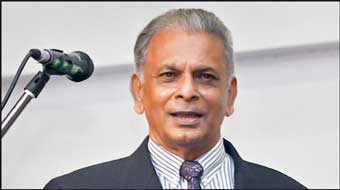 |
| PDASL Director General Dr. Neil De Silva |
By Devan Daniel
Frontier Energy Network will take Sri Lanka’s newly launched oil and gas licensing round to the international upstream market through a targeted campaign aimed at connecting the country with global operators and investors capable of evaluating and investing in the four offshore blocks on offer.
UK-based Frontier Energy Network Founder and CEO Gayle Meikle, speaking virtually yesterday at the launch of the ‘Sri Lanka Licensing Round 2026’, said the company, through its global upstream investment-promotion platform PetroInvest, would work alongside the Petroleum Development Authority of Sri Lanka (PDASL) to market the opportunity internationally.
“Firstly, a sincere congratulations to the Government of Sri Lanka, the Ministry of Energy and the Petroleum Development Authority of Sri Lanka on the launch of the Sri Lanka Licensing Round 2026. It is a privilege for Frontier, through our PetroInvest service, to be working alongside the team and to have the responsibility of taking this opportunity to the international market,” Meikle said.
Frontier has been appointed as the specialist international marketing and promotion partner for the licensing round, under which Sri Lanka is offering four offshore exploration blocks covering nearly 34,000 sq. km in the Mannar Basin.
Meikle said launching a licensing round was only the first step, with its success dependent on how effectively the opportunity was presented to potential international investors.
“Launching a licensing round is an important moment for the country and taking that opportunity successfully to the international market is a crucial part. It requires clear positioning, specialist industry marketing and, most importantly, reaching companies and decision-makers capable of evaluating and investing in those opportunities,” she said.
“Frontier is the specialist international marketing and promotion partner supporting the Sri Lanka Licensing Round through our PetroInvest service. We are working alongside the Petroleum Development Authority of Sri Lanka to take the licensing round to the international upstream market.”
The upstream petroleum industry covers the exploration and production end of the oil and gas business, including the search for resources, drilling and eventual extraction.
Meikle said Frontier’s mandate was not limited to general promotion, but involved identifying and engaging companies and individuals with the technical expertise and capital to consider Sri Lanka’s offshore acreage.
“Our role is to position the opportunity, communicate it effectively and connect Sri Lanka with Frontier’s international network of operators, investors, technical experts and senior industry decision-makers worldwide,” she said.
A key part of the campaign is a dedicated digital hub developed for the Sri Lanka Licensing Round 2026, intended to provide potential bidders with a single point of access to information on the acreage and bidding process.
“The website provides a single international destination for companies interested in understanding, evaluating and participating in the bid round,” Meikle said.
She said the opportunity section introduces the licensing round and provides an overview of Sri Lanka’s offshore petroleum prospects and the acreage being offered, while a separate team section introduces the PDASL officials responsible for delivering the bid round.
Maps available through the platform allow potential investors to examine the acreage and locations of the four blocks.
“Ultimately, creating the digital platform is only part of the job. Our role is to take the Sri Lanka opportunity out to the international market. Frontier is supporting an integrated campaign combining international communications, specialist marketing, direct investor engagement and promotion through our global upstream network,” she said.
The international campaign will begin with investor engagement in London at the World Energies Summit on 29 and 30 September.
“This includes international investor engagement in London at the World Energies Summit on the 29th and 30th of September, putting Sri Lanka in front of senior upstream leaders from across the global upstream sector,” Meikle said.
A dedicated virtual investor briefing will follow on 21 October, giving prospective investors direct access to Sri Lankan officials and an opportunity to examine the licensing round in greater detail.
“On the 21st of October, a dedicated virtual investor briefing will give interested companies the opportunity to hear directly from Sri Lanka, understand the licensing round in greater detail and engage with the team,” she said.
The campaign will then move to Asia, with Sri Lanka’s exploration acreage to be promoted to investors at the Asia Petroleum Geoscience Conference and Exhibition in Kuala Lumpur on 16 and 17 November.
“And lastly, in November, the campaign moves into Asia with investor engagement in Kuala Lumpur at the Asia Petroleum Geoscience Conference and Exhibition on the 16th and 17th of November,” Meikle said.
The international campaign will run alongside the formal bidding process for the four Mannar Basin blocks. Prospective companies will be able to access technical information to assess the geological potential of the acreage before deciding whether to bid.
Meikle said Frontier’s role was ultimately to connect Sri Lanka’s upstream petroleum potential with companies able to assess and invest in it.
“Ultimately, our role is about creating the bridge between the country’s upstream opportunity and the international market. For Sri Lanka, that means building international awareness, making the opportunity easy to understand and access, targeting the right companies and creating opportunities for meaningful investor engagement,” she said.
“This is what Frontier brings to the Sri Lanka Licensing Round 2026: specialist upstream marketing, international reach and a coordinated campaign to take Sri Lanka’s opportunity to the world.”
Meikle invited prospective investors to examine the licensing opportunity and formally register their interest as the international campaign gets underway.
“If you are interested in the Sri Lanka Licensing Round, please visit the website, explore the opportunity and register your interest. We look forward to welcoming you and engaging with you soon,” she said.
Sri Lanka has resumed international licensing for offshore oil and gas exploration after more than a decade, offering four Mannar Basin blocks covering 33,964 square kilometres in a fresh attempt to attract global energy companies to develop the country’s hydrocarbon resources.
The move comes more than a decade after Cairn India exited Sri Lanka following an exploration campaign that discovered natural gas and condensate but did not progress to commercial production.
Petroleum Development Authority of Sri Lanka (PDASL) Director General Dr. Neil De Silva said bids under the Sri Lanka Licensing Round 2026 (SL2026-01) were expected to close in early 2027, followed by evaluation and the award of blocks through Petroleum Resources Agreements. Seismic surveys and drilling would follow, with commercial production targeted by 2032 if commercially viable resources are established.
Sri Lanka already has two gas discoveries in the Mannar Basin, Dorado and Barracuda, both made in 2011. Dr. De Silva said Dorado has an estimated P50 resource of 314 billion cubic feet (bcf) of gas and Barracuda 525 bcf, giving a combined estimate of 839 bcf. P50 is the most-likely estimate, representing a 50% probability that the actual resource will equal or exceed that volume.
“Barracuda is very interesting because the upside potential of the Barracuda discovery is at least four times that,” Dr. De Silva said.
He said the discoveries represented only part of the Mannar Basin’s potential, with substantial areas yet to be explored.
Cairn drilled four wells in the Mannar Basin between 2011 and 2013. However, the deepwater location, high development costs and lack of supporting infrastructure made commercial development difficult at the time.
Dr. De Silva said conditions had changed considerably since Cairn’s exit, with technological advances making deepwater exploration and extraction more feasible and more companies entering the sector. While the cost of deploying a deepwater drilling rig remained broadly comparable to a decade ago, technology had improved the economics of exploration, with Chinese companies and technology also becoming more prominent globally.
The 2032 production target remains dependent on seismic studies and drilling establishing commercially recoverable resources. Companies awarded blocks will have to undertake seismic surveys and exploration and appraisal drilling before commercial development can proceed.


