Tuesday Oct 13, 2026
Tuesday Oct 13, 2026
Monday, 30 March 2026 05:44 - - {{hitsCtrl.values.hits}}

JAAF Secretary General Yohan Lawrence
By Charumini de Silva
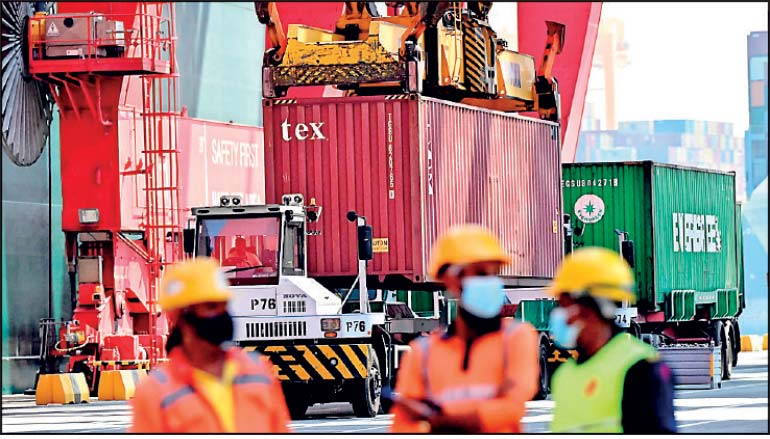
Sri Lanka’s export sector is being squeezed by a sharp spike in global freight costs and logistics disruptions, with the Joint Apparel Association Forum (JAAF) warning that a prolonged Middle East crisis could severely undermine trade flows, competitiveness, and broader economic stability.
“The impact is already being felt across both sea and air cargo, with shipping rates surging and routes disrupted as vessels avoid conflict-hit zones,” JAAF Secretary General Yohan Lawrence told the Daily FT.
He said sea freight costs have jumped dramatically in recent weeks, with rates rising by $ 1,000 to $ 1,500 per container (TEU). “Shipments to the UK, for instance, have nearly doubled from around $ 1,300 to $ 2,500. Import freight costs have also climbed steeply, increasing by 40% from India and as much as 75% from China due to space constraints and fuel surcharges,” he added.
Compounding the strain, Lawrence said major global shipping lines have temporarily suspended bookings to and from the Gulf region, while emergency war risk surcharges have been imposed on select routes.
“Air freight has followed a similar trajectory. Rates from China have risen from $ 2.70 per kilogram to $ 3.50, while westbound cargo, especially to the US, has surged from $ 3.85 to $ 6.50 per kilogram, reflecting tighter capacity and heightened risk premiums,” he disclosed.
Sri Lanka’s apparel sector came under intensified pressure in February 2026, as exports fell by 11.46% year-on-year (YoY) to $ 361.2 million with broad-based contraction amid weakening global demand. The steepest drop was registered in the European Union (EU), where exports declined by 19.48%, while shipments to the US fell by 3.53% and the UK by 5.67%. Other markets collectively saw an even sharper contraction of 18.54%, reflecting a widespread cooling in demand across destinations. The downturn has extended into cumulative performance, with exports for the first two months of 2026 declining by 6.91% compared to the same period last year.
Lawrence noted that the situation remains highly volatile, with costs shifting rapidly, making it difficult to quantify the full impact.
“While the direct increase in import transport costs may be relatively modest at around 1% of Free on Board (FOB) value, export-related costs have escalated significantly. Although many Sri Lankan exporters operate on FOB or Free Carrier (FCA) terms, where overseas buyers bear freight costs, global brands are increasingly pushing suppliers to absorb part of these increases, tightening margins further,” he explained.
The disruption is also creating operational risks. “In some cases, cargo bound for the Middle East has been offloaded at alternative ports, with shipping lines treating the journey as complete. Exporters are then left to trace and redirect shipments at their own cost, exposing them to financial and logistical uncertainty,” he said.
While Sri Lanka’s apparel sector has limited direct exposure to Middle Eastern markets, the broader trade shock is rippling across the economy. Cargo destined for the region is currently on hold, affecting cash flows and inventory cycles, particularly for industries with stronger Gulf linkages.
Export Development Board (EDB) Chairman Mangala Wijesinghe last week warned that Sri Lanka’s exports are likely to contract by between 5% and 8% in March, as escalating geopolitical tensions in the Middle East disrupt trade flows and logistics (https://www.ft.lk/top-story/Middle-East-crisis-weighs-on-March-exports/26-790140).
Lawrence warned that if the conflict persists for three to six months, the consequences could be severe.
“An extended crisis will have catastrophic impacts not just on our industry, but the economy itself,” Lawrence said, pointing to Sri Lanka’s heavy dependence on fuel imports and the knock-on effects on energy costs, transport, and export competitiveness. “The impact on worker remittances will also be significant,” he added.
The JAAF acknowledged Government efforts taken through the Industry Ministry and the EDB to prioritise fuel access for exporters, including allowing direct purchases of marine gas oil, but stressed that more needs to be done, particularly to ensure supply to small and medium-sized factories in remote areas.
Beyond immediate relief, he asserted that the JAAF has consistently pushed for structural reforms, especially in energy. Lawrence emphasised the need to accelerate renewable energy adoption and implement open access and power wheeling mechanisms to reduce reliance on costly fossil fuels.
“Sri Lanka needs to allow open access on a viable tariff and with a simplified process. Right now, all we see is a roadblock being placed in this process to ensure that we will never get a viable tariff on open access,” he added.
Lawrence argued that Sri Lanka risks losing competitiveness as global buyers increasingly favour sourcing destinations with greener and cheaper energy grids.
“We live in a world where in India, the price of open access power is less than grid energy, in a world where apparel customers are placing orders in countries that have increased use of renewable energy or a greener grid. In Sri Lanka, the Ceylon Electricity Board (CEB) has ignored the directive by the Public Utilities Commission of Sri Lanka (PUCSL) to get into fuel supply agreements, and this is causing us to have an uncompetitive energy tariff that is only likely to rise given the recent increases in fuel,” he explained.
The JAAF stressed that Sri Lanka needs to urgently scale up renewable energy and battery storage. “Right now, we are in a position where we are being held captive because of fossil fuel pricing. The irony that we cannot effectively harness both solar and wind energy at sensible pricing has never been more apparent than it is today,” he added.


