Tuesday Oct 13, 2026
Tuesday Oct 13, 2026
Tuesday, 31 March 2026 06:28 - - {{hitsCtrl.values.hits}}
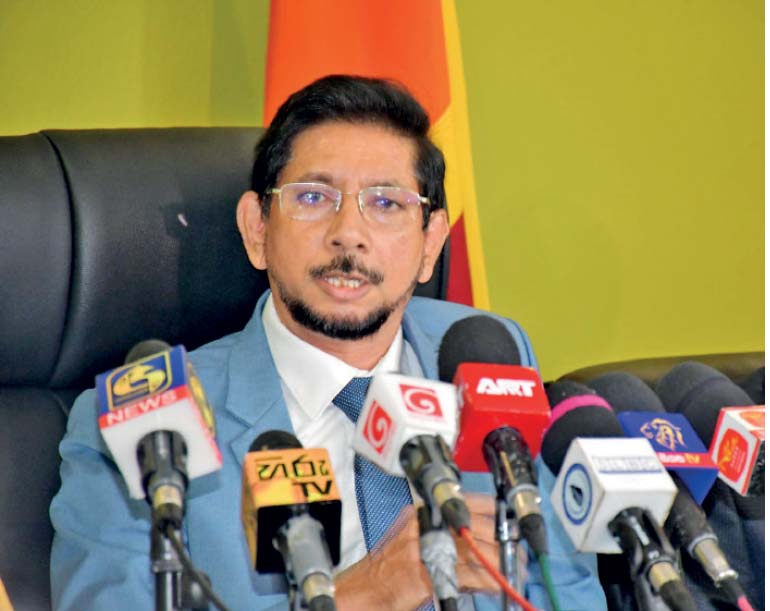
PUCSL Chairman Prof. K.P.L. Chandralal
By Charumini de Silva

 The Public Utilities Commission of Sri Lanka (PUCSL) yesterday approved an average 10% tariff increase, lower than the 13.56% hike initially sought by the Ceylon Electricity Board (CEB).
Addressing the media, PUCSL Chairman Prof. K.P.L. Chandralal said the Commission moderated the increase after weighing its potential impact on households, businesses, and the overall economy, following extensive public and stakeholder consultations held. “We think it was a fair decision, considering all factors and stakeholders involved,” he stressed.
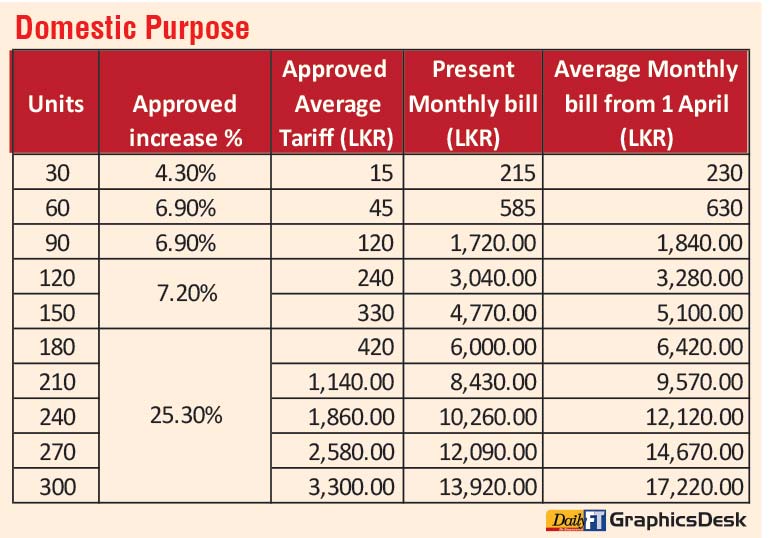
As per the tariff revision, under the domestic category, the least usage of up to 30 units or less will see a modest 4.3% increase, translating to a maximum monthly rise of Rs. 15.
Those using between 31 and 60 units will face a 6.9% increase, with bills rising by up to Rs. 45, while users in the 61-90 unit bracket will also see a 6.9% increase, with a maximum impact of Rs. 120. For households consuming between 91 and 180 units, tariffs will rise by 7.2%, pushing bills up by as much as Rs. 420. Those using over 180 units will see a 25% sharp rise, which will vary depending on usage during peak and off-peak times.
The PUCSL said religious and charitable institutions using less than 180 units will be exempt from any increase, while those exceeding that threshold will see a 9.6% hike.
The general-purpose sector category will face an 8% increase, while tariffs for industries will rise by 8.7% and hotels by 9.9%. Government institutions will see the steepest adjustment at 14.4%.
He said the revised tariff structure introduces a tiered approach aimed at cushioning low-users across the board.
The electricity regulator said the revisions were designed not only to reflect costs, but also to encourage more efficient energy use, particularly during peak hours between 6 p.m. and 10 p.m., when demand is highest.
It was also noted that plans are underway to introduce lower tariffs for the industries, hotels, and general-purpose sectors on Sundays and public holidays to ease pressure on the grid, as well as to mitigate any negative impact to the overall economy.
The PUCSL Chief stressed that the current revision was based solely on the CEB’s submitted cost data on 13 February and does not factor in ongoing geopolitical tensions in the Middle East or potential future increases in global fuel prices.
 “We have not taken into consideration the current situation, with fuel prices likely to increase further, as it depends on how this war situation in the Middle East is evolving. However, if global oil prices rise sharply and the CEB can justify an increase exceeding 15%, the utility may submit a fresh proposal for review,” Chandralal explained.
Despite concerns over supply constraints, the Commission maintained that there is no immediate risk of power cuts, citing assurances from fuel supplier, the Ceylon Petroleum Corporation (CPC), and the CEB’s commitment to uninterrupted electricity generation.
The PUCSL also dismissed claims that losses linked to the controversial coal procurements had been factored into the tariff revision, stating that such issues had no bearing on the current tariff decision.
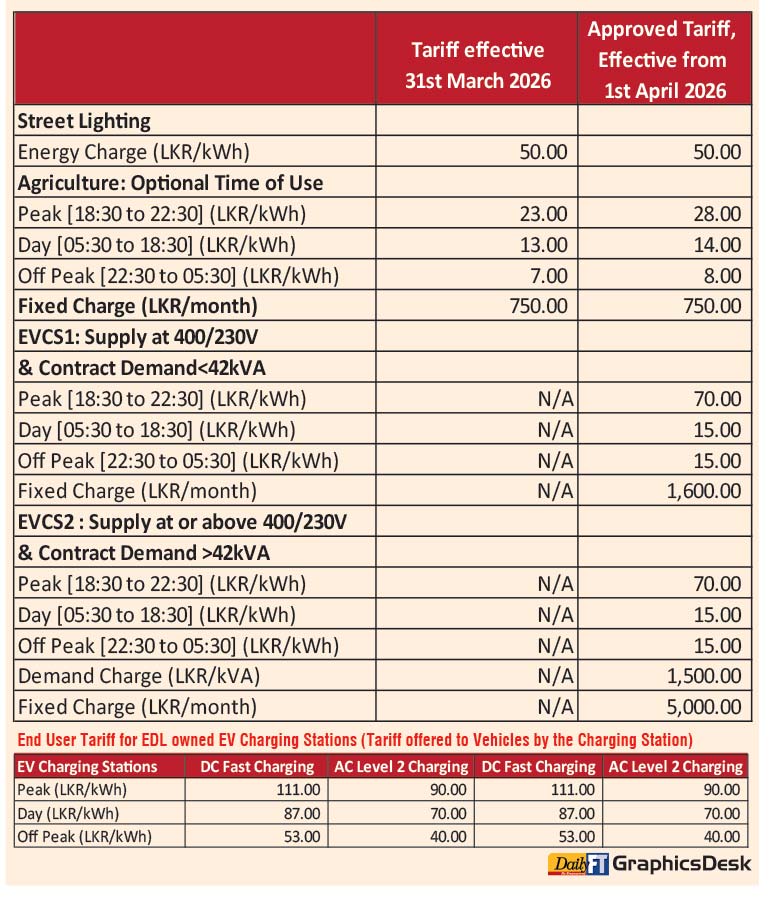
The Commission has decided to introduce a new tariff category for Electrical Vehicle Charging Stations (EVCS) to promote EV and demand side management (peak shifting).
According to the approved tariff structure, EV charging stations will be charged based on time-of-use rates, with separate pricing for DC fast charging and AC Level 2 charging.
As per the new rates, DC fast charging during peak hours will be Rs. 111 per kWh, day time will be Rs. 87 per kWh, and off-peak will be Rs. 53 per kWh. For AC Level 2, charging during peak hours will be Rs. 90 per kWh, day time will be Rs. 70 per kWh, and off-peak will be Rs. 40 per kWh.
According to the new tariff scheme, EVCS-1 applies to charging stations with supply at 400/230V and contract demand of up to 42 kVA, whilst EVCS-2 applies to charging stations with supply at or above 400/230V and contract demand exceeding 42 kVA.
The Commission stated that charging stations must have a dedicated electricity supply and obtain an exemption certificate or no-objection letter from the PUCSL to qualify for the new tariff. Electricity users who do not meet these requirements will be charged under the General Purpose electricity tariff category.


