Thursday Oct 01, 2026
Thursday Oct 01, 2026
Wednesday, 30 September 2026 00:00 - - {{hitsCtrl.values.hits}}
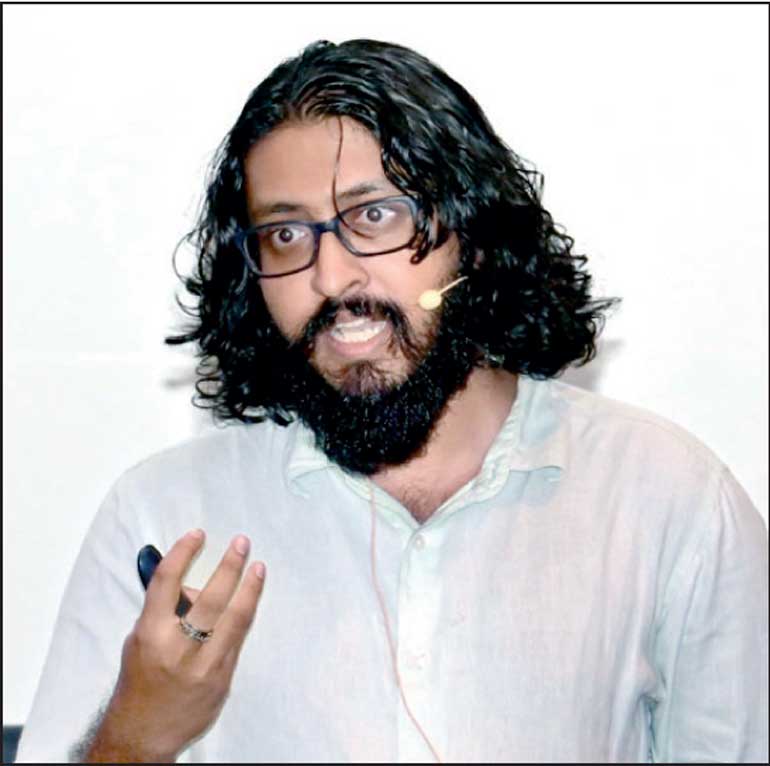
Frontier Research Head of Macroeconomic Advisory
Chayu Damsinghe
- Pic by Sameera Wijesinghe
Sri Lanka’s economy is going through its most fundamental structural change in seven to eight decades, Frontier Research said, warning that the shift will reward capital-intensive, margin-driven businesses and could leave labour-intensive, volume-based players facing an existential squeeze.
“The Sri Lankan economy is fundamentally different from anything we have seen for the last 70 to 80 years,” Frontier Research Head of Macroeconomic Advisory Chayu Damsinghe told a recent investor forum organised by the firm.
The last time Sri Lanka ran twin surpluses of this nature was in the 1950s, he said. Twin surpluses means a surplus on both the Government’s primary budget, which excludes interest payments, and the external current account.
Frontier benchmarked Sri Lanka against a dataset of 140 to 160 countries. Between 1990 and 2002, 70 to 120 countries posted a better primary fiscal balance than Sri Lanka and 60 to 100 a better current account balance.
Since 2023, Sri Lanka has at times ranked among the best in the world on its primary balance and may record the highest primary surplus of any country in 2026, Damsinghe said, though some countries have yet to report full data. Its current account, while not the world’s best, is far stronger than in the past, even after the biggest external shock in a generation.
On growth, only about 15 countries are expanding faster than Sri Lanka’s first-half rate of about 4.7%. Damsinghe dismissed concerns that 5% growth is inadequate, noting that global growth is constrained. Even under adverse assumptions, he said, Sri Lanka would slip from the top of the global rankings to perhaps 10th or 20th, not back to 100th.
Its export sectors are also starting to grow faster than the rest of the world, a pattern Sri Lanka has rarely seen.
Damsinghe said the familiar features of the old economy no longer hold. These include a clockwork 5% to 7% currency depreciation every few years with roughly 3% in between, Central Bank money printing, recurring boom-bust cycles driven by twin deficits and a Government that acted as the main spender.
In their place are two-way currency movements, a Central Bank focused on controlling inflation, markets driven by external volatility rather than domestic deficits, and a private sector that must generate its own cash flows. “It is not necessary that all of these changes are positive,” he said, “but it is nevertheless changing.”
Frontier remains firmly bullish on the long-term outlook, but said this upcycle will not resemble past ones. Earlier booms lifted most sectors and firms on broad-based liquidity. This time, growth is firm-specific, liquidity is uneven and costly, and investors have little history to draw on.
The biggest shift is in which businesses can succeed. Capital-intensive work is expected to outperform labour-intensive work, and margin-driven models to outperform volume-driven ones. Damsinghe said this is a big change for an economy that long relied on cheap labour and on volume-based activity sustained by broad Government spending.
He warned that businesses may be underestimating how quickly this could happen. Long-term decisions are currently overshadowed by the oil shock. But once oil prices revert and the recovery takes hold, Damsinghe said, these changes could happen ‘essentially overnight’.
Skilled labour is also being re-priced. Sri Lankan workers continue to move abroad as they up-skill, while at some skill levels more foreign labour is starting to come into Sri Lanka. Damsinghe said firms should start planning for this now.
Frontier expects divergence not just between sectors but within sectors and within individual firms, where some product lines will prosper as others fail. As the gap widens, capital, skills and business activity will move from weaker to stronger players.
Unlike past cycles, when everyone did well or everyone did badly and the Government could step in, the losers this time face losing funding, skilled staff and business relationships. The transition will be painful, particularly because it coincides with high external volatility, he said.
“The macro remains very positive, but that does not necessarily flow through to everyone’s balance sheet,” Damsinghe said. “Large divergences are what we would expect, especially when the macro does so well.”
Frontier said Sri Lanka would start to behave less like a perennial underperformer in global markets and more like a mainstream emerging market.

