Tuesday Sep 15, 2026
Tuesday Sep 15, 2026
Saturday, 7 February 2026 02:10 - - {{hitsCtrl.values.hits}}
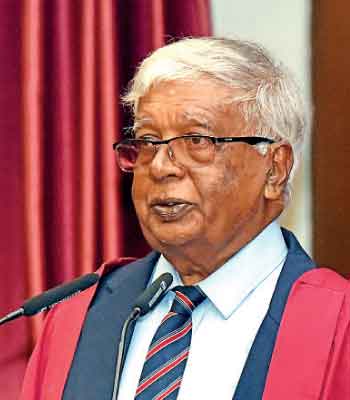 |
| SLEA President Prof. Sirimevan Colombage |
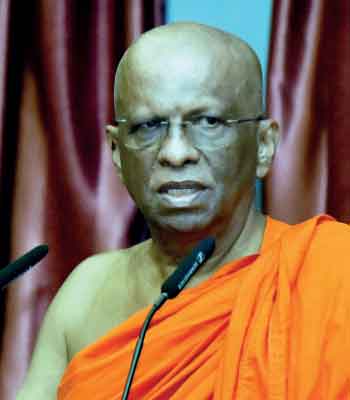 |
| SLEA Outgoing President Rev. Prof. Wijitaputra Wimalaratana |
By Devan Daniel
Sri Lanka’s economic recovery remains vulnerable due to persistent policy instability and weak growth foundations, economists warned yesterday, cautioning that recent macroeconomic stabilisation will not translate into durable revival without long-term structural reform and policy continuity.
Speaking yesterday at the opening of the 40th Annual Sessions of the Sri Lanka Economic Association (SLEA) at the BMICH, SLEA President Prof. Sirimevan Colombage said the country stood at a defining crossroads between hard-won stability and the risk of prolonged stagnation.
“The unprecedented economic crisis that occurred in 2022 reflected the culmination of long-standing structural weaknesses of the economy,” Prof. Colombage said. “Since then, the IMF-supported reform package has helped to restore macroeconomic stability in a big way.”
He credited the Government and the Central Bank for improvements in fiscal performance and the balance of payments, but warned that deeper challenges remain. “Despite these achievements, there are disturbing signs of low GDP growth and significantly high levels of poverty, unemployment and malnutrition,” he said.
Prof. Colombage also noted that Cyclone Ditwah, which struck Sri Lanka in late November last year, had a “devastating impact” on the economy, compounding existing vulnerabilities.
He identified the services sector as central to Sri Lanka’s recovery prospects, noting that it accounts for about 57% of GDP and provides employment to roughly half the workforce, compared to agriculture’s 8% share and industry’s 25%.
“Tourism and service exports related to information technology, communication and business process outsourcing have expanded significantly in recent years,” he said, adding that services exports generate around $ 7 billion annually, equivalent to about 35% of total foreign exchange earnings from goods and services.
However, Prof. Colombage cautioned that the sector remains overwhelmingly inward-looking. “Tradable services account for only about 20% of the total output of the services sector. Nearly 88% of services sector output is domestically consumed,” he said.
“Sri Lanka’s services sector is predominantly inward-looking, and this is a matter of concern.”
Transforming the services sector towards export orientation was essential not only to ease balance of payments pressures, but also to lift Sri Lanka onto a higher growth trajectory, he said. This would require a coherent policy framework spanning high-tech education, skills development, infrastructure, regulatory reform and fiscal incentives.
He also warned that income taxes imposed on services exports since last year were having “detrimental effects”, particularly on the IT sector, and called for stronger efforts to attract foreign direct investment into high-value-added service activities.
SLEA Outgoing President Rev. Prof. Wijitaputra Wimalaratana, in his address, took a longer-term view, arguing that Sri Lanka’s post-independence development strategy had remained overly defensive and inward-looking.
“For nearly 78 years, we have remained at the bottom of the global economic ladder,” he said. “The question is how long we are going to stay there, and whether we truly want to change it.”
He noted that since the World Bank introduced income classifications in 1989, Sri Lanka had moved up only one category, briefly reaching upper-middle-income status in 2019 before slipping back. “No country in the world has achieved high-income status purely through agriculture. Statistics do not lie,” he said.
Rev. Prof. Wimalaratana said countries that successfully transitioned to high-income status had done so through industry-led or services-led growth, while Sri Lanka failed to follow a comparable path. He also flagged policy volatility as a major structural constraint.
“Sri Lanka has no policy locks. In every election cycle, land policies, investment policies and economic direction are changed,” he said, calling for cross-party agreement to keep core economic policies unchanged for 15 to 20 years.
“Without policy stability, you cannot achieve long-term transformation,” he said, adding that economic revival could not be delivered by Government alone. “Everyone has to work together if Sri Lanka is to become a prosperous nation.”


