Sunday Oct 11, 2026
Sunday Oct 11, 2026
Tuesday, 25 August 2026 05:11 - - {{hitsCtrl.values.hits}}
Sri Lanka is facing a fresh export competitiveness challenge in the European Union (EU) as the recently concluded EU-India Free Trade Agreement (FTA) is expected to give Indian products significant tariff advantages across several labour-intensive sectors, prompting calls for urgent action to protect the country’s market access and strengthen its competitive position.
The issue was raised at a meeting between the Sri Lanka Export Development Board (EDB) and European Commission consultants Paul Baker and Talal Rafi, who are assessing the potential implications of the landmark EU-India agreement for Sri Lanka.
The Joint Apparel Association Forum (JAAF) also joined the discussion, highlighting the challenges that Sri Lanka’s apparel industry could face once the FTA becomes operational.
The negotiations were concluded on 27 January, with the agreement now awaiting legal review, signature, and ratification before entering into force.
The potential impact is particularly significant for Sri Lanka given the EU accounts for around 25% of the country’s merchandise exports, making it the second-largest export market after the US.
During the first half of 2026, Sri Lanka’s exports to the EU increased by 2.49% year-on-year (YoY) to $ 1.49 billion, indicating a marginal improvement in overall export performance to the region.
The agreement is expected to substantially improve India’s competitiveness in the EU, with apparel, marine products, leather and footwear, chemicals, plastics and rubber, sports goods, toys, and gems and jewellery among sectors expected to benefit from significant tariff liberalisation, including duty-free access for many products from the Agreement’s entry into force.
EDB Chairman Mangala Wijesinghe said Sri Lanka must move quickly to safeguard its preferential access under the EU’s Generalised Scheme of Preferences Plus (GSP+) scheme as Indian competitors gain improved tariff access.
He stressed the need for Sri Lanka to continue meeting the requirements of the EU’s revised GSP framework while positioning the country as a reliable, sustainable, and high-quality supplier.
“We intend to position Sri Lanka as a reliable, sustainable, and high-quality supplier to the global market, while encouraging local enterprises to move towards higher-value, differentiated products and strengthen compliance with EU standards,” Wijesinghe said.
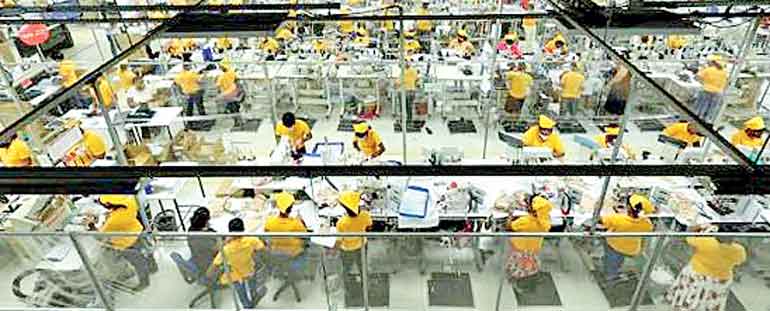
The threat is particularly acute for the apparel industry, which is already competing in a highly price-sensitive global market.
JAAF Secretary General Yohan Lawrence highlighted concerns over rules of origin and regional cumulation, particularly regarding fabrics and other inputs sourced from India and subsequently incorporated into garments manufactured in Sri Lanka for export to the EU under GSP+.
Industry representatives warned that if Sri Lankan manufacturers cannot secure appropriate cumulation arrangements involving Indian-origin inputs, the sector could face an additional competitiveness disadvantage just as Indian apparel exports receive preferential tariff treatment in Europe.
The EDB said Sri Lanka would engage with the EU on appropriate cumulation arrangements with India to protect export competitiveness and facilitate deeper regional supply chain integration.
Baker said economic modelling indicated the EU-India FTA could significantly increase Indian exports to the European market, while also attracting greater foreign direct investment into India.
However, he noted that tariff advantages would not eliminate the importance of sustainability, environmental performance, traceability, and regulatory compliance in the EU market.
This, he suggested, could provide Sri Lankan exporters with an opportunity to compete beyond price by accelerating value addition, differentiation, and compliance with increasingly stringent European standards.
The meeting comes as Sri Lanka’s exports to several major EU markets, including Germany, Italy, the Netherlands, France, and Belgium, recorded growth in 2025.
The observations from the EDB and apparel industry will be incorporated into the consultants’ final study for submission to the European Commission, potentially providing Sri Lanka with an important assessment of the risks and opportunities arising from the EU-India trade deal.


