Thursday Oct 22, 2026
Thursday Oct 22, 2026
Thursday, 2 April 2026 05:47 - - {{hitsCtrl.values.hits}}
|
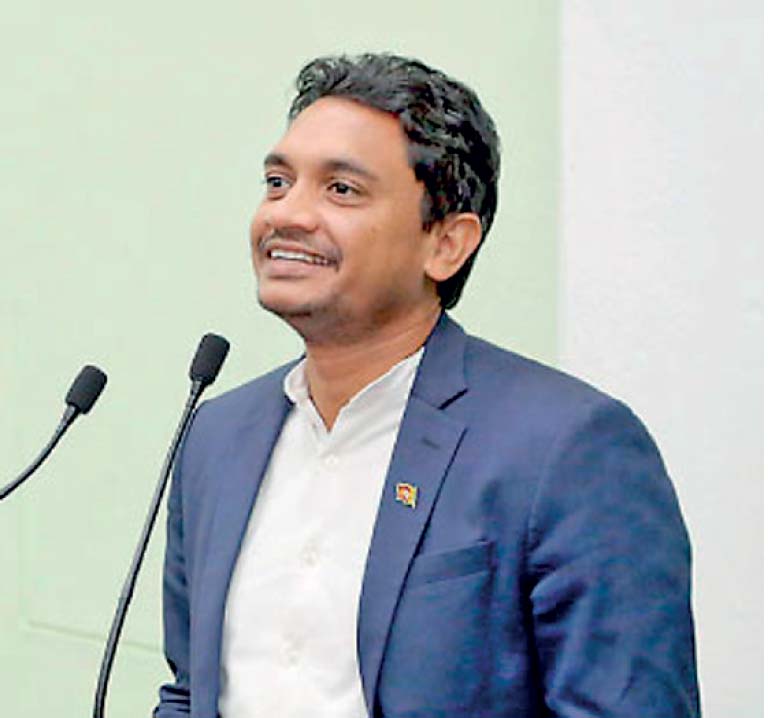
Industry and Entrepreneurship Development Deputy Minister Chathuranga Abeysinghe |
Industry and Entrepreneurship Development Deputy Minister Chathuranga Abeysinghe earlier this week took to social media to vent his frustration with the banking sector, accusing them of withholding State-funded concessional credit to micro, small and medium enterprises (MSMEs).
He said the Government’s Rs. 95 billion MSME financing push is facing bottlenecks at the banking level, with official data showing slow disbursement of funds.
Abeysinghe shared scheme-level and bank-level data, highlighting gaps between allocations and actual lending, while also alleging that some bank branches were discouraging applicants.
“Some bank branches prioritise increasing their own branch profits,” he said, adding that borrowers are often redirected towards higher-interest internal loan products or told that quotas are exhausted.
According to Central Bank of Sri Lanka (CBSL) data, the banking sector reported stronger profitability in 2025, with cumulative profits after tax rising 19.3% year-on-year (YoY) to Rs. 369 billion by end-December.
The increase was supported by higher interest income and a sharp rise in non-interest income, even as operating expenses continued to increase. Profits before tax rose 3.7% YoY to Rs. 583.7 billion, with net interest income growing 11.7% to Rs. 1.02 trillion. Non-interest income increased 49.8% to Rs. 275 billion during the year. CBSL data show the banking sector reporting a credit-to-deposits ratio of 69.9%, indicating that banks continue to maintain a relatively conservative lending stance. This ratio was 66.3% as at end-December 2023 and 63.9% a year later.
 In effect, banks have lent about Rs. 70 for every Rs. 100 of deposits, leaving a substantial share of funds invested in liquid assets and investments rather than fully deployed as loans.
This suggests that despite the recovery in private sector credit, banks continue to operate with comfortable liquidity buffers and retain capacity to expand lending if economic conditions strengthen.
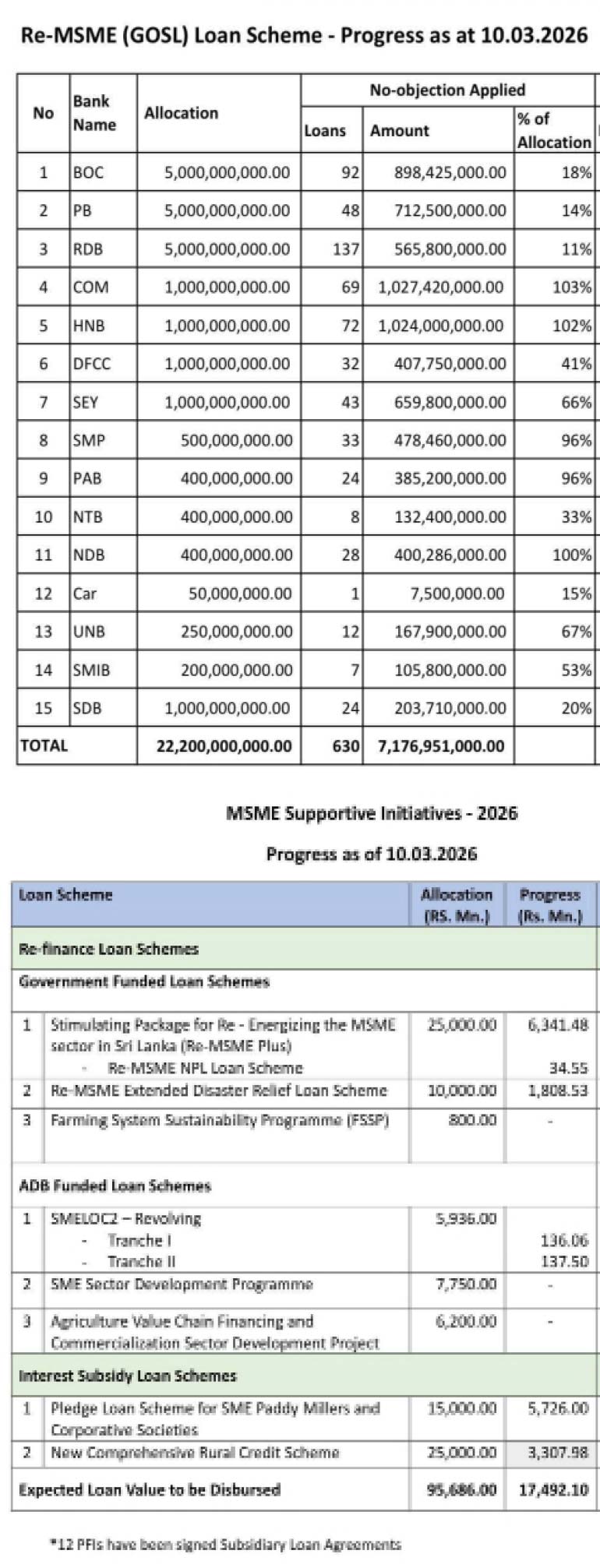
According to data posted by the Deputy Minister this week, under the broader MSME supportive initiatives for 2026, a total of Rs. 95.686 billion has been allocated across multiple loan schemes, but only Rs. 17.492 billion has been disbursed as at 10 March 2026, indicating a utilisation of around 18%.
Within this, the Government-funded MSME loan window represents one of several components rather than the full program.
Under the Govt. scheme, Rs. 22.2 billion has been allocated to participating banks. Of this, only Rs. 7.18 billion has been disbursed across 630 loans, reflecting utilisation of just over 32%.
Bank-level data shared by the Deputy Minister show a clear divergence in lending behaviour.
State banks have disbursed only Rs. 2.18 billion, with utilisation rates ranging from 11-18%. In contrast, several private banks have reached or exceeded their allocated limits. Commercial Bank has disbursed Rs. 1.027 billion against a Rs. 1 billion allocation (103%), Hatton National Bank Rs. 1.024 billion (102%), and NDB Bank Rs. 400.286 million (100%).
Other banks show mixed progress, with utilisation rates ranging from 20-96%. The data indicate that while demand for concessional credit exists, disbursement is uneven and, in some cases, lagging despite available allocations.
Abeysinghe said applicants facing difficulties should approach Industrial and Entrepreneurship Officers at the Divisional Secretariat level, noting that once banks submit applications, approvals from the Finance Ministry are processed within two weeks.
The MSME financing framework consolidates multiple loan schemes under a single structure, with funds channelled through 16 public and private banks. Applications are processed through a structured system involving field-level verification and digital approvals routed via the Development Finance Department.
The program is positioned as a key pillar of economic recovery, with concessional lending, interest subsidies, and credit guarantees aimed at addressing financing constraints faced by small businesses.