Saturday Feb 21, 2026
Saturday Feb 21, 2026
Tuesday, 23 December 2025 04:00 - - {{hitsCtrl.values.hits}}
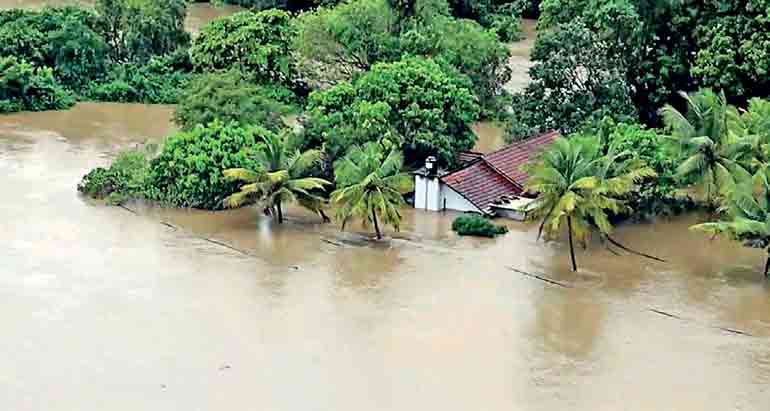
Cyclone Ditwah has inflicted an estimated $ 4.1 billion (approximately Rs. 1.3 trillion) in direct physical damage to buildings, agriculture, and critical infrastructure across Sri Lanka, equivalent to around 4% of GDP, according to the highly anticipated Global Rapid Post-Disaster Damage Estimation (GRADE) report released yesterday by the World Bank Group.
The cyclone, among the most intense and destructive in Sri Lanka’s recent history, severely affected close to 2 million people and 500,000 families across all 25 districts, disrupting livelihoods, essential services, and the broader economy.
According to the World Bank, the estimate covers direct physical damage only. It does not include income losses, business interruption, or the full costs of recovery and reconstruction, including potential “build back better” investments. Total recovery needs are therefore expected to be significantly higher.
The Sri Lanka GRADE report provides timely and critical insights to guide the emergency response, recovery planning, and longer-term disaster risk reduction efforts. The assessment uses the World Bank’s rapid, remote, model-based GRADE methodology, which estimates direct economic damage to physical assets. The report does not include losses related to income or production, nor the full costs of recovery and reconstruction.
The estimated $ 4.1 billion in direct damages represents a significant shock to affected regions. The Central Province was the hardest hit, with damages in the Kandy District estimated at $ 689 million, primarily caused by flooding and, to a lesser extent, by landslides.
Infrastructure, including roads, bridges, railways, and water supply networks, accounts for the largest share of damage, at an estimated $ 1.735 billion (42% of total damages), disrupting connectivity and access to markets and services.
Residential buildings and contents have been heavily affected, with damages totalling an estimated $ 985 million. The widespread impacts on homes highlight the need to consider building locations, flood control structures, and designs that are resilient to high winds and flooding.
Agriculture suffered an estimated $ 814 million in damage, including to paddy and vegetable crops, subsistence farming, maize, livestock, and agriculture infrastructure, as well as damage to inland fishing, posing serious risks to food security and rural livelihoods in already vulnerable communities.
Non-residential buildings (including contents), such as schools, health facilities, businesses, and large industrial facilities and factories located along major rivers and creeks, were also heavily impacted, accounting for $ 562 million in estimated damages, interrupting education, healthcare delivery, and local economic activity in cyclone-affected areas.
The assessment underscores how pre-existing socio-economic vulnerabilities—including poverty, limited access to services, and exposure to climate risks—are likely to amplify the cyclone’s impacts and slow recovery, particularly for women, children, older persons and female-headed households. Targeted recovery efforts will be essential to ensure support reaches the most at-risk communities.
“As we look closely at the hardest-hit districts, we see that deep-rooted vulnerabilities have left communities especially vulnerable,” said World Bank Group Country Manager for Sri Lanka and Maldives Gevorg Sargsyan. “In Badulla, Kegalle, and Puttalam, many households were already poor and now face some of the highest losses to homes. In Kandy and Nuwara Eliya, about two in four households are headed by women or older persons. Thousands of women and girls have been displaced or remain in unsafe homes. These realities underscore the need for tailored community-cantered recovery efforts that protect those most at risk.”
In the immediate aftermath of the cyclone, the World Bank Group has mobilised up to $ 120 million from ongoing projects to support recovery and help restore essential services and infrastructure—including healthcare, water, education, agriculture, and connectivity—in the areas hit hardest.
While the GRADE report provides a rapid estimate of direct physical damage, recovery and reconstruction needs are expected to significantly exceed these figures. The report highlights the importance of comprehensive recovery strategies that address humanitarian needs, restore livelihoods, strengthen resilient housing and infrastructure, and integrate climate and disaster risk considerations into future development.
The World Bank acknowledges the Government of Sri Lanka’s leadership in completing this assessment. The assessment benefitted from close collaboration with the External Resources Department, the Treasury, the National Planning Department, and the Disaster Management Centre.
Disasters disproportionately affect the poor and most vulnerable. For over a decade, the World Bank’s GRADE approach has supported more than 54 countries by providing timely, evidence-based assessments to inform decision-making after disasters. Over 10 years, GRADE has completed 71 post-disaster assessments worldwide, with subsequent validations confirming approximately 90% accuracy when compared to detailed, ground-based assessments.
The GRADE report for Sri Lanka was conducted and financially supported by the Global Facility for Disaster Reduction and Recovery (GFDRR) and the Finance Ministry of Japan, through the World Bank program for Mainstreaming Disaster Risk Management in Developing Countries in collaboration with the World Bank.