Monday Sep 21, 2026
Monday Sep 21, 2026
Monday, 29 December 2025 05:56 - - {{hitsCtrl.values.hits}}
|
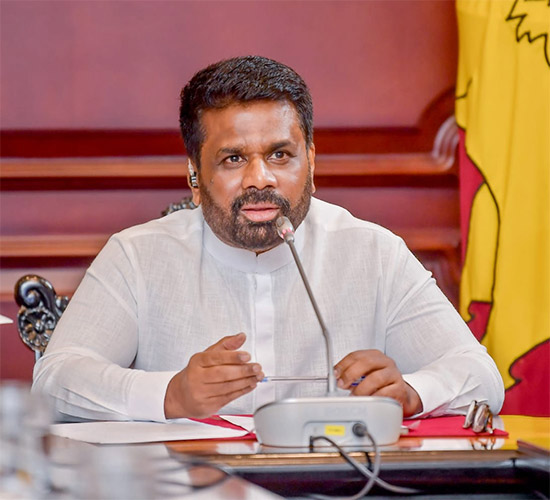
President and Finance Minister Anura Kumara Dissanayake
|
The Government’s fiscal position under the 2026 Budget has weakened sharply following the approval of a Rs. 500 billion Supplementary Estimate to fund post-Cyclone Ditwah recovery, according to a Finance Ministry report released after Parliamentary approval on 19 December.
The Budget deficit for 2026 has been revised upward to 6.5% of GDP from the earlier estimate of 5.1%, marking a further deterioration from the 4.5% of GDP deficit projected for 2025.
At the same time, the primary surplus forecast for 2026 has been cut to 1% of GDP from the previously estimated 2.5%, and well below the 3.8% surplus recorded in 2025.
The revisions were disclosed in a report published under the Public Financial Management Act, No. 44 of 2024, following Parliament’s approval of the supplementary spending allocation.
Total revenue and grants remain unchanged at 15.4% of GDP in 2026, marginally lower than the 15.9% projected for 2025.However, total expenditure has risen to 21.9% of GDP for 2026 from the earlier estimate of 20.5%, which was unchanged from both 2024 and 2025.
Recurrent expenditure for 2026 has been revised up to 16.9% of GDP from 16.5%, although it remains below the 17.9% and 17.3% of GDP recorded in 2024 and 2025, respectively.
Capital expenditure has seen the sharpest adjustment, rising to 5% of GDP in 2026 from the original estimate of 4%. This compares with 2.6% of GDP in 2024 and 3.2% in 2025.
Despite the near-term deterioration, the Finance Ministry projects a gradual fiscal consolidation over the medium term. The Budget deficit is expected to narrow from 6.5% of GDP in 2026 to 3.8% by 2030, while the primary surplus is projected to recover from 1% to 2.6% of GDP over the same period.
Tax revenue is forecast to improve modestly from 14.2% of GDP to 14.4% by 2030, while recurrent expenditure is expected to decline from 16.9% of GDP in 2026 to 15.2% by 2030.
President and Finance Minister Anura Kumara Dissanayake said additional Ditwah-related financing would be met through the Government’s existing cash buffers, which stood at nearly Rs. 2 trillion according to Central Bank data published on 26 December.
“The borrowing limit will remain at Rs. 3.74 trillion as announced in the 2026 Budget,” the Finance Ministry report said.
The report also noted that the Government plans to finance disaster-relief measures partly through the over-performance of the primary surplus, estimated at 1.5% of GDP in 2025. In addition, new revenue measures announced in the 2026 Budget are expected to generate an additional 0.3% of GDP annually, supporting revenue-based fiscal consolidation in line with Governance-Linked Bond parameters.
From 2027 onwards, primary expenditure is to be maintained at 13% of GDP, while the primary surplus is targeted to remain at 2.6% of GDP.
According to an International Monetary Fund (IMF) staff paper released last week, Sri Lanka’s debt sustainability risks are still high, and sustained improvement in public debt dynamics relies on continued fiscal discipline, leaving no room for policy slippage.
“Emergency spending, social support, and reconstruction efforts need to be efficient and well-targeted amid limited fiscal space. Authorities should design a careful strategy to preserve the path to debt sustainability while supporting Sri Lanka’s recovery and reconstruction. Prioritising spending is essential. Clear communication of reform efforts, objectives, and constraints will be vital to foster public support and sustain reform momentum amid challenging circumstances,” the IMF said after approving $ 206 million Rapid Financing Instrument (RFI) for Sri Lanka.
The IMF will send a team in early 2026 re-evaluate the Fifth Review under the ongoing Extended Fund Facility (EFF) program, which was originally due for conclusion on 15 December and could have released a tranche worth $ 347 million.
The Government has made steady gains before Ditwah hit the economy, with the World Bank estimating an initial $ 4.1 billion economic loss and International Labour Organisation (ILO) forecasting the total disaster risk at $ 15 billion. Even the IMF forecasts an additional $ 700 million balance of payments (BOP) deficit for 2026.
“Sri Lanka’s ambitious reform agenda is bearing fruit and program performance has been strong. Authorities are committed to the objectives of the IMF-supported reform program with appropriate re-design to incorporate the disaster and continue to engage with staff to complete the Fifth Review at the earliest possible juncture. Program objectives remain: (i) restoring fiscal and debt sustainability while protecting the vulnerable, (ii) safeguarding price and financial sector stability, (iii) rebuilding external buffers, (iv) strengthening governance and reducing corruption vulnerabilities, and (v) enhancing growth-oriented structural reforms,” the IMF report said.