Thursday Oct 15, 2026
Thursday Oct 15, 2026
Wednesday, 20 May 2026 06:00 - - {{hitsCtrl.values.hits}}
Parliament yesterday passed the controversial Inland Revenue (Amendment) Bill with amendments after the Government refused to withdraw penal provisions criminalising certain tax compliance failures, despite strong Opposition criticism and Supreme Court intervention on key clauses.
The amendments, which form part of the Government’s broader revenue administration reforms under the IMF-supported fiscal consolidation program, triggered a sharp debate over the balance between strengthening tax enforcement and protecting civil liberties.
The most contentious provisions centred on new powers granted to the Inland Revenue Department (IRD) and the introduction of criminal penalties for specified tax compliance failures.
Under the amendments, failure to file annual income tax returns, failure to register for a Tax Identification Number (TIN), and failure to appear before the IRD when summoned may attract fines of up to Rs. 400,000, imprisonment of up to six months, or both. However, criminal proceedings can only proceed after taxpayers are formally notified and given 30 days to comply following safeguards mandated by the Supreme Court.
The Bill was revised after several petitions were filed before the Supreme Court challenging its constitutionality.
Clause 31(4), one of the most controversial provisions in the original Bill, was effectively withdrawn following the Court’s determination that it was unconstitutional in its original form. The clause proposed allowing the Commissioner General of Inland Revenue to issue certificates to Magistrate’s Courts treating disputed tax defaults as criminal fines, including during pending appeals.
The Supreme Court held that the mechanism was arbitrary and inconsistent with constitutional protections unless amended to suspend enforcement action while administrative reviews or Tax Appeals Commission proceedings remained active.
However, Clause 34, introducing a new Section 185A criminalising certain tax compliance failures, remained in the Bill after the Court ruled that the provision could proceed with procedural safeguards.
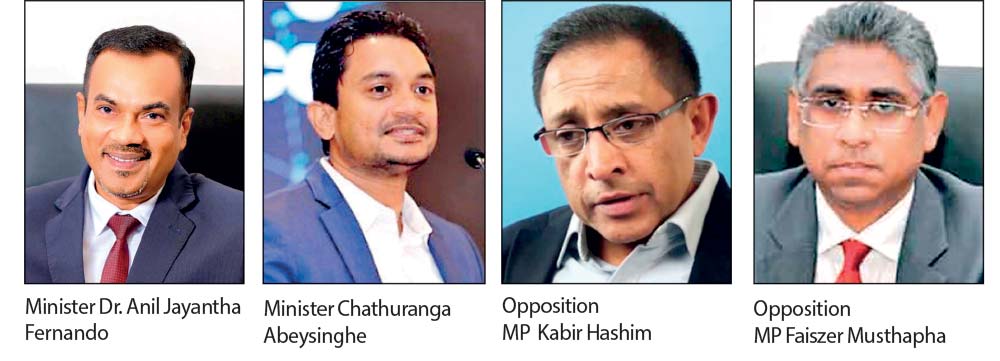
Opening the debate for the Opposition, Samagi Jana Balawegaya MP Kabir Hashim said the amendments reflected a broader shift in the relationship between the State and citizens.
“A successful tax system is not based on oppression and abuse of power. A successful tax system is based on trust, fairness and a strong social contract,” he said.
Hashim argued that Sri Lanka’s historically stronger tax-to-GDP ratios had been achieved without resorting to punitive enforcement measures against ordinary citizens and SMEs.
He warned that the amendments risked eroding institutional checks and balances by concentrating excessive powers within the tax administration framework.
“If one of these institutions holds a monopoly on making laws and punishments, that is not democracy but a dictatorship,” he said.
Hashim said the criminalisation of compliance failures marked a fundamental policy shift rather than a routine amendment to tax law.
“This is not a simple amendment but a change in Government policy and vision,” he said, warning that even delays in obtaining TIN registration could expose young entrepreneurs and ordinary citizens to criminal penalties.
He also argued that the Government had failed to address longstanding weaknesses within the IRD before introducing stronger enforcement provisions.
Hashim said the administration had promised to modernise and digitise the IRD, recruit 3,000 professionals, and fully integrate the Revenue Administration Management Information System (RAMIS) with institutions including Customs, the Department of Motor Traffic, the Registrar of Persons and the Land Registry, but had failed to complete those reforms.
“You are amending the IRD Act without building the necessary capacity,” he said.
Hashim maintained that the core issue within Sri Lanka’s tax system remained administrative inefficiency rather than insufficient penal powers.
He claimed that corporate tax exemptions amounted to about Rs. 978 billion in 2022, while tax arrears in 2023 stood at around Rs. 1.6 trillion. He also cited a 2023 Auditor General’s report stating that VAT arrears amounted to Rs. 369 billion, alleging that many cases had not been properly pursued.
According to Hashim, the Government was attempting to increase revenue collection through punitive legislation instead of improving tax administration efficiency and addressing large-scale tax leakages.
President’s Counsel and Opposition MP Faiszer Musthapha also criticised the amendments, warning that administrative non-compliance traditionally treated as a civil matter would now become a criminal offence.
Musthapha said ordinary taxpayers entering the tax net would face increased compliance risks under the new framework.
He noted that failure to file returns, failure to register for tax, or failure to appear before the Commissioner General when summoned could result in six-month prison terms and fines of up to Rs. 400,000.
“There is a distinction between tax evasion and administrative oversight,” he said, arguing that criminal proceedings for compliance failures could disproportionately affect ordinary taxpayers unfamiliar with complex tax procedures.
Musthapha also criticised the reduction in the VAT registration threshold from Rs. 5 million to Rs. 3 million monthly turnover, arguing that the measure would increase pressure on smaller retailers and businesses operating on narrow margins since VAT is levied on turnover rather than profits.
Responding on behalf of the Government, Industry and Entrepreneurship Development Deputy Minister Chathuranga Abeysinghe defended the amendments, insisting the administration would not withdraw the penal provisions.
“The only ones who need to worry are wilful tax evaders,” he said.
Abeysinghe argued that the Opposition had failed to acknowledge the scale of tax avoidance and evasion in Sri Lanka and said stronger legal provisions were necessary because tax assessments had historically remained tied up in prolonged litigation.
“The reason why the penal provisions were included and the IRD was empowered is that up to now, when tax assessments were issued no one accepted them and they were stuck in court for several years,” he said.
He maintained that taxpayers would be given adequate opportunities to rectify issues before legal action was initiated.
“If there is an issue with filing taxes or an assessment, the IRD first asks the taxpayer to rectify it for which time is also given and taxpayers can also provide valid reasons,” he said.
Abeysinghe said court proceedings would only arise after multiple opportunities for compliance had been provided.
“If this does not work, the matter is taken up at Magistrate’s Court where taxpayers can show cause and provide explanations,” he added.
He also rejected Opposition claims that the Government had failed to modernise tax administration, stating that RAMIS had already been integrated with several Government agencies to improve compliance monitoring.
Abeysinghe outlined several concessions included in the amendments, including exemptions for life insurance maturity claims, removal of taxes on donations and gifts to Government institutions, tax credits for salary arrears, and relief measures for SMEs through waivers of interest and penalties.
He said the Government had increased the number of tax files from fewer than 800,000 to around 1.3 million, while estimating that more than 2.3 million individuals fall within higher income categories.
Abeysinghe also defended the expansion of withholding tax mechanisms covering 28 professional categories and said TIN requirements would gradually become mandatory for a wider range of activities to improve compliance.
He said the Government’s long-term objective was to reverse Sri Lanka’s direct-to-indirect tax ratio from 20:80 to 80:20.
“We need enabling laws to make Sri Lankans tax compliant and to streamline administration,” he said.
Labour Minister and Finance and Planning Deputy Minister Dr. Anil Jayantha Fernando said the amendments were necessary to strengthen fiscal stability and establish a more transparent and efficient tax administration system.
“This Government has a responsibility to the people of the country to lay the foundations for a prosperous nation and one aspect of that is a trustworthy, transparent, fair and seamless tax administration,” he said.
Fernando said stronger tax administration had already contributed to improved revenue performance.
According to him, Government tax revenue collection had reached Rs. 2.27 trillion by 15 May, equivalent to 43.6% of the annual target.
He said improved revenue collection enabled the Government to allocate an additional Rs. 500 billion for Ditwah-related relief and another Rs. 100 billion to absorb the impact of global supply disruptions linked to the Middle East conflict.
Fernando acknowledged that Sri Lanka’s tax collection costs remained among the highest in the region but said the Government was investing in digital systems and greater inter-agency integration to improve efficiency and compliance.
He defended the penal provisions as necessary tools to contain widespread tax leakages, including VAT fraud.
“The last thing the IRD wants is to spend time and resources fighting court cases, but going to court is only the last resort,” Fernando said.
The passage of the Bill marks a significant escalation in the Government’s post-crisis revenue reform agenda as authorities seek to broaden the tax base, improve compliance and sustain fiscal consolidation under the IMF program, while critics warn that expanded enforcement powers could create new compliance and legal risks for taxpayers.


