Tuesday Aug 04, 2026
Tuesday Aug 04, 2026
Monday, 3 August 2026 00:00 - - {{hitsCtrl.values.hits}}
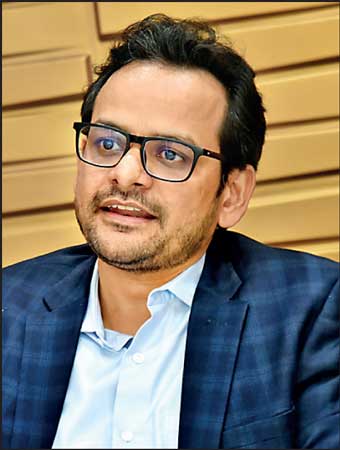 |
| Citigroup Director and Economist for India and Sri Lanka Baqar Zaidi – Pic by Sameera Wijesinghe |
By Nisthar Cassim
Citigroup Director and Economist for India and Sri Lanka Baqar Zaidi recently described Sri Lanka’s economic recovery as “remarkable” and “consistent,” beating everyone’s expectations.
“It has been a remarkable recovery. I don’t remember the last time a country has beaten market expectations so consistently. The striking feature has been not just the fact that we have had upside to our expectations, it is the breadth of surprises; macros have been above expectation consistently,” Zaidi told the Daily FT in an exclusive interview in Colombo.
He pointed to Sri Lanka achieving positive growth in successive quarters as noteworthy.
“You can pick any major macro parameter, and Sri Lanka has done consistently well,” emphasised Zaidi. He noted that to consistently achieve 5% growth was commendable.
“Despite the fiscal tightening, to get the kind of growth achieved by Sri Lanka tells you that the inherent domestic demand of the private sector has recovered well. If you keep doing it consistently, it tells you that there is a design, an inherent strength in the economy,” he added.
Zaidi also noted that on the fiscal side, the Government has done much better than what the market expected. With regard to the current account, he said Sri Lanka’s performance has been much better than what the market would have expected.
He also noted that even on general policy and political stability, Sri Lanka has fared well as against initial reservations from some foreign investors and analysts.
Expanding further on Sri Lanka’s resilience, he said that 5% growth came amidst external shocks including the high US tariff impact, the conflict in the Middle East leading to supply side shocks, and internal challenges such as Cyclone Ditwah.
“Sri Lanka’s domestic economy continues to do well. Investment continues to do well. This tells you two things. One, that the economy has learned, and this is true for the global economy as well, to adapt to shocks, both domestic and external. Secondly, it tells you that consistent reforms, policy stability, macro stability, are finally giving dividends.”
Challenges remain for Sri Lanka
Though giving a high rating to Sri Lanka’s recovery, the Citigroup Director and Economist for India and Sri Lanka acknowledged that challenges remain for the country. He pointed out that whilst 5% growth is good, if one breaks it down, there are sectors of the economy which are still below its 2018 levels.
“For example, the construction and mining sectors are two sectors which are growing in double digits. But despite double digit growth over the last two years in absolute level terms, their economic activity is still 25% to 30% below the 2018 level,” he explained.
“Whilst there has been recovery, because of the severe extent of the shock between 2019 to 2020, the overall growth has not been enough to completely bring the economy back to just 2018 levels. At aggregate level, it is fine, but there are segments of the economy which are still below pre-crisis levels,” Zaidi added.
He also noted that the challenge for Sri Lanka is sustaining recovery and stimulating growth in a much difficult global macro backdrop. “This makes achieving some of the targets of the International Monetary Fund (IMF) program difficult,” he opined, and pointed to the impact of possibly higher oil prices and the current account going into deficit.
Improving debt sustainability levels
Zaidi also welcomed the fact that Sri Lanka’s public debt sustainability is improving,
“In the absolute sense, debt is still high, so there’s a lot of work left to be done to meet those debt sustainability targets that the IMF set a couple of years ago,” he added.
He expressed confidence that Sri Lanka can meet its debt obligations from 2028 onwards.
In each of the critical parameters of debt sustainability, debt servicing, and debt financing, Sri Lanka is doing much better than what the IMF had forecast in March 2023. This, and the buffers created thus far, tells you that there should not be a big worry in terms of finance, in terms of servicing the debt. The only thing that needs to be watched out for are the repeated global supply shocks, which can put pressure on the current account and foreign exchange reserves.
“So we can be comfortable in saying that, at least as of now, there is limited risk visible where Sri Lanka is not able to service external debt,” added the Citigroup Director and Economist for India and Sri Lanka.
He was of the view that Sri Lanka needs to continue the good work of implementing the IMF reform targets. “Those targets are paying dividends,” he added.
Zaidi also said that Sri Lanka needs to put the improved macroeconomic stability to good use.
“If the overall macro stability is maintained, especially in the next couple of years, as Sri Lanka’s debt servicing picks up, the real economy will do its job. Of course, whether it is tourism, manufacturing, or construction, growth must continue. Unfortunately, in each of those aspects, Sri Lanka faces a much more difficult geopolitical environment than in the past,” he explained.
Opportunity India
The importance of Sri Lanka maximising the India opportunity was also stressed.
“Sri Lanka is very close to the fastest-growing large economy, which is India. Sri Lanka can take advantage by being part of India’s supply chain, being part of India’s growth story,” he said adding that Sri Lanka should be able to move up the value chain in terms of manufacturing, tourism, renewable energy, services such as logistics, IT services, and given its high Human Development Index, the educated talent pool etc.
Persisting with reforms including State-Owned enterprises and greater Public-Private Partnership, according to Zaidi, will help in bringing foreign investment.


