Thursday Jul 23, 2026
Thursday Jul 23, 2026
Thursday, 23 July 2026 00:00 - - {{hitsCtrl.values.hits}}
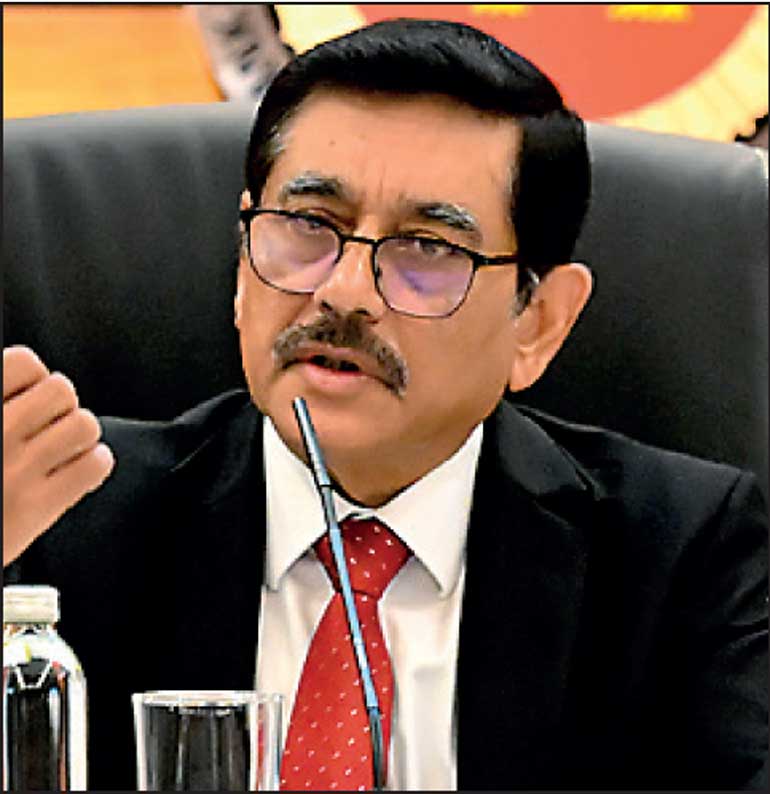
Governor Dr. Nandalal Weerasinghe – Pic by Daminda Harsha Perera
By Charumini de Silva
Central Bank of Sri Lanka (CBSL) Governor Dr. Nandalal Weerasinghe yesterday said the Monetary Board’s proactive decision to raise policy interest rates by 100 basis points in May is beginning to produce the intended effects, with domestic demand, import growth, and credit expansion showing early signs of moderation.
Addressing the post-Monetary Policy Review media briefing, he said the Board decided to keep policy rates unchanged this month to allow more time for the previous tightening to work its way through the economy.
“Today, around six to seven weeks after that decision, we are beginning to see the impact of those policy measures. Together with other actions taken by the Government and the CBSL, there are encouraging signs that excess demand is moderating. In particular, both import demand and credit growth have started to slow,” he said.
The Governor recalled that the May rate hike was prompted by expectations that inflation would move towards the upper end of the CBSL’s target range following adjustments to administered prices, particularly fuel prices, amid Middle East tensions and the Government’s cost-reflective pricing policy.
At the same time, strong domestic demand and rapid private sector credit growth had fuelled import demand beyond the CBSL’s earlier projections, prompting a pre-emptive policy response.
Dr. Weerasinghe said monetary policy operates with a lag and that the Board would continue to monitor the full impact of the previous tightening, whilst closely watching supply-side price pressures, geopolitical developments, and global oil price movements.
He noted that exchange rate stability and moderating import demand indicate that the policy measures are beginning to deliver the desired results.
“We believe the strong policy action taken at the previous review will continue to have a greater impact over the coming months,” he said.
The Governor said inflation could edge up over the next few months due to the pass-through of recently administered price increases, but stressed that these effects are expected to be temporary.
“Inflation expectations remain well anchored. Once these one-off price adjustments dissipate, inflation is projected to return to our target of 5%,” he added.
Responding to questions on the decline in official reserves during June, Dr. Weerasinghe rejected suggestions that vehicle imports alone were responsible. “It was not only vehicle imports. Overall import demand has been elevated across a broad range of categories,” he explained.
He said monthly imports have remained above $ 2 billion in recent months, reflecting higher international petroleum prices, increased import volumes, and stock-building of fuel reserves. “Vehicle imports contributed to the increase, but represented only one component of the broader rise in imports,” he added.
The Governor said reserve accumulation continues to receive support from multilateral financing.
Noting that Sri Lanka has already received inflows linked to the Fifth and Sixth Reviews under the International Monetary Fund (IMF)-supported program, he expects further disbursements from the Asian Development Bank (ADB) and the World Bank this month and next month.
“These inflows, together with the CBSL’s foreign exchange purchases from the market, are expected to strengthen the country’s external buffers. According to the IMF program, gross official reserves are projected to exceed $ 8 billion by the end of 2026,” he said.
On the June Net International Reserves (NIR) target under the IMF program, Dr. Weerasinghe said the final calculation is still being completed, but the CBSL’s preliminary assessment indicates that the target has been met.
He also noted that both the June and December reserve targets had been revised under the IMF program to reflect prevailing economic conditions.
Responding to concerns that many Sri Lankans have yet to feel the economic recovery, the Governor said macroeconomic indicators clearly demonstrate that the economy has turned around.
“The answer is, look at the data,” he said.
He pointed to the economy’s 5.1% growth in the first quarter of 2026, following the sharp contractions experienced during 2022 and 2023, noting that quarter-on-quarter growth has remained positive since the recovery began.
“The data speak for themselves,” he said, adding that indicators such as credit growth, imports, exports, and broader economic activity are consistent with the official GDP estimates published by the Department of Census and Statistics.
Acknowledging that global uncertainties could slow the pace of expansion over the coming quarters, Dr. Weerasinghe said the CBSL expects the economy to maintain a similar growth trajectory in the second quarter and continue its recovery.

