Tuesday Sep 15, 2026
Tuesday Sep 15, 2026
Friday, 9 January 2026 00:00 - - {{hitsCtrl.values.hits}}
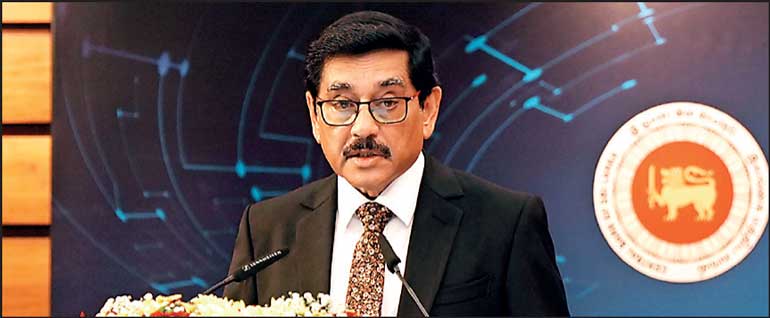
CBSL Governor Dr. Nandalal Weerasinghe
– Pic by Lasantha Kumara
By Charumini de Silva
The Central Bank of Sri Lanka (CBSL) yesterday outlined an ambitious and wide-ranging policy agenda for 2026 and beyond, placing price stability, financial system resilience, climate risk management, and institutional modernisation at the centre of the country’s transition from post-crisis recovery to durable, inclusive growth.
Delivering the annual policy address, CBSL Governor Dr. Nandalal Weerasinghe said Sri Lanka enters 2026 with stabilised macroeconomic conditions, stronger buffers, and renewed growth momentum, but cautioned that sustaining these gains would require disciplined policymaking, institutional credibility, and continued reforms, particularly in the face of climate shocks, global uncertainties, and evolving financial risks.
“The economic growth is expected to remain around 4-5% in 2026, supported by expanding private sector credit, easing financial conditions, and improved macroeconomic buffers,” he said. Inflation, which remained below the 5% target for an extended period following deflationary pressures, is projected to gradually rise and converge to target by the second half of 2026, subject to risks linked to supply disruptions and post-cyclone reconstruction dynamics.
He stressed that the CBSL would remain vigilant to supply-side shocks, particularly from climate-related events such as Cyclone Ditwah, while acknowledging the limited role of monetary policy in directly offsetting such shocks.
The Governor said for 2026, the CBSL will deepen its data-driven, forward-looking monetary policy framework, strengthening modelling capacity and expanding the use of granular, high-frequency data to improve policy calibration.
“The Bank will also review the inflation target agreement with the Government, including stakeholder consultations, to ensure adequate flexibility to absorb future shocks while preserving credibility under the flexible inflation-targeting regime,” he added.
Key operational reforms planned for 2026 include refinements to the single policy rate framework, enhancements to liquidity management to align market rates with the Overnight Policy Rate (OPR), and structural changes to the Statutory Reserve Ratio (SRR), including a revised reserve maintenance period and phased withdrawal of COVID-era concessions.
He also announced that a benchmark intra-day reference exchange rate will be introduced in 2026, aimed at enhancing transparency, reducing volatility, and supporting the development of innovative foreign exchange products. The base years of the Nominal Effective Exchange Rate (NEER) and Real Effective Exchange Rate (REER) indices will also be updated to reflect current trade patterns following the full removal of import controls.
“Gross Official Reserves exceeded $ 6.8 billion by end-2025, the highest since the crisis, and that reserve management will continue to prioritise safety, liquidity, and returns,” the Governor said, reaffirming the CBSL’s commitment to market-based reserve accumulation.
He said the financial system entered 2026 with stronger capital, liquidity, and profitability, enabling it to withstand shocks. “Building on this, the CBSL will prioritise systemic risk oversight, including further development of the Countercyclical Capital Buffer (CCyB) and enhanced interconnectedness analysis across regulated entities,” he stressed.
Dr. Weerasinghe also highlighted that climate risk has emerged as a key concern, prompting the expansion of the Sustainable Finance Roadmap 2.0 and the planned broadening of the Sri Lanka Green Finance Taxonomy in 2026 to incorporate social dimensions of sustainability.
“The CBSL will undertake a comprehensive review of banking sector regulations in 2026, aligning loan classification and risk management standards with international best practices, while also reviewing the legal framework governing non-bank financial institutions (NBFIs). The Bank will continue to implement the master plan for consolidation, aimed at creating stronger, more efficient institutions capable of supporting large-scale investment and digital innovation,” he outlined.
The Governor also said significant progress made in strengthening Sri Lanka’s financial sector resolution framework in 2025 is expected to culminate in full operational readiness in 2026, reinforcing crisis preparedness and orderly resolution mechanisms.
“Under the National Payment System Roadmap 2025-2027, the CBSL will push ahead with legal reforms and cross-border payment linkages in 2026 to support a less-cash, more digital economy,” he added. Consumer protection and market conduct supervision will be further strengthened, with greater emphasis on early detection of consumer-related risks and enhanced disclosure standards.
Phase II of the National Financial Inclusion Strategy will be formulated in 2026, focusing on underserved populations, inclusive green finance, and stronger consumer safeguards. A comprehensive review of the foreign exchange policy framework will continue, including policies on non-resident investments and external commercial borrowings.
A major national priority in 2026 will be Sri Lanka’s third Financial Action Task Force (FATF) Mutual Evaluation, with the Financial Intelligence Unit (FIU) coordinating preparations. The Governor warned that an adverse outcome could carry severe economic and reputational consequences, including potential grey-listing, underscoring the need for strong political commitment and inter-agency coordination.
The Governor said as the custodian of the Employees’ Provident Fund, the CBSL will roll out major service and system upgrades, including paperless processes, digital contributions, and a unified “One e-system” to improve efficiency and transparency for nearly 22 million members. Internally, the Bank will advance HR reforms, governance frameworks, and digital transformation, including the roll-out of a Centralised Data Processing and Analytics System and Open API architecture.
Dr. Weerasinghe said Sri Lanka must now shift decisively from recovery to resilience by strengthening buffers, reinforcing policy credibility, and maintaining reform momentum.
He reaffirmed the CBSL’s commitment to safeguarding price and financial stability, whilst enabling sustainable and inclusive growth in an increasingly uncertain global and climate-vulnerable environment.


