Thursday Jun 04, 2026
Thursday Jun 04, 2026
Wednesday, 3 June 2026 00:00 - - {{hitsCtrl.values.hits}}
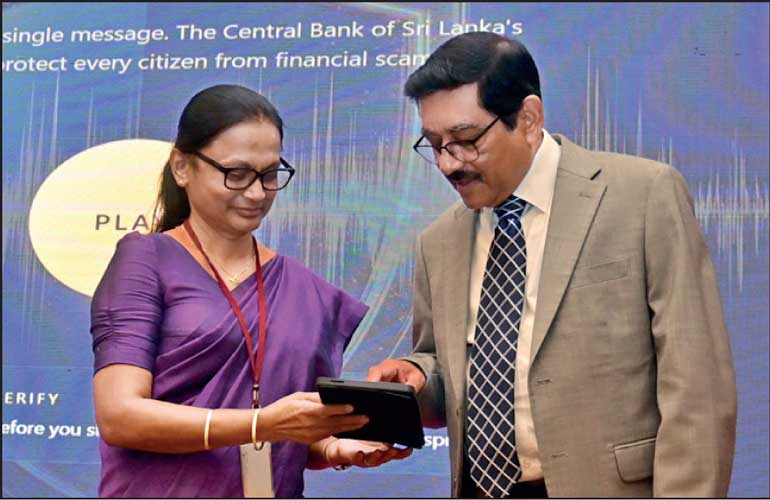
CBSL Governor Dr. Nandalal Weerasinghe (right) launching the ‘Be Scam Proof’ awareness campaign yesterday — Pic by Sameera Wijesinghe
By Charumini de Silva
The Central Bank of Sri Lanka (CBSL) yesterday launched a month-long countrywide awareness campaign titled “Be Scam Proof”, warning that increasingly sophisticated digital fraud and persistent illegal investment schemes are posing a growing threat to consumers, financial inclusion and trust in the financial system.
Speaking at the launch of Financial Consumer Protection Month 2026, CBSL Governor Dr. Nandalal Weerasinghe said Sri Lanka faces a dual challenge of protecting citizens from technologically advanced scams as well as addressing longstanding gaps in financial literacy that allow illegal schemes to flourish.
“We live in extraordinary times for financial services. Digital banking has placed the power of an entire branch in the palm of a customer’s hand, while social media has brought a vast world of financial products and services to our fingertips,” he said.
However, Dr. Weerasinghe noted that financial fraud in Sri Lanka extends beyond technology-driven scams and stems from deeper structural issues, including uneven access to reliable financial information and limited consumer awareness, particularly outside urban centres.
According to the Governor, many Sri Lankans still struggle to distinguish between licensed financial institutions and illegal schemes, creating opportunities for fraudsters to exploit gaps in public knowledge.
“This gap between legal boundaries established by regulators and the public’s awareness is where fraudsters continue to operate. Both the presence of technology and the absence of information are being exploited simultaneously,” he added.
Dr. Weerasinghe said regulators are witnessing two extremes; consumers who are unable to identify licensed finance companies from fraudulent operators, and digitally connected individuals who continue to fall victim to phishing attempts, malicious links and other online scams.
The Governor highlighted the growing prevalence of sophisticated digital fraud, warning that advancing technologies have made scams more convincing and difficult to detect.
At the same time, he pointed to the continued spread of illegal investment and deposit-taking schemes, including unauthorised plantation-based investment operations that often promise unusually high returns.
Highlighting the broader economic implications, Dr. Weerasinghe said financial fraud was not unique to Sri Lanka and had become a global challenge confronting regulators and law enforcement agencies worldwide.
Citing international research, he noted that financial fraud and consumer abuse not only erode household wealth, but also weaken confidence in the formal financial system and undermine broader economic recovery and resilience.
“Trust is a critical foundation of the financial system. Without that trust, financial institutions cannot function effectively, and economic resilience is weakened,” he said.
The Governor warned that the impact of scams falls disproportionately on vulnerable groups with limited financial resources, often wiping out years of accumulated savings and pushing households into prolonged financial hardship.
“Fraudulent investment schemes, illegal deposit-taking operations and sophisticated digital scams do not merely cause individual losses. They can destroy the accumulated savings of entire families and communities,” he said.
Dr. Weerasinghe also observed that periods of economic uncertainty often create favourable conditions for scammers, who exploit individuals facing financial stress and seeking quick financial relief.
Against this backdrop, he described financial consumer protection as a key pillar of modern financial inclusion policy and noted that it forms an important component of Sri Lanka’s National Financial Inclusion Strategy.
The month-long “Be Scam Proof” campaign aims to raise awareness through a coordinated national effort involving financial institutions, fintech companies, telecommunications providers, media organisations, cybersecurity agencies, law enforcement authorities, educators, influencers and financial analysts.
“This cannot be done by the Central Bank alone,” Weerasinghe stressed, calling for stronger collaboration across the financial system, technology ecosystem and media landscape.
He urged media organisations to move beyond reporting individual scam incidents and play a more proactive role in educating the public about financial risks.
“The stories you tell and the messages you carry can help protect livelihoods and build resilience across communities nationwide,” he said.
The Governor also called on financial institutions and fintech providers to strengthen consumer safeguards, while urging telecommunications operators to intensify efforts to prevent misuse of communication networks by fraudsters.
Addressing digital content creators and social media influencers, he emphasised the responsibility that comes with public trust and encouraged them to support awareness efforts aimed at protecting consumers.
The campaign will place particular emphasis on reaching vulnerable groups, including rural communities, low-income households, senior citizens, students and young people.
He said CBSL has developed a multimedia awareness drive featuring posters, educational materials, short films, a dedicated theme song and extensive engagement through both traditional and digital media channels.
Dr. Weerasinghe said changing consumer behaviour requires more than simply providing information and called for a broader community-based approach involving schools, universities, workplaces and households.
He also urged citizens to take greater responsibility for protecting their own financial wellbeing by questioning suspicious promises, verifying information before making financial decisions and exercising caution when engaging with unfamiliar investment opportunities.
“Every individual has a role to play in protecting not only themselves but also the integrity and resilience of the broader financial system,” he said.
The Governor noted that while the Central Bank has conducted several awareness campaigns in recent years, efforts must continue beyond a single week or month and evolve alongside emerging technologies and changing consumer behaviour.
“These conversations must continue beyond a single week or a month. They must evolve to match emerging threats, new technologies and changing consumer behaviour,” he stressed.
The Governor said the ultimate objective is to build a financially informed and resilient public capable of recognising and resisting scams, helping create a financial system that is both inclusive and secure.
“We must work together across the financial system, technology ecosystem, media landscape and law enforcement agencies to build the coordinated defence that this moment demands,” Dr. Weerasinghe said.
CBSL Assistant Governor W.A. Dilrukshini said the “Be Scam Proof” campaign represents a broader and more comprehensive approach than previous awareness programs.
Although earlier initiatives focused on specific issues such as pyramid schemes and financial literacy, she explained the new campaign addresses a wide spectrum of threats including: pyramid schemes, illegal deposit-taking operations, plantation-based investment scams, account lending and account renting schemes and digital and cyber-enabled financial fraud.
Dilrukshini noted that financial scams are becoming increasingly adaptive and sophisticated.
“Just as awareness and regulatory action begin to contain one threat, another emerges; often more sophisticated, more deceptive and harder to detect,” she said.
She stresses that scam prevention requires a sustained effort rather than a one-off awareness campaign.


