Thursday Oct 15, 2026
Thursday Oct 15, 2026
Tuesday, 19 May 2026 02:21 - - {{hitsCtrl.values.hits}}
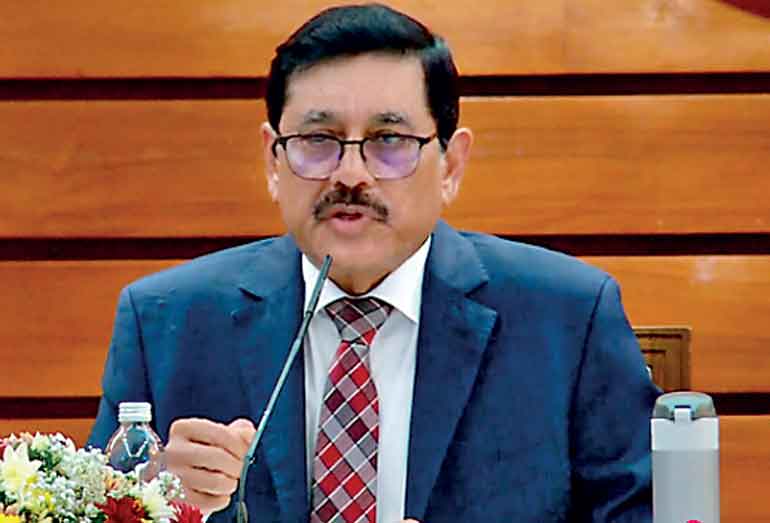
Governor Dr. Nandalal Weerasinghe
The Central Bank of Sri Lanka (CBSL) expects nearly $ 1 billion in inflows from multilateral agencies to provide additional bandwidth to stabilise the exchange rate, as the rupee comes under pressure from higher oil prices, rising imports, and uncertainty linked to the Middle East conflict.
CBSL Governor Dr. Nandalal Weerasinghe yesterday said Sri Lanka expects around $ 700 million from the International Monetary Fund (IMF) early next month, alongside a further $ 250 million from the Asian Development Bank (ADB) and World Bank, while noting that speculative activity was contributing to uncertainty in the foreign exchange market.
“We are intervening when necessary and planning ahead to avoid painful adjustments down the road, so we have stable reserves and the means to contain high volatility in the foreign exchange market,” the CBSL Governor said.
He noted that that while the Sri Lankan rupee had depreciated 4.8% so far this year, other countries were experiencing sharper depreciation, with India experiencing over 6%.
The rupee has weakened sharply in recent weeks, with the CBSL’s indicative selling rate crossing Rs. 331 to the US dollar for the first time since December 2023, amid rising global oil prices, elevated shipping costs, and growing demand for foreign currency. The currency has weakened from around Rs. 309 at the end of December 2025 to beyond Rs. 323-331 levels in recent weeks.
Market participants said importers have been moving early to secure future dollar requirements amid fears of prolonged supply disruptions and higher global energy costs, while exporters have delayed conversions expecting the exchange rate to rise further during the mandatory conversion period, tightening dollar liquidity in the domestic market. “The problem is external, no one knows where the Middle East crisis will take us,” one market participant said.
The IMF, World Bank, ADB, and Fitch Ratings have all maintained that Sri Lanka’s macroeconomic recovery and fiscal performance have remained stronger than initially expected, while cautioning that a prolonged Middle East conflict, elevated oil prices, and disruptions to global trade and shipping would create pressures not only for Sri Lanka but for economies globally.
Former CBSL Governor Dr. W.A. Wijewardena told the Daily FT that the recent depreciation of the rupee reflected both the strengthening of the US dollar and growing strains in the global economy.
“The rupee has to depreciate to reflect unfolding global economic realities and maintain external competitiveness,” he said.
Responding to criticism that the CBSL’s reserve accumulation operations earlier this year created excess rupee liquidity that later fuelled import growth and exchange rate pressure, Dr. Wijewardena rejected the argument that reserve purchases alone were responsible for the currency weakness.
“The CBSL was building reserves by purchasing dollars and the resulting liquidity was expected to support private sector credit growth and economic activity,” he said, noting that the CBSL was no longer a net purchaser of foreign exchange in the domestic market.
However, he said prolonged external shocks, particularly from the Middle East conflict and higher oil prices, could eventually require tighter monetary conditions.
“One way to stabilise the exchange rate, or prevent inflation from exceeding the 7% upper threshold, is to tighten monetary policy,” Dr. Wijewardena said. “If the Middle East conflict continues, the economy and citizens should expect some tightening because aggregate demand would need to be curtailed. This is why structural economic reforms are now more crucial than ever.”
“If exporters are holding their foreign exchange earnings expecting a better rate, they could be disappointed given the near $ 1 billion inflows expected in the short term, with $ 700 million due next month, which the Government can sell to the CBSL and can be used to intervene in foreign exchange market,” Dr. Wijewardena said.
At a Committee on Public Finance (CoPF) hearing last week, Dr. Weerasinghe attributed the depreciation primarily to external shocks, particularly the surge in Sri Lanka’s petroleum import bill following the escalation of geopolitical tensions in the Middle East.
“For example, now compared to the petroleum bill, I think this first five months so far, four months’ petroleum bill itself has been $ 1 billion compared to last year, whole year is $ 1.5 billion,” the former Governor told lawmakers.
He said Sri Lanka’s monthly import bill had climbed close to $ 2 billion in recent months, while export earnings remained relatively stable at around $ 1 billion to $ 1.2 billion per month, creating pressure on foreign exchange availability.
The former Governor also pointed to weaker tourism inflows and elevated fuel demand as contributing factors behind the currency pressure, while insisting the CBSL would not attempt to defend a fixed exchange rate under the country’s inflation-targeting framework.
“It is difficult for the CBSL to fix exchange rates. We can only smoothen out the short-term volatility,” he said.
The CBSL has also met bank treasury heads in a bid to calm market nerves. Market participants said the regulator was closely monitoring the interbank market after spot market quotations widened sharply in recent sessions.
Meanwhile, Advocata Institute Chief Executive Officer Dhananath Fernando in a recent interview with Insight News argued that rising liquidity in the banking system, driven partly by reserve accumulation operations, was also contributing to import demand, credit growth, and depreciation pressures.
“When they buy dollars from commercial banks, they buy it from printed money,” Fernando said. “That printed money enters the banking system and then credit expands.”
CBSL data showed private sector credit by licenced commercial banks expanded by Rs. 2.1 trillion in 2025, representing growth of 25.2%, while finance company lending grew nearly 49%. Analysts say the pickup in credit has coincided with strong liquidity conditions in the banking system following reserve accumulation operations and foreign exchange swap transactions earlier this year.
Inflation has also begun to accelerate, with headline inflation rising to 5.4% last month from around 2% previously, driven by fuel, electricity, and transport costs. Economists warn that further depreciation could increase pass-through effects into fuel, electricity, and water tariffs in the coming months.
At the CoPF hearing, Dr. Weerasinghe acknowledged that prolonged global uncertainty, particularly around oil markets, could worsen inflation and exchange rate pressures.
“If this is remaining longer period, there will be more adverse outcomes in terms of exchange rate, in terms of current account, in terms of inflation,” Dr. Weerasinghe said. “But Sri Lanka is better placed to face these challenges.”
According to the latest CBSL data, foreign currency reserves fell by $ 295 million to $ 6.54 billion in March from $ 6.83 billion in February amid escalating global energy supply shocks due to the US-Israel war on Iran.
Gold holdings also edged lower, declining by $ 3 million to $ 219 million from $ 222 million a month earlier.
Despite the decline in headline reserves, CBSL data also showed the country continues to face sizeable near-term foreign currency obligations.
Predetermined short-term net drains on foreign currency assets amount to $ 2.1 billion over the next 12 months, comprising repayments relating to foreign currency loans, securities, and deposits.
The aggregate short position in forwards and futures in foreign currencies vis-à-vis the rupee, including the forward leg of currency swaps, amounted to $ 3.87 billion.
The position reflects future foreign exchange obligations arising largely from swap-related transactions, although the CBSL said the major share of swaps is expected to be rolled over, limiting immediate reserve outflows.
External sector inflows nevertheless remained relatively resilient during the first quarter of 2026, despite widening trade pressures.
Sri Lanka’s trade deficit widened to $ 2.3 billion during the January-March period, while tourism earnings amounted to $ 954 million.
Cumulative worker remittances for the first four months of 2026 also rose to over $ 3.06 billion, registering a robust 24.5% year-on-year (YoY) increase and marking the strongest January-April performance in Sri Lanka’s history.
The CBSL became a net seller of US dollars in April, marking the first time in 22 months, recording net dollar sales of $ 13 million. The last instance of net dollar sales was reported in June 2024. Despite the April reversal, the CBSL remained a net purchaser of foreign exchange during the first four months of 2026, buying a cumulative $ 697.2 million, following net purchases of around $ 2 billion in 2025.
CBSL plans real-time exchange rate indicator
The Central Bank of Sri Lanka (CBSL) plans to introduce a real-time reference exchange rate indicator for the foreign exchange market by the end of the year, as part of broader efforts to deepen market-based currency operations amid rising volatility in the rupee.
Speaking at the Committee on Public Finance (CoPF), CBSL Deputy Governor Dr. Chandranath Amarasekara said the proposed framework would provide exporters, importers, and financial institutions with a more current benchmark for foreign exchange transactions.
“At the end of this year, we are planning to introduce a reference exchange rate to the forex market,” Dr. Amarasekara said.
He said most market participants currently rely on the previous day’s exchange rate when making decisions on export proceeds and import payments, limiting price discovery in the market.
According to the CBSL, the new system is also expected to facilitate the future introduction of derivative products that would allow businesses and financial institutions to hedge exchange rate risk more effectively.
Dr. Amarasekara also warned that Sri Lanka was likely to record a small current account deficit this year after three consecutive years of surpluses, mainly due to higher oil prices and global economic pressures.
“We’ve had surpluses for three years. For this year, we are expecting a small deficit in the current account,” he told the CoPF. “So essentially, if you look at current inflows and outflows, we are expecting outflows greater than inflows this year, mainly because of what is happening in the global economy and particularly with higher oil prices. Obviously, there will be a higher oil bill that we will have to face.”


