Wednesday Sep 16, 2026
Wednesday Sep 16, 2026
Tuesday, 15 September 2026 06:08 - - {{hitsCtrl.values.hits}}
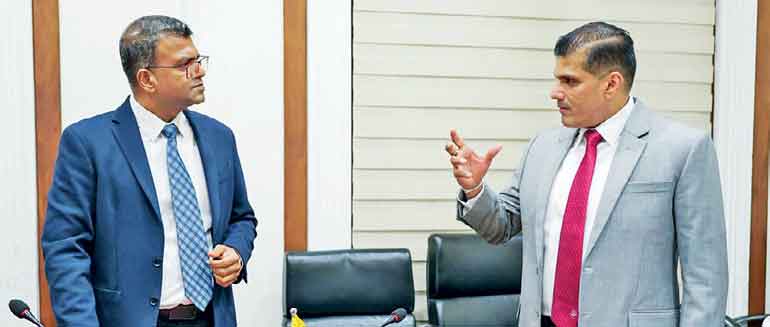
CA Sri Lanka President Tishan Subasinghe (right) in conversation with Finance Ministry Secretary Dr. Harshana Suriyapperuma following the submission of proposals to Budget 2027
Advocates compliance-led revenue growth, digital transformation, taxpayer fairness and more competitive business environment
Proposes revising Advance Personal Income Tax threshold to Rs. 200,000 per month, providing relief to middle-income earners
Estimates measure would result in approximate revenue contraction of
Rs. 26 b against 2026 baseline and Rs. 79 b compared with 2025 actual revenue
Moots next phase of enhancing tax compliance should focus on connecting taxpayer registration with economic activity, ownership, financial transactions and cross-agency information
Recommends establishing integrated data ecosystem through National Taxpayer Information Network and Universal Business Identification Number, connecting information from Customs, VAT transactions, corporate ownership, financial accounts, property records and other relevant datasets
Urges to move progressively from volume-based enforcement towards formal Compliance Risk Management framework, classifying taxpayers according to low, medium and high risk
To support formalisation and sustainable growth, especially SMEs, proposes tiered corporate income tax structure based on annual turnover
The Institute of Chartered Accountants of Sri Lanka (CA Sri Lanka) yesterday said it has submitted its comprehensive proposals for the National Budget 2027 to Finance Ministry Secretary Dr. Harshana Suriyapperuma.
The proposals were submitted by CA Sri Lanka President Tishan Subasinghe, accompanied by Members of the Council, Faculty of Taxation Alternate Chairman Prasad Dasanayaka, and CEO Lakmali Priyangika.
The 16-page proposals, developed through extensive consultations with members and deliberations at the Institute’s 5th Annual Economic and Tax Symposium, present a comprehensive roadmap for strengthening Sri Lanka’s fiscal position through improved compliance, digitalisation, formalization, and taxpayer confidence, while supporting investment and sustainable economic growth.
Presenting the proposals, Subasinghe emphasised that Sri Lanka’s next phase of fiscal reform must move beyond repeated increases in statutory tax rates.
“Sri Lanka has made commendable progress in restoring macroeconomic stability and rebuilding fiscal credibility, but we cannot sustain this momentum through excessive reliance on tax rate hikes alone,” Subasinghe said.
“Our focus must now shift towards better capturing the economic activity already taking place across the country and bringing more of it into the formal tax system. We need to broaden and strengthen the tax base through improved compliance, better use of information and more predictable tax administration. The Institute believes that by prioritising digitalisation, formalization, and taxpayer confidence, we can mobilise revenue fairly and efficiently while fostering an environment conducive to investment and sustainable growth,” he said.
The proposals are anchored on three complementary objectives: mobilising additional revenue without excessive reliance on higher statutory tax rates; modernising tax administration and improving voluntary compliance; and strengthening the investment, business, and institutional environment required for sustainable growth.
CA Sri Lanka highlights the fragility of Sri Lanka’s current revenue structure, which remains heavily dependent on indirect taxation. In 2025, indirect taxes accounted for approximately 11.9% of GDP, compared with only 3.5% from income taxes.
The Institute notes that this imbalance places a disproportionate burden on consumers and can contribute to informal economic activity. It therefore proposes a clear hierarchy for revenue mobilisation, with statutory rate increases considered only after other avenues have been exhausted.
The proposed hierarchy is:
*Improve compliance with existing taxes;
*Identify economic activity that currently remains untaxed;
*Reduce revenue leakages;
*Broaden the tax base through digitalisation and better information;
*Review and rationalise tax exemptions; and
*Only then consider broad statutory rate increases.
This approach, the Institute believes, would enable Sri Lanka to strengthen revenue mobilisation while minimising unnecessary pressure on compliant taxpayers and businesses.
Connecting registration to economic activity
The proposals highlight that while Sri Lanka’s registered taxpayer population increased from 1,239,541 in 2024 to 1,470,011 in 2025, an increase of approximately 18.6%, registration alone does not guarantee effective compliance or revenue mobilisation.
“The next phase should focus on connecting taxpayer registration with economic activity, ownership, financial transactions and cross-agency information,” the proposals state.
CA Sri Lanka therefore recommends establishing an integrated data ecosystem through the National Taxpayer Information Network (NTIN) and Universal Business Identification Number (UBIN), connecting information from Customs, VAT transactions, corporate ownership, financial accounts, property records, and other relevant datasets.
The Institute proposes that the UBIN, NTIN and electronic invoicing should be developed as part of the wider World Bank-supported digital transformation agenda, ultimately contributing towards a single digital economic identity that can improve both revenue administration and the delivery of Government services.
Harnessing data and Artificial Intelligence for compliance
The proposals call for Sri Lanka to move progressively from volume-based enforcement towards a formal Compliance Risk Management framework, classifying taxpayers according to low, medium, and high risk.
As part of this transition, CA Sri Lanka proposes an Artificial Intelligence (AI)-assisted Tax Compliance Risk Engine to identify potential high-risk cases involving shell companies, unexplained wealth, circular transactions, and Value Added Tax (VAT) fraud. The system would function as a selection and risk-identification tool rather than a final determinant of tax liability, ensuring that technology supports professional assessment and due process rather than replacing them.
The Institute also recommends strengthening the existing High-Wealth Individual (HWI) Compliance Program through a formal wealth-to-income risk model.
To address gaps between actual economic capacity and reported income, the proposals recommend enhanced monitoring of financial assets, cryptocurrencies, and insurance investments through annual information returns.
CA Sri Lanka further proposes a VAT Intelligence Program, initially as a pilot initiative, using objective indicators such as electricity consumption, bank deposits, and point-of-sale (POS) data to identify potential compliance risks in high-risk, cash-intensive sectors, including gold and auto-parts businesses.
Modernising VAT and Customs administration
The Institute recommends the phased introduction of mandatory electronic invoicing, beginning with large VAT taxpayers and high-risk sectors before progressively expanding across the wider business community.
It also proposes automated Customs–Import Data Reconciliation, comparing Customs values and landed costs against inventory, sales, VAT, and income tax returns to identify potential revenue leakages, particularly in import-dependent sectors.
The proposals also identify the need to address unregulated economic activity in specific sectors. In the broadcasting sector, CA Sri Lanka recommends action to address an estimated 300,000 illegal Direct-to-Home (DTH) connections, which are estimated to generate approximately Rs. 3.6 billion in unregulated revenue, with potential tax recovery estimated at around Rs. 1.5 billion.
Tax relief while protecting revenue
CA Sri Lanka proposes revising the Advance Personal Income Tax (APIT) threshold to Rs. 200,000 per month, providing relief to middle-income earners.
The Institute estimates that the measure would result in an approximate revenue contraction of Rs. 26.01 billion against the 2026 baseline and Rs. 79.08 billion compared with 2025 actual revenue.
While recognising the fiscal impact, CA Sri Lanka believes the measure could stimulate economic activity and improve disposable income amid continuing inflationary pressures. The proposals therefore emphasise that the fiscal cost should be considered alongside the potential economic benefits of increased consumption and formal economic activity.
A proportionate tax framework for SMEs
To support formalisation and sustainable growth, CA Sri Lanka proposes a tiered corporate income tax structure based on annual turnover.
The proposed framework would recognise:
*Micro enterprises: annual turnover up to Rs. 20 million;
*Small enterprises: annual turnover up to Rs. 350 million;
*Medium enterprises: annual turnover up to Rs. 1 billion; and
*Large enterprises: annual turnover exceeding Rs. 1 billion.
The structure would be supported by a proportionality principle in tax compliance, recognising that smaller businesses should not face the same administrative burden as larger corporations.
Micro businesses should be able to maintain simplified records, while small and medium-sized businesses (SMEs) could progressively adopt standardised digital templates. The objective is to encourage businesses to formalise and grow without excessive compliance requirements inadvertently pushing smaller enterprises into informality.
The Institute also recommends that the Central Bank of Sri Lanka (CBSL) encourage financial institutions to rely, where appropriate, on audited financial statements and tax returns when assessing credit applications, thereby reducing the need for SMEs to incur additional costs to satisfy lending requirements.
CA Sri Lanka further calls for the urgent expedition of Development Banks’ concessionary lending facilities for SMEs, with access linked to the submission of audited accounts. This would provide much-needed support to businesses facing current cash-flow constraints while simultaneously encouraging stronger financial reporting practices.
Strengthening capital gains and tourism taxation
The CA Sri Lanka proposals also call for stronger and more transparent capital gains assessments, including a framework under which valuations prepared by accredited independent professionals are formally considered by the Inland Revenue Department (IRD).
For tourism, CA Sri Lanka recommends a dedicated Digital Tourism Booking Framework to address tax-base erosion associated with non-resident digital platforms facilitating accommodation bookings in Sri Lanka.
The framework would seek to capture offshore deductions and related economic value, including booking commissions, franchise royalties, and global marketing fees paid to non-resident platforms, ensuring that Sri Lanka’s tax base appropriately reflects the economic activity generated within the country.
Strengthening taxpayer rights and predictability
CA Sri Lanka also proposes a statutory Right to Self-Correction, allowing taxpayers to correct genuine errors while distinguishing taxpayer-initiated corrections from pre-assessment correction opportunities.
The Institute also recommends establishing an Independent Taxpayer Ombudsman to address complaints relating to administrative treatment, unreasonable delays, communication failures, and systemic service issues.
In addition, the proposals call for a Tax Administration Service Charter establishing clear standards for fairness, timeliness, communication, and adequate advance notice of compliance requirements. This would help prevent situations where taxpayers face retrospective compliance difficulties following sudden changes in requirements, such as changes to VAT invoice procedures.
CA Sri Lanka also proposes amending the law to allow the Commissioner-General of Inland Revenue to waive or reduce disproportionate interest on just and equitable grounds, where appropriate.
A further holdover provision is proposed to suspend tax collection during the appeal process in qualifying cases. This would help prevent undue financial pressure on taxpayers and reduce the risk of coercive settlements while legitimate disputes are being determined.
Building a modern Inland Revenue Department
The Institute stresses that reform of the IRD must go beyond simply filling existing vacancies.
While CA Sri Lanka calls for the urgent filling of 223 senior-level vacancies, it also recommends lateral recruitment for specialised technical positions, including data scientists and other digital and analytical professionals.
Continuous professional development should form an integral part of this transformation, including training partnerships with professional bodies such as CA Sri Lanka in specialised areas such as international taxation and transfer pricing.
The proposals also recommend establishing a permanent Tax Policy and Revenue Analytics Unit within the Finance Ministry to undertake tax-gap analysis, tax expenditure evaluation, and revenue forecasting.
To strengthen transparency and accountability, the Institute proposes the publication of information relating to tax expenditure, tax arrears, and key compliance indicators.
International taxation and emerging revenue issues
CA Sri Lanka recommends a formal assessment of Sri Lanka’s exposure to the Organisation for Economic Co-operation and Development’s (OECD) 15% global minimum effective tax rate under Pillar Two, together with consideration of a Qualified Domestic Minimum Top-up Tax (QDMTT) to protect the domestic tax base.
The Institute also recommends restoring the real tax share on cigarettes towards the World Health Organisation (WHO) benchmark of 75%, with estimated annual revenue recovery of Rs. 17.3 billion, subject to Treasury validation.
However, CA Sri Lanka stresses the importance of evidence-based policymaking. Estimates relating to cigarette excise reform should be validated against possible illicit-market effects, while potential QDMTT revenue cannot be responsibly estimated without multinational enterprise-level GloBE income data.
Similarly, revenue estimates associated with NTIN, HWI compliance, and Customs reconciliation should be supported by formal tax-gap studies.
A reform agenda built on evidence and trust
CA Sri Lanka emphasises that all major tax and revenue proposals should undergo a formal Revenue Impact Assessment before being considered for inclusion in the National Budget.
The Institute urges the Government to give immediate priority to integrated tax data, HWI compliance, Customs–IRD reconciliation, and Pillar Two implementation, while progressively building the digital and institutional infrastructure required for a modern revenue administration.
Subasinghe said: “Fiscal consolidation cannot be sustained through repeated increases in statutory tax rates alone. Our proposals offer a balanced approach that strengthens compliance, leverages digitalisation, protects taxpayer rights, and creates a more predictable and fair tax environment that can support sustainable economic growth and improved public confidence.”
“As the national body of accountants, we stand ready to work with the Government in implementing these reforms and contributing to Sri Lanka’s journey from resilience to revival,” Subasinghe added.


