Thursday Oct 15, 2026
Thursday Oct 15, 2026
Wednesday, 14 October 2026 00:00 - - {{hitsCtrl.values.hits}}
By Devan Daniel
Businesses should not bank on tax cuts in the 2027 Budget, the Treasury has signalled. The Government is instead relying on reforms, digitised tax administration and a World Bank-backed strategy targeting 7% growth to lift the economy.
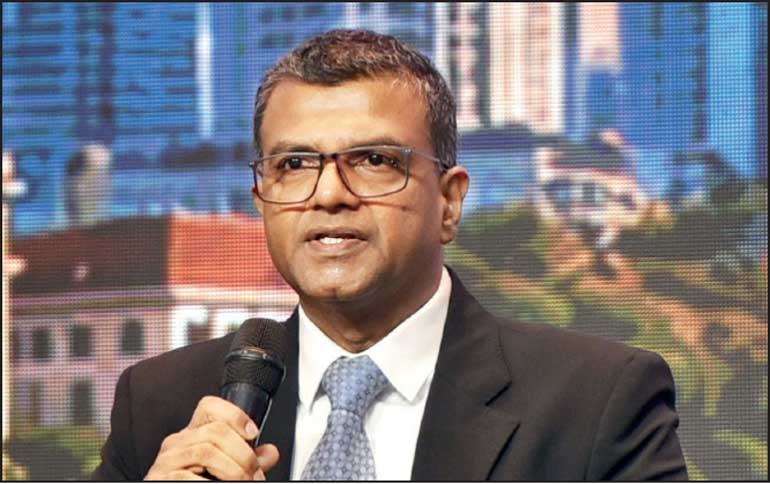
Treasury Secretary Dr. Harshana Suriyapperuma was speaking yesterday at the Sri Lanka Economic and Investment Summit. He was answering a question on whether the Budget would ease corporate tax, VAT and the Social Security Contribution Levy (SSCL), which businesses say are among the highest in the region and are holding back investment.
“The reason Sri Lanka is at that point is not by choice. As a nation, we were forced to that point because of the reckless way the economy was managed, without foresight or insight,” he said.
Dr. Suriyapperuma said revenue measures were performing as expected and had lifted the revenue-to-GDP ratio from about 7% to 16%. Interest payments, which absorbed 80% of revenue two to three years ago, have fallen to 40% this year. He said the revenue was being returned to the community through welfare payments, the diesel subsidy and Rs. 96 billion in SME lending this year, most of which went to micro, small and medium enterprises.
“As of now, the priority is to allow businesses to stay afloat, succeed, expand and create more jobs. I’m sure that in time to come, it will give us space to re-look at some of the rates that we have now,” he said.
Rather than raising rates, the Government is increasing revenue by improving tax administration. The Act allows the Inland Revenue Department (IRD) up to 45 days to process VAT refunds. Dr. Suriyapperuma said the average is now 29 days, and in the second month of the new system, a refund was processed in a single day because input and output claims are matched automatically.
“We are talking of Rs. 120 billion in additional revenue that we are generating, not by increasing rates, but by improving our processes and systems,” he said. He was referring to a positive cash flow effect of about Rs. 10 billion a month.
He said the IRD had worked to change the perception among businesses that money paid in never came back. The Treasury met business chambers, trade associations and IRD officials monthly for a year, and the IRD cleared a backlog of long-pending refund claims.
On growth, Dr. Suriyapperuma said the Government was working with the World Bank on a strategy for 7% growth. Compounded over the years, this would double the economy from $ 100 billion to $ 200 billion. Per capita income currently stands at about $ 5,000. The strategy includes immediate, short-, medium- and long-term measures.
He said external validation of Sri Lanka’s stability, such as a rating upgrade, mattered more than the Government’s own claims. “No matter how loud we speak for ourselves, it is the validation from independent agencies that Sri Lanka has reached the destination that really matters,” he said.
He described the second pillar as continued reform, through amendments to existing Acts and new Bills to close gaps and reduce leakages. Some Bills have completed the process and will be tabled at the upcoming Cabinet meeting, while others are awaiting responses from the Legal Draftsman’s Department.
The third pillar is implementation. “No matter how many Bills and new regulations we have, at the end of the day, it will boil down to implementation,” he said.
As evidence that implementation is under way, he said Sri Lanka scored 95% on a global trade facilitation index in April, placing it above the global average according to World Trade Organisation data. He added that the Tourist VAT Refund Scheme, which has been running for nearly a year, is working well.
Digital invoicing is also being rolled out in three phases. The first phase, covering exporters, has been completed. The second phase, covering nearly 36,000 VAT-registered suppliers, is now in user testing, and hundreds of businesses volunteered to be among the first cases. Work has also started on the third phase, a full nationwide rollout.
He also cited the SriLankan Airlines restructuring. The airline needed at least 75% creditor acceptance, but received 99%, including from creditors who had taken it to court two months earlier.
Beyond domestic reforms, Dr. Suriyapperuma said the Government’s growth push would focus on connecting SMEs to global value chains. “Instead of businesses trying to serve a market of 20 million locally, we want them to expand and reach the 200 million and 2 billion markets outside Sri Lanka,” he said. He added that competitiveness strategies would be rolled out, some of them in the Budget.
“Reach out to us. We are ready to listen,” he told the business community.


