Friday Oct 09, 2026
Friday Oct 09, 2026
Friday, 9 October 2026 00:00 - - {{hitsCtrl.values.hits}}
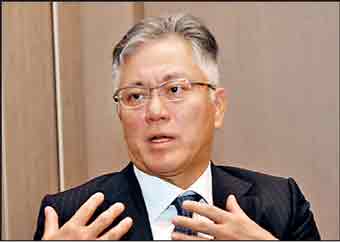 |
| BCG Asia Pacific Chairman Yasushi Sasaki |
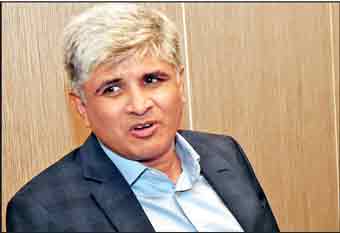 |
| BCG India Head Rahul Jain |
By Nisthar Cassim
Encouraged by the resilience and rebound, as well as the growing acceptance of its expertise, global giant Boston Consulting Group (BCG) is keen to help businesses grow, thereby contributing to nation-building in Sri Lanka.
This vision was shared by BCG Asia Pacific Chairman Yasushi Sasaki and India Head, Managing Director and Senior Partner Rahul Jain, who are in Sri Lanka along with around 600 Managing Directors and Partners for their annual planning conference over three days.
“We find companies in Sri Lanka to be quite visionary, and they have the mindset to think bolder, take on transformations,” the BCG duo told the Daily FT in an interview.
They said that BCG is seeing much greater client acceptance and, hence, want to help Sri Lankan businesses and the country.
“In the last 18 months, things have really shot up. We are looking at greater local presence. We have taken a small office space also and we want some of our people to be housed here. We want to grow our business and contribute to the growth of the nation and to the betterment of humanity,” Sasaki and Jain said.
“Business is only one piece. The other is always how much we can help in nation-building, in industry-building, and help the society at large,” emphasised Sasaki, who is in Sri Lanka for the first time.
Noting that there is strong demand in Sri Lanka, the BCG duo said the company’s role is to support these clients.
“Firstly, we are keen to strengthen their business that will contribute to the society in Sri Lanka, and then one day, if they can move up their way to globalise the operation, that will be a great contribution to the global society. This is BCG’s mindset. We are really committed to Sri Lanka and to the success of our clients,” Sasaki and Jain added.
Regarded as a global consulting firm that partners with leaders in business and society to deliver transformative impact, BCG has over 2,300 experts globally of which over 600 are in the Asia Pacific.
“We work with governments everywhere, as long as it is really value adding and constructive, and it helps in the right cause. To really make a deep impact in the functioning of the government, one needs to know the country really well. So we are in the working stages of that, and we do believe that in time to come, we will play a big role there as well,” the BCG duo added.
They also said that post-crisis, Sri Lanka has recovered commendably and has great potential for the future. “It [Sri Lanka] is promising in my view. After the crisis, Sri Lanka is back. That is a key work theme for BCG this week,” Sasaki said, adding that he looks forward to discussion with Sri Lankan CEOs.
“Sri Lanka has shown remarkable resilience and businesses learn resilience through the experience of crisis. That would be a great asset to guide the economy and business in the future amidst external uncertainties,” he added.
According to BCG, some of the current and emerging challenges for businesses and nations alike include Artificial Intelligence (AI) and geopolitics.
It was pointed out that global CEOs now understand the importance of AI as a necessity. They put AI as their topmost priority and are keen to master it to guide organisations effectively. Geopolitics, the BCG duo identified as a never-ending story.
“Great leaders are really good at training the geopolitical muscle itself. They try to be resilient and adaptive to the situation. If you can overcome these challenges, there are great opportunities for countries and businesses,” they emphasised.
The BCG duo also stressed that Sri Lanka must better harness the India opportunity, being the geographically strategic neighbour.
“We are seeing growing interest to explore opportunities in the Indian. Certainly, there are a lot of collaboration opportunities, and it can be a win-win. We don’t need to compete with each other but collaborate,” pointed out Jain. “There is enough opportunity from a supply chain point of view, synergistic point of view to support each other. Businesses from both countries must leverage each other as a market, but also as a supply source for both products and services,” he added.
Sasaki stressed the importance of Sri Lanka retaining its great young talent within the country. “There is a role for the Government as well as business leaders, because talent will determine the future of the country,” he said.
BCG sees banking and finance in Sri Lanka among growth sectors. “It is the foundation for the economy. The sector should look at attracting more capital from outside the country, and then hopefully, as a next step, be aspirational to expand the business outside Sri Lanka,” the BCG duo said, adding that leveraging AI was key as well.
BCG also listed agriculture and tourism as natural strengths for Sri Lanka, and said they must be leveraged better with innovation and productivity. Logistics is another growth opportunity given Sri Lanka’s strategic location and aspiration to be a regional hub, for which improved efficiency is required. BCG also believes textile and apparel to be among sectors in which Sri Lanka can expand drawing lessons from Vietnam and Bangladesh.
“Sri Lanka has some great apparel companies who can play a much bigger role in the global supply chain,” the BCG duo added.
They also emphasised the importance of developing small and medium enterprises/entrepreneurs (SMEs). “Our message is, without SMEs, no nation grows. Holistic development in a country requires the uplifting of SMEs. Whether it is financing them or giving them market opportunities, governments need to think of how to uplift SMEs because without that, the nation doesn’t work,” they stressed, adding that “if SMEs are aspirational, BCG is willing to help.”


