Thursday Oct 22, 2026
Thursday Oct 22, 2026
Friday, 3 July 2026 00:00 - - {{hitsCtrl.values.hits}}
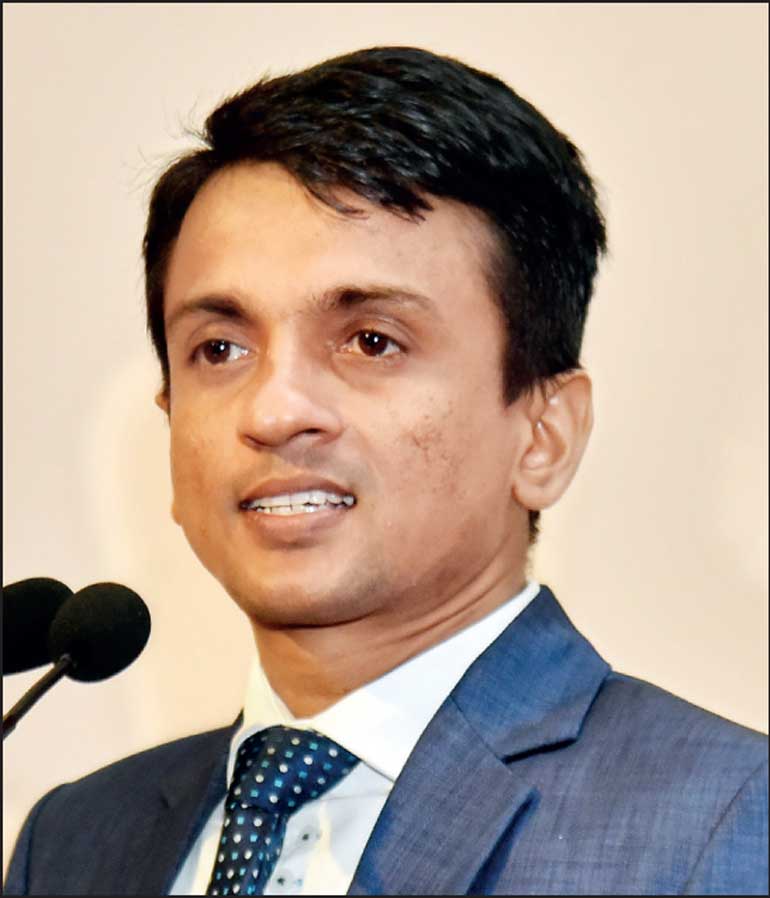
Advocata Institute CEO Dhananath Fernando – Pic by Upul Abayasekara
Although Sri Lanka has restored macroeconomic stability and completed its sovereign debt restructuring, international investors continue to demand yields well above US Treasury benchmarks to hold the country’s debt, signalling that investors have yet to price in Sri Lanka’s economic stabilisation, Advocata Institute CEO Dhananath Fernando said yesterday.
Delivering the keynote address at CA Sri Lanka’s 5th Annual Economic and Tax Symposium, Fernando said International Monetary Fund (IMF) debt sustainability projections show Sri Lanka’s post-restructuring external debt service obligations will rise to around $ 3.5 billion in 2027, while the country’s 2035 International Sovereign Bond (ISB) continues to trade at a yield of about 8.3%, compared with roughly 4.3% on comparable US Treasury securities.
The spread, he said, shows investors continue to price Sri Lanka as a high-risk sovereign despite its recovery from the 2022 default.
“The economy is stable, but the market really doesn’t see the indication that the risks are coming down,” Fernando said.
He argued that debt restructuring has eased Sri Lanka’s immediate repayment burden but has not fundamentally resolved the country’s long-term debt sustainability challenge.
Drawing on the IMF’s debt sustainability analysis, Fernando contrasted Sri Lanka’s pre-restructuring repayment profile, which would have required external debt servicing of around $ 7 billion in 2023, with the revised post-restructuring schedule.
While the new repayment profile is considerably more manageable, he cautioned that Sri Lanka remains dependent on maintaining access to international capital markets.
“Our debt numbers are now within our capacity to pay,” he said. “But it doesn’t mean we are completely out of the woods.”
Fernando said sovereign debt should not be viewed as something governments simply repay from accumulated savings. Instead, countries refinance maturing obligations by issuing new debt.
“We borrow from Peter to pay Paul,” he said. “If we raise $ 2 billion through a five-year Bond in 2027, that repayment simply moves to 2032 with additional interest.”
The country’s ability to refinance future obligations at sustainable borrowing costs, he said, ultimately depends on convincing investors that Sri Lanka has become a fundamentally lower-risk borrower rather than a country that has merely emerged from default.
That, in turn, requires continued improvements in sovereign credit ratings.
Fernando noted that although rating agencies have begun upgrading Sri Lanka following the completion of debt restructuring, the country remains well below investment-grade status and continues to face elevated borrowing costs.
“The deal is to increase the rating,” he said.
He argued that achieving further upgrades will become increasingly challenging as global capital becomes more selective amid geopolitical tensions, shifting trade patterns, and intensifying competition for investment.
The persistence of elevated sovereign yields demonstrates that markets have yet to fully price in Sri Lanka’s economic stabilisation, he said.
“This means investors are asking 8.3% because they still see a massive risk,” Fernando said.
Although he commended the Government for restoring fiscal discipline, Fernando argued that fiscal consolidation alone will not alter that perception.
“Our fiscal house is in order,” he said, but cautioned that stronger tax collections alone cannot generate the long-term growth needed to sustain debt repayments. “We cannot tax our way towards prosperity.”
Fernando also observed that Sri Lanka’s recent economic expansion of around 5% had been driven largely by construction activity and tax receipts, particularly following the resumption of vehicle imports, rather than by a broad-based improvement in productivity.
While those developments have strengthened public finances, he argued they are unlikely on their own to convince investors that Sri Lanka’s long-term growth prospects have materially improved.
Instead, Fernando said debt sustainability ultimately depends on raising productivity, expanding exports, and building a more competitive private sector capable of generating the foreign exchange required to meet future external debt obligations.
Without those reforms, he warned, Sri Lanka risks returning to another IMF-supported adjustment cycle despite having completed its debt restructuring.
“The solution lies within our own territory,” Fernando said. “It is what we do that defines how we face external shocks.”


