Friday Oct 16, 2026
Friday Oct 16, 2026
Tuesday, 24 February 2026 03:14 - - {{hitsCtrl.values.hits}}
 |
 |
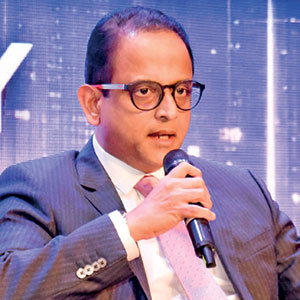 |
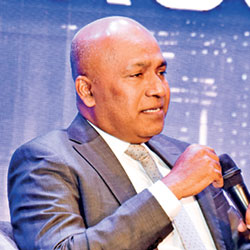
| People's Bank CEO and General Manager Clive Fonseka | HNB Managing Director and CEO Damith Pallewatte | BOC Chairman Kavinda de Zoysa |
 People’s Bank General Manager/CEO Clive Fonseka notes State lender was among hardest hit amidst sovereign trap
Hatton National Bank Managing Director/CEO Damith Pallewatte opines episode validated country’s prudential framework, but revealed weaknesses in practice
Bank of Ceylon Chairman Kavinda de Zoysa says crisis exposed importance of operational risk
By Charumini de Silva
Sri Lanka’s top bankers last week revealed that the 2022 sovereign and currency crisis permanently altered how they manage risk, forcing a decisive shift away from concentrated sovereign exposure, collateral-heavy lending, and complacency over foreign currency liquidity.
Speaking at the 36th anniversary convention of the Association of Professional Bankers of Sri Lanka (APB), industry leaders described the crisis as a structural reset rather than a temporary shock.
Three years after the country’s sovereign default and the street protests known as the Aragalaya, the industry’s senior figures say the crisis has delivered a lasting reset in how risk is priced, measured, and, crucially, respected.
In a panel titled ‘Clarity in Complexity — Steering Growth,’ they said banks have discovered that sovereign risk is not theoretical, collateral is not always liquid, and liquidity in rupees is not liquidity in dollars.
People’s Bank General Manager/CEO Clive Fonseka said the State lender was among the hardest hit, given its role in financing essential imports at the height of the turmoil.
“At the time, nearly 60% of its loan book was exposed to State-owned enterprises (SOEs), alongside a substantial Government securities portfolio. When interest rates spiked to around 30% and the rupee plunged, the risks embedded in sovereign-linked assets became stark,” he recalled.
The lesson has since been codified in balance sheet rebalancing, he said, adding that the bank has shifted towards private-sector lending, strengthened its risk architecture, and reduced concentration risk.
“The lesson was clear—sovereign exposure is risk,” he said, noting that lending to SOEs and holding Treasury paper could no longer be treated as inherently safe. The bank has since reduced concentration risk, strengthened capital buffers, and restructured its risk management framework.
“A key fault line exposed during the crisis was the mismatch between rupee liquidity and dollar obligations. Despite ample domestic liquidity, banks struggled to source foreign currency as deposit rates on dollars surged above 20%, forcing costly swaps,” he pointed out.
Fonseka however said, capital adequacy, liquidity, and profitability have since improved significantly following the reset.
Hatton National Bank Managing Director/CEO Damith Pallewatte framed 2022 as a “stress event” that validated, rather than discredited, Sri Lanka’s regulatory architecture. The prudential framework often criticised as overly restrictive for a developing market, he suggested, ultimately shielded the system.
“The episode validated the country’s prudential framework, but revealed weaknesses in practice,” he added.
Collateral values, once considered reliable safeguards, became illiquid during the crisis. “Cash flow is king,” he said, adding that banks now stress-test borrower cash flows against extreme but plausible scenarios – something that was not rigorously embedded before the 2022 economic crisis.
Risk management, he added, must exceed regulatory minimums. “The risk officer is not the enemy,” he said, reflecting on his own years as a Chief Risk Officer. The function must shift from gatekeeper to strategic adviser, supported by data and technology.
He said foreign currency mismatches have also come under tighter scrutiny. “Lending in rupees to export earners with dollar revenues once seemed convenient. When the currency dislocated, those mismatches became acute. Asset–liability currency alignment, previously treated as a compliance exercise, is now regarded as core risk discipline,” Pallewatte said.
Noting that liquidity management has similarly evolved, he said Treasury Bills may be safe in credit terms, but they are not always liquid in a crisis. “The experience has forced Boards to question not only what qualifies as high-quality liquid assets, but whether those buffers can be monetised in real time,” he added.
Bank of Ceylon Chairman Kavinda de Zoysa said the crisis also exposed the importance of operational risk — from fuel shortages to prolonged power cuts that disrupted business continuity.
“Boards are now taking a more hands-on approach to governance and resilience planning,” he added.


