Monday Oct 19, 2026
Monday Oct 19, 2026
Monday, 19 October 2026 05:19 - - {{hitsCtrl.values.hits}}
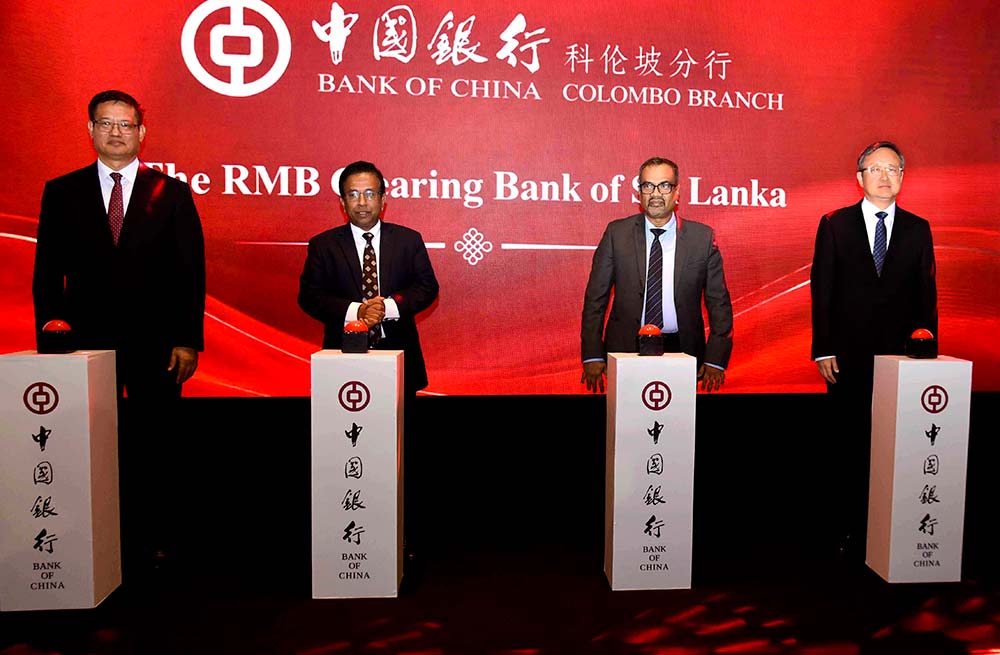
Bank of China Colombo branch unveiled Sri Lanka’s first RMB clearing bank last week. From left: Chinese Ambassador Wei Huaxiang, CBSL Deputy Governor K.G.P. Sirikumara, Finance and Planning Deputy Minister Dr. Anil Jayantha Fernando, and Bank of China President Zhang Hui – Pic by Upul Abayasekara
Bank of China Colombo branch last Thursday became Sri Lanka’s first renminbi (RMB) clearing bank, formally launching operations that allow trade and investment with China to be settled directly in the Chinese currency, rather than through the US dollar.
The branch was authorised as a clearing bank by the People’s Bank of China (PBOC), China’s central bank. Central Bank of Sri Lanka (CBSL) Deputy Governor K.G.P. Sirikumara said the move would strengthen the connection between Sri Lanka’s banking system and China’s financial system. He cautioned, however, that the facility’s benefits hinge on how widely it is adopted.
“The success of this initiative will depend not only on establishing the facility, but also on how widely it is used,” Sirikumara said at the launch.
An RMB clearing bank is a lender designated by the PBOC to process, clear, and settle RMB transactions outside mainland China.
Until now, local lenders handling RMB went through banks in China. “Previously, domestic interbank RMB transfers in Sri Lanka generally had to be routed through correspondent bank accounts in China. This could involve additional processing time and intermediaries,” Sirikumara said.
Banks and businesses can now maintain RMB accounts with the clearing bank, make cross-border RMB payments with China, and settle RMB payments locally. He said this was expected to improve efficiency, lower transaction costs, and make transfers more convenient. Importers also stand to avoid converting rupees into US dollars and then into RMB, a process CBSL Governor Dr. Nandalal Weerasinghe has said raises costs and exposes traders to multiple exchange rate risks.
The potential gains are significant given the scale of trade with China, Sri Lanka’s largest source of imports. Imports from China totalled $ 5.15 billion in 2025, up 16% year-on-year, while exports rose 10% to $ 279 million, according to Export Development Board data. Sirikumara said RMB settlement could simplify payment arrangements and open access to a wider range of RMB banking and financing services. Over time, he said, it could also support greater trade and investment.
He also pointed to a potential link with China’s Cross-Border Interbank Payment System (CIPS), which processes cross-border RMB payments through standardised payment messaging and settlement arrangements. He said the clearing bank could help Sri Lankan financial institutions explore access to it. Former Chinese Ambassador Qi Zhenhong told an earlier RMB Internationalisation Forum in Colombo that the CIPS had 1,729 participants, covering over 5,000 licensed banking institutions across 189 countries and regions. Sirikumara said the idea of an RMB payment facility between the two countries was first discussed at that forum.
Sirikumara called on commercial banks to engage with the clearing bank, explore its services, and build awareness among customers. He also urged importers and exporters to assess whether settling in RMB would be suitable and cost-effective for their businesses. The CBSL will work closely with the PBOC, Bank of China, and licensed banks to ensure the arrangement runs smoothly, he added.
Sri Lanka’s designation forms part of a wider expansion of China’s clearing network this year. The PBOC authorised Bank of China’s London branch as the UK’s RMB clearing bank in February, a month before the Colombo branch. It has since named clearing banks for Indonesia in June and Frankfurt in August.


