Monday Sep 28, 2026
Monday Sep 28, 2026
Thursday, 9 April 2026 00:00 - - {{hitsCtrl.values.hits}}
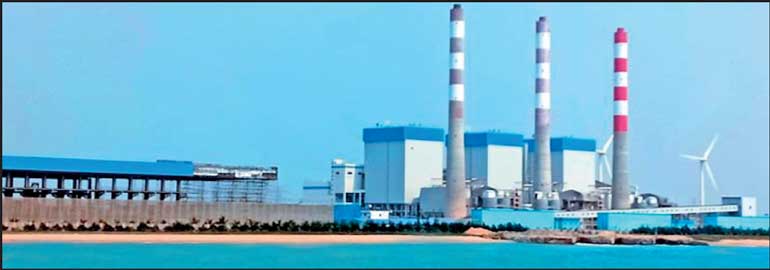
Lakvijaya Power Plant
Sri Lanka’s National Audit Department has found that failures in procurement governance, supplier selection, and quality controls in coal purchases for the Lakvijaya Power Plant resulted in a loss of Rs. 2,237.7 million, with a further Rs. 2,332.5 million identified as recoverable penalties.
This comes even as President Anura Kumara Dissanayake told Parliament on Tuesday that the issue stemmed from suppliers failing to meet required standards.
“The real issue lies in the quality of coal. This is not a problem with the tender process, but rather with the supplier failing to provide coal of the required standard. The coal is tested in designated laboratories. Before shipment, a laboratory report certifies that the coal meets the required standards. Based on this, we make 80% of the payment. The remaining 20% is paid after further testing in an Indian
laboratory,” he said.
The audit indicates that beyond supplier underperformance, weaknesses in procurement procedures, testing reliability, and oversight contributed to the outcome, in a report titled ‘Special Audit Report on the Coal Purchase Process by Lanka Coal Company for Lakvijaya Power Plant and Coal Procurement for the 2025/2026 Season’ dated 2 April 2026.
The Lakvijaya Power Plant, which contributes between 30% and 40% of national electricity generation, requires about 2.25 million metric tons of coal annually. Due to monsoon conditions, coal shipments can only be unloaded between October and March, requiring advance procurement and stockpiling to ensure uninterrupted generation.
The special audit, initiated following concerns raised in Parliament, shows that issues extended across supplier selection, qualification standards, quality verification, and procurement planning.
At the point of award, the audit finds that procurement rules were not adhered to. It states:
“In this procurement, it was clearly stated in the notice that bids were invited from suppliers who had completed their registration by the date the notice was published, and bids were also sent to three suppliers who had not confirmed their registration by paying the full registration fee by that date. It was observed that the aforementioned Trident Champhar Ltd., which was selected for this procurement, had also not confirmed its registration by that date.”
The report identifies that entry standards into the supplier pool had been weakened. It states:
“It was observed that the Lanka Coal Company, when establishing the criteria for registering coal suppliers, had relaxed those criteria to an unacceptable level and that criteria with lower standards than those requested with the bid documents had been considered during registration. Due to this, it was observed that suppliers with experience in supplying coal at or near the rejected gross calorific value level have also been given the opportunity to supply coal for this power plant.”
Quality assurance mechanisms were also compromised. The audit finds that coal testing at the loading port relied on an entity that was not accredited, with associated licencing issues, and that the reports issued for all shipments were unreliable.
Despite inconsistencies between inspection reports and plant-level data, no verification action was taken. The audit states:
“Accordingly, in the event of discrepancies between these reports and the data obtained from the plant’s control unit, even though the buyer was given several options to obtain confirmation of the reports obtained at the loading port, Lanka Coal Company had not taken steps to avail of those options.”
The coal supplied did not meet required calorific standards, resulting in reduced generation efficiency and higher consumption. The audit notes that the power plant had not been able to generate the desired electricity capacity using the relevant coal.
This translated into financial losses. The audit states:
“It was observed that the total estimated loss due to overconsumption as a result of the increase in the amount of coal required to generate 1 kilowatt hour (kWh) of electricity using coal in the original nine ships supplied by Trident Chemphar Ltd., for the 2025/2026 season was Rs. 2,237.7 million as calculated by the audit.”
It adds that “the penalty that can be recovered from the supplier is Rs. 2,332.5 million.”
Operationally, the reduced performance created additional system demand, with the audit estimating up to 114,531,131 kWh of additional energy may be required depending on operating conditions.
Procurement execution failures compounded the issue. The audit finds that the Lanka Coal Company failed to utilise a critical import window, stating that it had failed to procure a shipload of coal within the 40-day period from 13 November 2025 to 30 December 2025, when the opportunity to procure coal existed.
It further notes that planned deliveries fell short, with only 12 cargoes received against 18 expected by March 2026.
The shortfall led to emergency procurement, including from a supplier that had previously failed to meet minimum calorific value thresholds.
The audit warns that these failures could disrupt generation continuity, stating that delays and supply gaps may adversely affect the continuous supply of electricity.
The findings follow earlier audit reports in 2016 and 2022, pointing to recurring weaknesses in coal procurement, with recommendations to strengthen internal controls, tighten supplier selection criteria, and improve verification of coal quality.
President Dissanayake, addressing Parliament this week, said the impact of coal quality issues was already evident in reduced generation from the Lakvijaya Power Plant.
“Due to the reduced quality of coal, an issue frequently raised, there is a shortfall in expected power generation, which in turn requires us to compensate using other power plants at an additional cost. The day before yesterday, the power plants were operating at full capacity. Normally, we expect 270 units from a plant. However, from the three plants, one produced 270 units, another 266 and the third around 244 units. This fluctuates,” he said.
He noted that while installed capacity stands at 900 MW, actual output is lower, with about 810 MW generated after accounting for internal consumption, and said coal quality remains the key constraint on achieving expected output levels.
The President said the Government has withheld payments and imposed penalties on suppliers, and that any additional costs from switching to alternative generation sources such as diesel would be recovered.
“Accordingly, if there are additional costs incurred due to having to generate electricity using diesel instead of coal because of quality issues, those costs will be recovered from the respective companies. Under no circumstances will these costs be passed on to the electricity bills of the citizens of this country,” he said.
He added that penalties had already been applied, noting that a supply priced at $ 98 per tonne had been reduced by $ 64 per tonne under penalty, and warned that legal action would be pursued if required.
The President said the Government would adopt a cost-sharing approach to manage the broader impact, with part of the burden borne by the Treasury, part by consumers, and part recovered from suppliers. He said losses over a three-month period could reach about Rs. 32 billion, of which Rs. 15 billion would be covered by the Government through subsidies, while around Rs. 7 billion linked to coal-related issues would be recovered.
The audit’s Rs. 2.24 billion reflects direct efficiency losses from substandard coal, while the President’s Rs. 7 billion reflects broader system costs, including higher-cost alternative generation.


