Sunday Sep 13, 2026
Sunday Sep 13, 2026
Saturday, 6 December 2025 02:40 - - {{hitsCtrl.values.hits}}
|
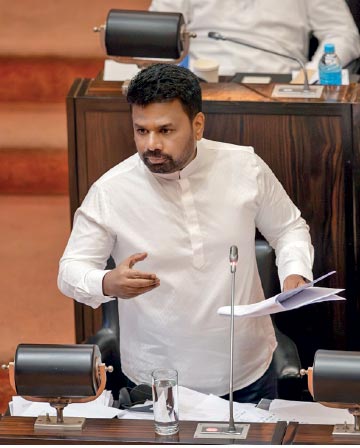
President Anura Kumara Dissanayake making a special statement at the Parliament yesterday |
Rejecting calls to present an interim Budget to deal with the post-Ditwah recovery, President Anura Kumara Dissanayake yesterday told Parliament that the Government has presented a Rs. 50 billion supplementary estimate to finance urgent disaster relief, with another to be presented for Rs. 500 billion in January 2026.
He asked MPs to approve the measure, noting that it forms part of a broader package of reallocations to address the scale of economic and social damage.
He also said the Government is in discussions with the International Monetary Fund to increase the size of the next programme tranche and has requested an additional $200 million from the Fund’s Special Drawing Rights window to meet immediate foreign exchange needs.
He said the IMF had proposed postponing Sri Lanka’s fifth review from December to January or February following the disaster.
“In December, we were due to receive a tranche of $ 324 million. We are in discussion to increase that tranche. To increase it, we need both negotiations and time,” he said.
Discussions with the Asian Development Bank are also under way to secure financing for small and medium-scale enterprises affected by the floods and landslides.
The President said Ditwah was the most severe natural disaster in recent decades and that entire villages and families had been affected. “Our aim must be to create a state of higher quality than that which existed for those who lived,” he said. He confirmed that 1.7 million people had been affected, 5,165 houses destroyed and 57,312 partially damaged.
With the Rs. 50 billion supplementary estimate and an existing Rs. 22.2 billion allocation, the Government has Rs. 72.2 billion earmarked for deployment over the next 25 days.
“Along with that, we already have Rs. 22.2 billion. That means we have Rs. 72.2 billion to spend over the next 25 days,” he said. He added that Rs. 10.5 billion had already been released to District Secretaries.
Households will receive Rs. 25,000 to clean and sanitise their homes and a Rs. 50,000 one-off grant to replace essential kitchen equipment.
Families who lost homes to landslides and remain in displacement camps will receive Rs. 25,000 per month for three months, with plans to extend this to six months. Families who lost both homes and livelihoods will receive Rs. 50,000 per month from December to March to secure temporary accommodation.
In agriculture, the Government will provide Rs. 150,000 per hectare for paddy, grains and legumes and Rs. 200,000 per hectare for vegetables.
“Our aim is to prepare this shattered economy to recover. Agriculture is central to that,” he said. Registered livestock farms and SMEs will each receive Rs. 200,000, while registered fishing boats that were destroyed will receive Rs. 400,000 per vessel.
The Treasury will provide Rs. 15,000 for educational materials for affected schoolchildren, supplemented by Rs. 10,000 from the President’s Fund. Compensation for disaster-damaged properties includes up to Rs. 5 million for business premises and Rs. 5 million to rebuild fully destroyed houses.
Families without land will receive land or up to an additional Rs. 5 million to purchase land. Grants of Rs. 1 million to Rs. 2.5 million will be available for partially damaged homes. For each death, the State will provide Rs. 1 million.
The President said the Government would redirect Rs. 40 billion from existing road development allocations and had instructed Provincial Councils to use part of their budgets for affected road networks.
He said 87% of the electricity supply had been restored and critical repairs to the Mahiyanganaya 132 kV transmission line were under way, together with work to restore water and telecommunications systems.
President Dissanayake said the economy had been on a recovery path before the disaster, noting revenue of 15.9% of GDP, a projected deficit of 4.5% and improvements in exports and tourism.
“This (2026) Budget has been prepared with the aim of completing a particular economic strategy. We will not dismantle it,” he said, rejecting calls for an interim budget.
He added that the Government would present a further Rs. 500 billion supplementary estimate to the 2026 Budget and that Parliament would need to meet in December under emergency provisions to consider the immediate estimate now before the House.
He also announced the formation of a Presidential Task Force for reconstruction with seven specialised units and said new legislation would be brought to Parliament to support a multi-year recovery.
Calling for political unity, he said, “At least in the face of this disaster, let us come together around a common policy framework and work to lift the country out of this crisis.” He urged both the Opposition and the private sector to support a three-year national reconstruction effort.