Friday Sep 25, 2026
Friday Sep 25, 2026
Saturday, 20 December 2025 00:39 - - {{hitsCtrl.values.hits}}
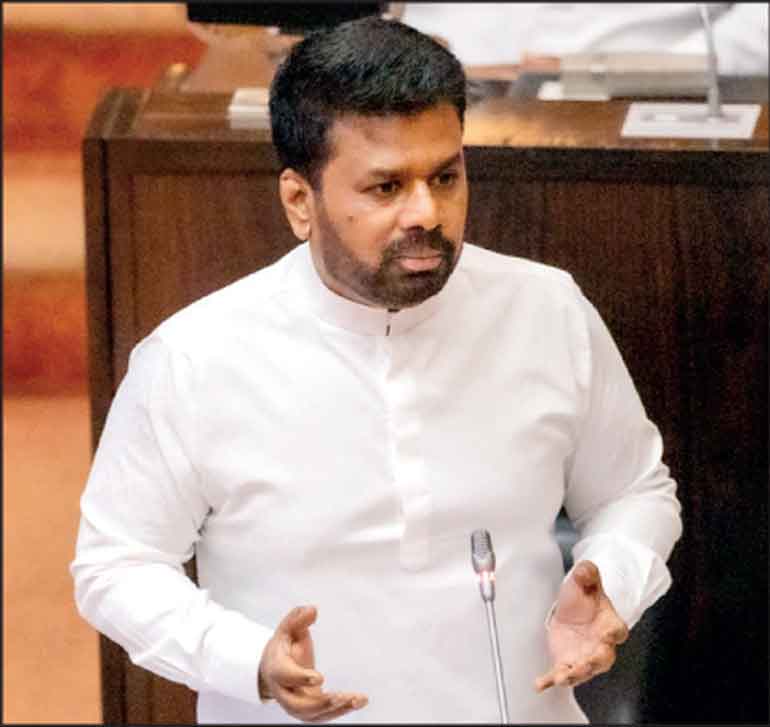
President and Finance Minister Anura Kumara Dissanayake
President and Finance Minister Anura Kumara Dissanayake yesterday sought to counter the alarmists and doomsayers claiming the economy would crash as a result of the additional Rs. 500 billion the Government plans to spend in 2026 on the post-Ditwah recovery.
Pointing to Sri Lanka’s strongest fiscal performance on record, he said it had created the space to deploy the Rs. 500 billion supplementary estimate for post-Ditwah recovery without undermining macroeconomic stability or increasing public debt.
Closing a two-day special Parliamentary session on the supplementary estimate, Dissanayake rejected warnings that the additional spending would trigger economic collapse in 2026, arguing that such claims ignored the scale of fiscal consolidation achieved over the past 14–15 months.
“Will the economy come under stress with the Rs. 500 billion supplementary estimate? As Opposition MP Dr. Harsha de Silva has pointed out many times, the Government has the fiscal space to allocate this sum without adding to the existing debt. We are thankful to him for expressing these sentiments,” he said, adding that the focus should now shift from donations towards attracting investment for recovery as Dr. de Silva had earlier said.
“We agree with this important decision from Dr. de Silva,” the President said.
The President said Sri Lanka had reversed a long-standing pattern of weak fiscal management, under which the Treasury routinely operated on overdrafts carrying interest rates exceeding 30% at times. He noted that Treasury overdrafts stood at Rs. 180 billion in 2017, Rs. 274 billion in 2019, Rs. 575 billion in 2020, and exceeded Rs. 821 billion in 2021.
“I am happy to report that by November 2025, the Treasury had a surplus of Rs. 1.2 trillion,” Dissanayake said. “It is this achievement that has allowed us to allocate Rs. 500 billion to meet the urgent requirements posed by Ditwah.”
He said 2025 had marked several fiscal “firsts” in Sri Lanka’s post-Independence history. Government revenue reached 15.9% of GDP, the highest level since 2007, while the Budget deficit narrowed to 4.5% of GDP, the lowest since 1977. For the first time, annual revenue targets were exceeded, with collections reaching Rs. 5.12 trillion by 5 December, surpassing the Budget forecast of Rs. 4.96 trillion.
“In the entire history of Sri Lanka, this is the first year revenue estimates have been exceeded,” the President said.
Dissanayake also said the Government had broken with past practice by refraining from raising borrowing limits beyond those approved by Parliament. While the 2026 Budget provided for a debt limit of Rs. 3.8 trillion, this had been reduced by Rs. 60 billion, and the Rs. 500 billion supplementary estimate would be accommodated without any increase in the borrowing ceiling.
He highlighted that Sri Lanka recorded a primary surplus of 3.8% of GDP in 2025, the highest ever. “Since 1950, the primary account has been in surplus only six times, and each time it was below 1% of GDP,” he said.
The President said these gains had stabilised an economy that was previously vulnerable even to minor domestic or external shocks. “We inherited an economy where even the smallest shock could lead to turmoil. Over the past 14–15 months, we have carefully managed the economy and placed it on a path of recovery and growth after the debt crisis,” he said.
He noted that Cyclone Ditwah struck during this recovery phase, severely impacting livelihoods, infrastructure and the environment. “If the economy was not in a stable position, we would not be able to deal with the aftermath of Ditwah,” Dissanayake said, while acknowledging that the economy had not yet fully regained the capacity to absorb large shocks.
To support recovery, the Government has mobilised a total of Rs. 700 billion, comprising the Rs. 500 billion supplementary estimate, Rs. 130 billion redirected from capital expenditure and the use of Treasury surpluses. “Prosperity is not about accumulating wealth in the Treasury. It is about investing in citizens and their future,” he said.
Dissanayake said the Government was mindful that injecting Rs. 500 billion into the economy could create inflationary and balance-of-payments pressures, given the import content of domestic consumption and construction activity. He estimated that road construction projects alone carry a foreign exchange component of about 18%.
“When Rs. 500 billion enters the domestic market, demand for dollars will increase. That is only natural,” he said. To mitigate these risks, the Government would carefully sequence spending, appoint a special commission to channel part of the funds towards productivity-enhancing activities, and secure external financing support.
Sri Lanka has requested a $ 200 million Rapid Financing Instrument from the IMF and expects additional assistance from the World Bank and Asian Development Bank. The Government estimates that an additional $ 500 million in external financing will be required in 2026 to avoid balance-of-payments pressures.
The President also said Sri Lanka was on track to record its highest annual foreign direct investment inflows, while tourism earnings were expected to exceed the 2018 record of $ 3.8 billion. Merchandise exports are projected to approach $ 18 billion.
He said the World Bank’s rapid damage assessment on Ditwah, due to be submitted shortly, would provide clearer guidance on the scale and sequencing of reconstruction needs.
“We are careful about how we deploy the Rs. 500 billion. This has been carefully thought through,” Dissanayake said, reiterating that the recovery effort would proceed without reversing fiscal gains or endangering economic stability.
Dissanayake said the Government had already introduced several relief measures to help affected households and businesses recover, but acknowledged that disbursement on the ground could face complexity and delays, as local government authorities and Grama Niladharis would need to make beneficiary decisions based on multiple variables.
Dissanayake also announced a series of relief measures aimed at restoring business activity in cyclone-affected areas. The Government will refinance bank loans of up to Rs. 25 million for large businesses and up to Rs. 1 million for small businesses affected by Ditwah, with funds provided directly to banks.
“The Government will give the funds to the banks. Banks will give the loans to the businesses based on the damage they suffered,” he said, adding that banks would charge an administrative fee of about 2% to 3%, while the Government would not levy any charge. The financing will be provided as working capital.
Small businesses will receive between Rs. 250,000 and Rs. 1 million, while industries registered with the Ministry of Industries will receive Rs. 200,000. Businesses with damaged buildings will receive Rs. 500,000 without assessment, with the option to forego this amount and apply for up to Rs. 5 million following a damage assessment if reconstruction needs are higher. Unregistered small businesses that lost stocks or structures will also receive grant assistance.
The President said a final decision on implementation would be taken following discussions with district secretaries scheduled for Saturday.
In addition, Dissanayake announced compensation measures for poultry farmers, following heavy losses caused by Cyclone Ditwah. The Government will compensate farmers Rs. 500 per dead layer chicken, up to a maximum of 2,000 birds or Rs. 1 million per farmer, and Rs. 250 per dead broiler chicken, up to a maximum of 4,000 birds or Rs. 1 million.
He also announced a Rs. 10,000 compensation payment for free-range backyard poultry farmers, along with the provision of new chicks to enable them to resume operations.
Dissanayake said the Government had already introduced multiple relief measures to support affected households and businesses, but acknowledged that disbursement on the ground could face complexity and delays, as local authorities and Grama Niladharis would need to determine eligibility based on multiple variables.


