Friday Nov 13, 2026
Friday Nov 13, 2026
Friday, 13 November 2026 03:46 - - {{hitsCtrl.values.hits}}
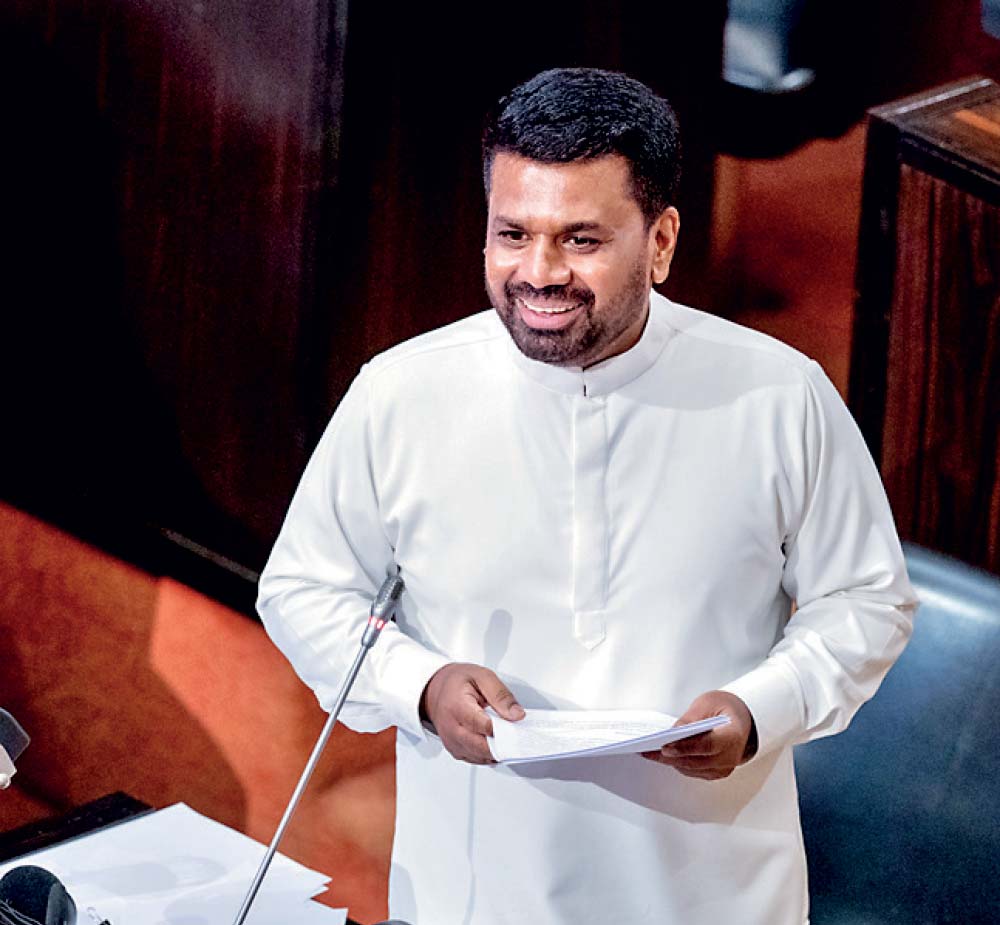
President and Finance Minister Anura Kumara Dissanayake smiles during the presentation of Budget 2027 in Parliament yesterday
 President and Finance Minister Anura Kumara Dissanayake yesterday in Parliament presented Budget for 2027, touted by many as a ‘Budget for all,’ and the ‘best Budget’ by any recent Government.
While the Budget raises total spending by Rs. 624 billion to Rs. 7.9 trillion, it spreads the increase across investment, manufacturing, agriculture, renewable energy, ports, aviation, railways, micro, small and medium enterprises (MSMEs), women-led business, disability access, education, and digitalisation, alongside a cut in personal income tax.
The 81st Budget, his National People’s Power (NPP) Government’s third, carries over 80 expenditure proposals against about a dozen revenue measures, and sets out the trade-off in plain terms: the primary surplus falls to 2.3% of GDP, or Rs. 890 billion, from 3.6%, and revenue slides to 15.8% of GDP from 16.5%, below the Government’s own 16% floor.
“A country’s Budget is not just an accounting exercise,” Dissanayake said, reprising the formulation he used last year. “Our expectation is to make it a Budget that strengthens the production economy, protects small and medium-scale industrialists, makes room for investment, connects knowledge and technology to the economy through digital economic activities, protects the environment, and ensures social justice.”
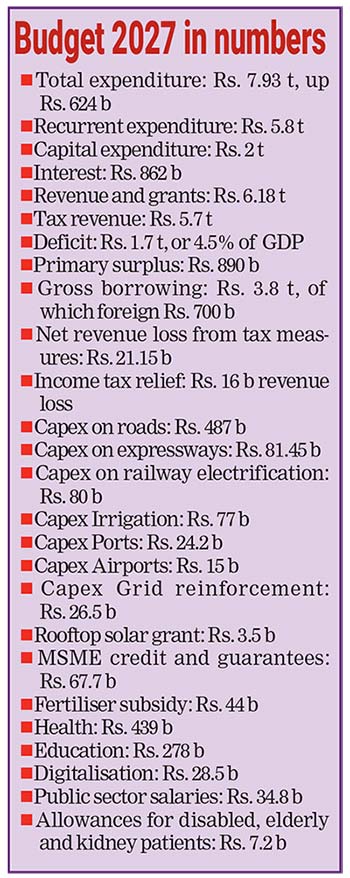
Total revenue and grants are estimated at Rs. 6.2 trillion, up Rs. 199 billion on the revised 2026 figure of Rs. 5.98 trillion, with tax revenue at Rs. 5.7 trillion.
 Expenditure rises to Rs. 7.9 trillion from Rs. 7.3 trillion, of which recurrent spending is Rs. 5.8 trillion, capital spending Rs. 2 trillion, or 5.12% of GDP, and interest Rs. 862 billion. The deficit widens to Rs. 1.75 trillion or 4.5% of GDP from Rs. 1.3 trillion and 3.7%, and gross borrowing to Rs. 3.8 billion, including Rs. 700 billion in foreign financing.
Primary expenditure climbs to 13.6% of GDP, which the President attributed to Cyclone Ditwah reconstruction, before reverting to 13% in 2028. The Budget confirms Rs. 500 billion in supplementary provision for the cyclone and carries Rs. 260 billion of it into next year.
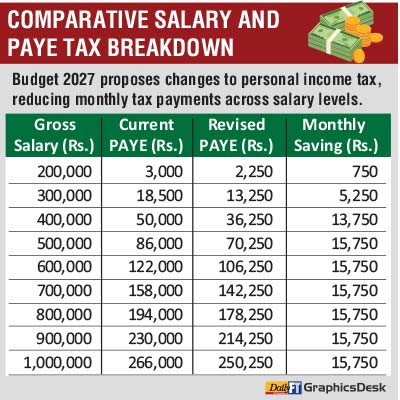
The revenue measures are dominated by relief. The personal income tax free threshold rises to Rs. 162,500 a month from Rs. 150,000, the annual exemption to Rs. 1.95 million, bands are reset to 6%, 12%, 18%, 24%, 30%, and 36%, and maximum relief rises to Rs. 36,250 a month.
The measure amounts to a revenue loss of Rs. 16 billion. The Special Commodity Levy on imported sprats falls to Rs. 10 a kilogramme from Rs. 100, on dried fish to Rs. 10 from Rs. 302, and on sugar by Rs. 50 from 13 November. CESS is cut 25% on some 800 Harmonised System (HS) codes and phased out over two years at Rs. 10,000 million. The Ports and Airports Development Levy goes on paper and solar batteries, Value Added Tax (VAT) is exempted on books and periodicals at Rs. 2.9 billion, and the Tourism Development Levy is abolished.
Investment promotion is the largest single thrust. Board of Investment (BOI) enterprises committing at least $ 3 million in export manufacturing or tourism receive a 200% enhanced capital allowance, double the present rate. A Treasury-owned promotion company staffed by private sector and foreign professionals takes Rs. 1.5 billion, the National Single Window for Trade Rs. 2 billion, and Customs scanners Rs. 1 billion. A National Quality Infrastructure agency is to be formed.
 Energy spending centres on grid stability, with Rs. 26. 5 billion for synchronous condensers at Habarana and Mannar and a STATCOM at Padukka, backed by the World Bank. Battery storage rises to 560 MW from 160 MW, rooftop solar with storage attracts Rs. 25,000 a kilowatt to 10 kilowatts at Rs. 3.5 billion overall, and the Kilinochchi to Habarana 400kV line takes Rs. 500 million with $ 150 million sought from the Asian Infrastructure Investment Bank (AIIB). Wind and solar parks are planned at Mannar, Pooneryn, and Siyambalanduwa.
Ports take Rs. 24.2 billion. The West Container Terminal II is to be built to 3.2 million Twenty-Foot Equivalent Units (TEUs) with Asian Development Bank (ADB) and World Bank finance, a logistics centre goes to Request for Proposals (RFPs) within two months, and bunkering capacity grows by 50,000 cubic metres on build-operate-transfer terms. Trincomalee gets Rs. 1.3 billion and the Kankesanthurai passenger terminal Rs. 2 billion. At Katunayake, Terminal 1 expands to 9 million passengers at Rs. 15 billion with the Japan International Cooperation Agency (JICA), while Mattala, carrying accumulated losses above Rs. 70 billion, is offered to international operators.
Rail electrification takes Rs. 80 billion million for the Kelani Valley, Main and Coastal lines, plus Rs. 1.2 billion million for the project. Roads absorb Rs. 487 billion, including Rs. 53.5 billion for Kadawatha to Meerigama and Rs. 30 billion for Nittambuwa to Pasyala.
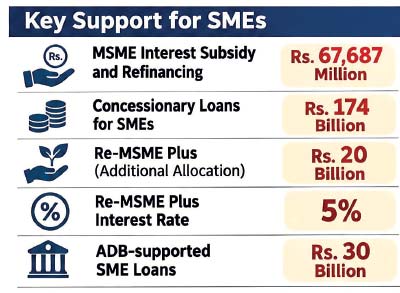
MSMEs receive Rs. 67.7 billion in subsidised credit and guarantees expected to mobilise Rs. 174 billion in lending, with RE-MSME PLUS adding Rs. 20 billion at 5%. Women-headed households get group loans to Rs. 1 million at 3% through Samurdhi banks, with Rs. 200 million in seed subsidy and Rs. 12.5 billion in expected lending. Persons with disabilities get Rs. 150 million for assistive devices, Rs. 200 million for transport, and focal points in every Ministry. Allowances for the disabled, elderly, and kidney patients rise Rs. 2,500 to Rs. 12,500.
Education takes Rs. 278 billion, including Rs. 96.5 billion for a five-year digital program, and Mahapola rises to Rs. 20,000. Digitalisation is budgeted at Rs. 28.5 billion. Irrigation gets Rs. 77 billion, fertiliser Rs. 44 billion at Rs. 30,000 a hectare, northern fishing harbours Rs. 5 billion, and rural water Rs. 85 billion. Health takes Rs. 439 billion, including 6,534 new staff and Rs. 3 billion for ambulances.
President Dissanayake flagged El Niño, expected by the World Meteorological Organisation to peak in February 2027, as a risk to food and hydropower, and closed with a challenge to the Opposition. “Govern the Government. Question our policies. Produce a better program than ours,” he said, adding that the sacrifices borne through the crisis should not be made permanent.
See Full Budget 2027 Speech and Proposals in DFT2 pull-out


