Monday Sep 21, 2026
Monday Sep 21, 2026
Monday, 21 September 2026 04:02 - - {{hitsCtrl.values.hits}}
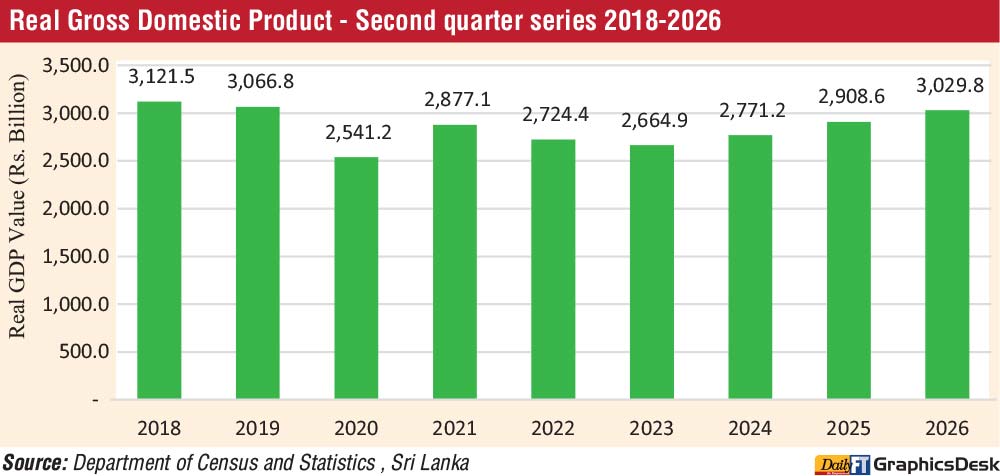
Sri Lanka’s real Gross Domestic Product (GDP) for the second quarter of 2026 remained below the level recorded in the same quarter of 2019, seven years and a pandemic, an economic crisis, and a debt default later, according to Department of Census and Statistics (DCS) data on GDP at constant 2015 prices.
Real GDP for 2Q, measured at constant 2015 prices to strip out the effect of inflation, rose 4.2% year-on-year (YoY) to Rs. 3.03 trillion, the DCS said in its Summary Indicators for the Second Quarter of 2026.
That compares with Rs. 3.07 trillion recorded in 2Q 2019, the last comparable pre-crisis period, meaning quarterly output remains around 1.2%, or approximately Rs. 37 billion, below where it stood before the pandemic.
The shortfall reflects the scale of the disruption the economy absorbed in the intervening years. Real GDP for the quarter fell 17.1% in 2020 as COVID-19 lockdowns halted economic activity, before rebounding 13.2% in 2021.
The rebound proved short-lived: real GDP contracted a further 5.3% in 2022 and 2.2% in 2023, as Sri Lanka’s economic crisis and subsequent debt default took hold. Growth resumed in 2024, at 4%, before accelerating to 5% in 2025 and easing slightly to 4.2% in the quarter under review.
Over the full 11-year span, real GDP for the second quarter has grown from Rs. 2.72 trillion in 2015 to Rs. 3.03 trillion in 2026, a cumulative increase of around 11.2%.
Expressed as a compound annual growth rate, this works out to under 1% a year over the period, underscoring how little net ground the economy has gained since 2015 once the pandemic and crisis years are factored in.
Despite the accumulated toll of the pandemic, the economic crisis and, more recently, the Middle East conflict’s impact on oil prices and tourism, the economy has continued to expand each year since 2024.
The Central Bank of Sri Lanka (CBSL) is projecting growth of 4-5% and the International Monetary Fund (IMF) is projecting 3% for 2026 as a whole, rates economists consider healthy given the scale of the disruptions the economy has weathered over the period.
The DCS data show Gross National Income (GNI) followed a similar pattern, rising 4.2% YoY to Rs. 2.96 trillion in 2Q, against Rs. 2.68 trillion in the corresponding quarter of 2015.


