Sunday Sep 13, 2026
Sunday Sep 13, 2026
Friday, 23 January 2026 00:00 - - {{hitsCtrl.values.hits}}
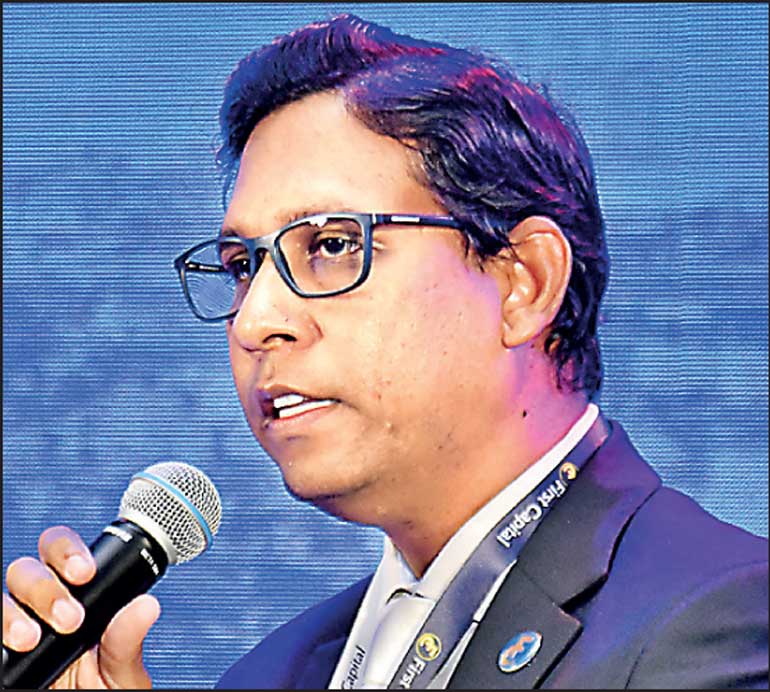
Chief Research and Strategy Officer Dimantha Mathew
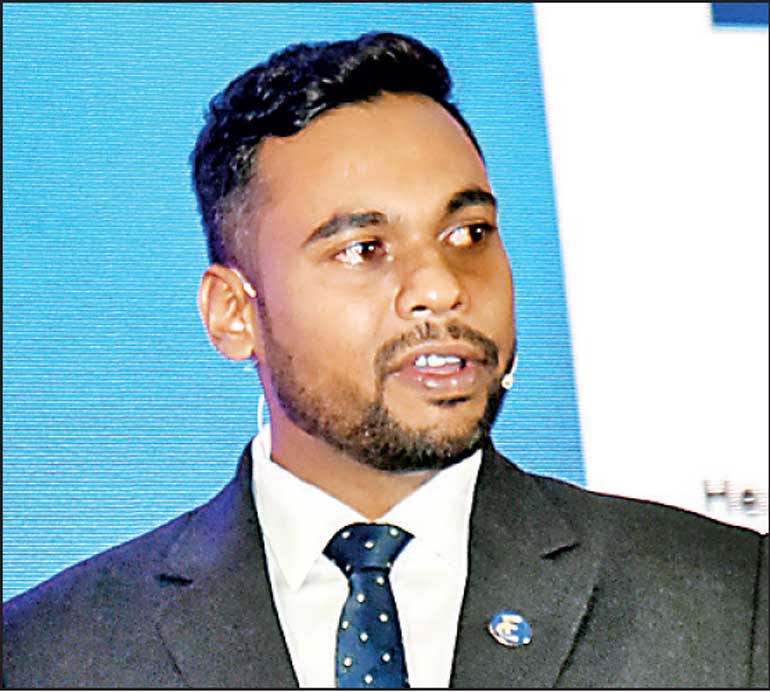
Assistant Vice President – Research Ranjan Ranatunga
First Capital Holdings PLC yesterday cautioned that Sri Lanka’s debt concerns are re-emerging as economic growth moderates, stressing that fiscal discipline alone will not be sufficient to stabilise debt dynamics without faster structural reforms and stronger Foreign Direct Investment (FDI) inflows.
Releasing its ‘Investment Strategy: Jan 2026 – Sri Lanka’ report at its annual investor forum, First Capital said GDP growth is expected to slow to 3-4% in 2026 and 2027, down from an estimated 4-5% in 2025, reflecting weaker consumer spending, limited reform momentum, and the economic impact of Cyclone Ditwah.
First Capital Holdings PLC Chief Research and Strategy Officer Dimantha Mathew said Sri Lanka has achieved a measure of macroeconomic stability through aggressive fiscal consolidation, but warned that the economy now faces a critical choice.
“We have achieved stability through some stern fiscal decisions, but now is the time to be more aggressive on the reform side,” he said. “Reforms such as State-owned enterprise (SOE) restructuring, tariff reform, and faster digitalisation, including the digital ID, are measures that can be implemented within months and have a meaningful impact on growth.”
Mathew cautioned that growth slowing to around 3-4% would not generate sufficient momentum to push down debt-to-GDP ratios, particularly as Sri Lanka is unlikely to repeat last year’s large trade surplus that supported reserve accumulation and external debt servicing.
“If growth slows to 3-4%, you are not generating enough GDP growth to reduce debt ratios,” he said. “At the same time, the trade surplus we had last year is unlikely to be there again, which creates pressure on reserves, the currency and interest rates.”
Providing the macro outlook, First Capital Holdings PLC Assistant Vice President – Research Ranjan Ranatunga said that under a 3-4% growth scenario, Sri Lanka’s debt-to-GDP ratio would remain above International Monetary Fund (IMF) projections and gradually rise, while sustained growth above 5% would allow debt ratios to decline below IMF targets over the medium term.
He said private sector trade growth, which surged in 2025, is expected to moderate in 2026 as interest rates edge higher and pent-up demand for vehicle imports eases. Imports are forecast to rise with post-cyclone reconstruction activity, while export growth is expected to remain subdued in the near term, widening the trade deficit.
Ranatunga said foreign reserves are expected to increase only gradually to about $ 7.25 billion in 2026 and $ 7.5 billion in 2027, as higher imports, external debt servicing, and currency depreciation limit the Central Bank of Sri Lanka’s (CBSL) ability to accumulate dollars. The rupee is projected to depreciate by around 5% in 2026, with the exchange rate expected to range between Rs. 310-320 per dollar in the first half of the year and Rs. 320-330 in the second half.
On interest rates, he said the Average Weighted Prime Lending Rate (AWPR) is forecast to remain at 9-10% in the first half of 2026 before rising to 10-11% in the second half, reflecting tighter liquidity, elevated private sector credit growth, and upward pressure on government securities yields. Market bond yields are expected to rise by 50-100 basis points over the next 12 months.
Ranatunga said remittance inflows, which reached a record $ 8.076 billion in 2025, are expected to rise to about $ 8.7 billion in 2026, providing partial support to the balance of payments. Tourism arrivals are projected to recover to around 2.7 million in 2026, with earnings estimated at $ 3.5 billion, although income growth is expected to lag arrivals due to lower per-capita spending.
On equities, First Capital maintained its ASPI fair value for December 2026 at 21,000-22,000, based on expected earnings growth of 17% in 2026 and valuations in line with the market’s long-term average price-earnings multiple. The firm said it has reduced its recommended equity allocation to 85% from 100%, citing more moderate earnings growth and rising macro risks.
Ranatunga said First Capital assigns a 70% probability to a low-growth “snail pace” scenario, driven by slow reform progress, and a 30% probability to a higher-growth outcome supported by accelerated reforms and stronger FDI inflows.
“The difference between these outcomes is reforms,” he said. “Without faster progress on land, trade and entrepreneurship reforms, growth remains constrained. With reforms, Sri Lanka can move to a higher growth path and place debt on a more sustainable trajectory.”


