Friday Apr 24, 2026
Friday Apr 24, 2026
Friday, 24 April 2026 05:43 - - {{hitsCtrl.values.hits}}
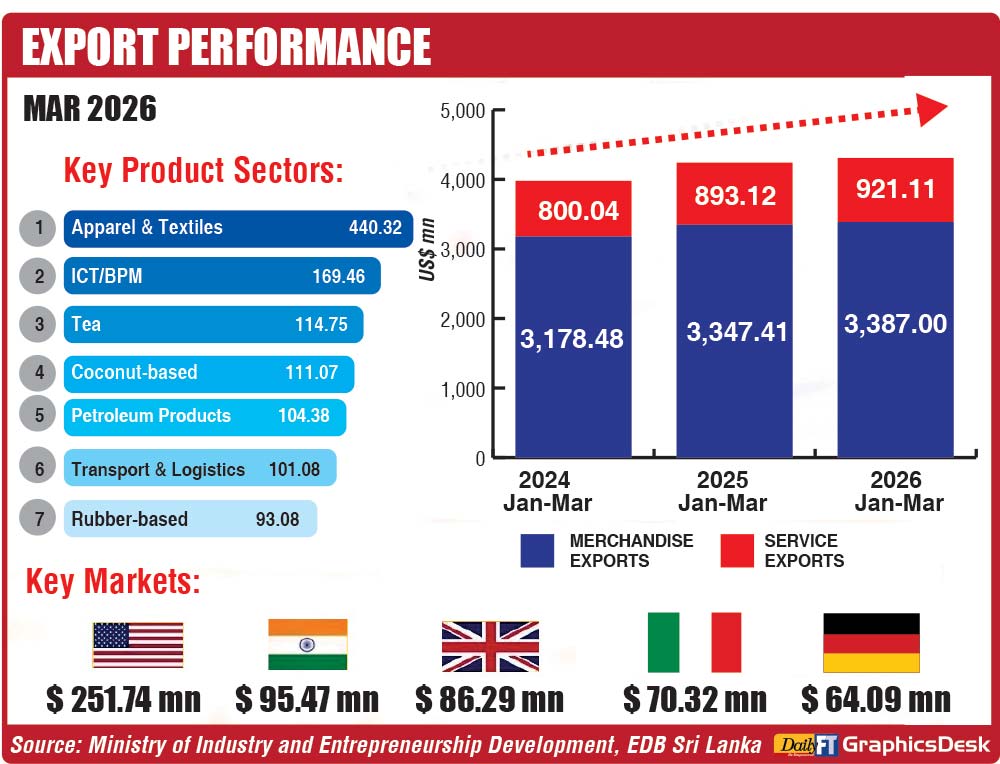 Sri Lanka’s total export earnings registered a modest increase in the first quarter of 2026, reaching over $ 4.3 billion, up 1.6% year-on-year (YoY), according to the Sri Lanka Export Development Board (EDB).
Merchandise exports in 1Q rose 1.2% YoY to exceed $ 3.3 billion, while estimated services exports grew at a faster pace of 3.13% YoY to $ 921.11 million, reflecting resilience in sectors such as ICT/BPM, construction, financial services, and logistics.
However, the overall performance was weighed down by a sharp decline in March. Total exports for the month fell 5.2% YoY to over $ 1.46 billion, as escalating geopolitical tensions linked to the US-Israel war on Iran disrupted global trade flows.
Industry sources pointed to the closure of the Strait of Hormuz as a key factor, causing significant shipping delays and rerouting of cargo. Some consignments already in transit were diverted or even discharged midway, affecting export volumes.
March merchandise exports decreased by 4.94% YoY to over $ 1.18 billion. Services exports also declined in March, falling 6.26% YoY to $ 286.92 million, mirroring the broader slowdown in external demand and logistical constraints.
On a month-on-month (M-o-M) basis too, March exports registered a 10.63% decrease compared to February 2026.
Addressing the media, EDB Chairman and CEO Mangala Wijesinghe described the first quarter outcome as a resilient way towards achieving the country’s annual export targets.
“Overall, the positive performance recorded during 1Q underscores the resilience of Sri Lanka’s export sector. Despite the temporary setback in March, sustained export earnings supported by stable merchandise trade and the increasing contribution of services signal a steady recovery trajectory for 2026,” he added.
Wijesinghe noted that coconut-based exports, electrical and electronic components (EEC), food and beverage, and gems and jewellery, as well as ICT/BPM showed remarkable progress during 1Q.
He said the cumulative growth recorded during January to March demonstrates the sector’s ability to navigate evolving global market conditions. This is supported by sustained demand in key export categories, the gradual strengthening of services exports, and ongoing export promotion and market diversification efforts.
The EDB Chief attributed the decline in March exports to the tensions in the Middle East and its direct impact to increased shipping costs, insurance costs, logistic constraints, and sudden increase in operational costs.
“We remain confident that, with focused policy support and market diversification efforts, Sri Lanka will be able to maintain this positive momentum despite the global headwinds,” he said.
The EDB noted that the moderate merchandise exports growth was driven largely by improved demand across the agricultural and industrial product categories.
As per the data shared by the EDB, apparel and textiles remained the dominant contributor, but the sector saw an 8.06% YoY decrease between January and March 2026, reaching $ 1.27 billion. This contraction was largely driven by weaker demand in key export markets, particularly the US and the European Union (EU), which together account for over 50% of total market share. Exports to the US declined by 6.37%, while shipments to the EU fell by 7.28%. In addition, exports to the UK also decreased by 7.93%, further contributing to the overall sectoral downturn.
Earnings from coconut-based products, processed food and beverages, and EEC increased by 20.85%, 26.05%, and 44.18%, respectively, during 1Q 2026 compared to the corresponding period in 2025.
Export earnings from coconut and coconut-based products rose significantly by 20.76 % to $ 314.09 million during January-March 2026 compared to the same period last year. This performance was supported by growth across all major coconut product categories, including coconut kernel products (21.05 %), fibre products (0.04%), and shell products (52.68%).
The sector’s strong performance was primarily driven by increased export earnings from coconut oil (34.97%), desiccated coconut (35.07%), coconut cream (37.27%), liquid coconut milk (12.63%), and activated carbon (46.8%), reflecting sustained global demand and continued value addition within the industry.
Food and beverages export earnings increased by 26.05% YoY to $ 174.5 million during the period January to March 2026, supported by a strong performance in processed food exports, which grew by 35.85% to reach $ 78.44 million.
Meanwhile, earnings from exports of EEC increased by 44.18% YoY to $ 142.02 million during 1Q. This growth was driven by strong performance across key product categories, including electrical transformers (+41.73%), insulated wires and cables (+35.9%), and switches, boards and panels (+22.22%). In addition, exports of boilers and piston engines also contributed to the upward trend, reaching $ 16.28 million, reflecting a notable increase during 1Q 2026.
Export earnings from seafood increased by 30.93% to $ 63.16 million during January-March 2026 compared to the same period in 2025. This growth was driven by strong performance in key product categories, including frozen fish (+17.56%) and fresh fish (+106.27%), reflecting improved export volumes and stronger market demand.
However, major agriculture exports witnessed a noticeable decline during 1Q 2026. Earnings from tea exports decreased by 5.22% YoY to $ 351.58 million during January-March 2026. This decline was mainly driven by weaker performance in key product categories, with Bulk Tea exports falling by 9.3% and Tea Packets decreasing by 4.98%, compared to the corresponding period in 2025.
Export earnings from rubber and rubber finished products recorded a marginal decline of 0.96% to $ 248.86 million during 1Q 2026 compared to the same period in 2025. This slight decrease was primarily attributed to reduced exports of industrial and surgical rubber gloves, which fell by 9.2%, exerting downward pressure on overall sector performance.
In addition, export earnings from spices and essential oils recorded a marginal decline of 5.38% YoY to $ 112.63 million during January-March 2026. This decrease was mainly driven by the weak performance of key product categories, particularly pepper (-45.9%) and cloves (-77.36%), which significantly impacted overall sector earnings.
On the services side, ICT/BPM and financial services showed positive growth during the first quarter months with increases of 31.15% YoY to $ 468.72 million and 38.23% YoY to $ 17.87 million, respectively.
The stable 1Q figures build on the positive trajectory recorded in 2025. Sri Lanka’s total export earnings reached over $ 17.25 billion last year, marking a 5.6% YoY increase and achieving nearly 95% of the $ 18.2 billion export target.
For 2026, Sri Lanka has set an ambitious export revenue target of $ 20 billion, reflecting an anticipated YoY growth of 10-12%. Merchandise exports are expected to exceed $ 15.7 billion in 2026, while services exports are projected to rise to $ 4.3 billion.
“These projections form part of a broader roadmap to boost Sri Lanka’s export earnings to $ 36 billion by 2030, comprising $ 25 billion from merchandise exports and $ 11 billion from services. The strategy prioritises scaling up value-added exports, expanding market access, and accelerating services-led growth alongside traditional goods exports,” he added.
Among the top 15 export markets, India, China, Italy, Belgium, and Japan demonstrated positive YoY growth both in March 2026 and cumulatively for the January-March period, indicating emerging market resilience.
The US, the largest single export destination for Sri Lanka accounting for around 22% of total merchandise exports, registered a decline of 8.42%, reaching $ 251.74 million in March 2026. Cumulative exports for the period January to March 2026 also registered a marginal decrease of 3.38%, amounting to $ 749.38 million compared to the corresponding period in 2025.
India consolidated its position as Sri Lanka’s second-largest export destination, surpassing the UK, with exports growing by 12.02% to $ 287.49 million during January-March 2026, despite a marginal increment in March 2026. Meanwhile, exports to the UK declined by 5.84% to $ 235.73 million over the same period, reflecting weaker performance in this key European market.
The United Arab Emirates (UAE), which has consistently ranked among the top 15 export destinations in recent years, registered a notable decline of 11.83% during the period from January to March 2026. This negative trend further intensified in March 2026, with a YoY contraction of 72.6% in monthly export performance, primarily attributable to geopolitical tensions between the US and the Gulf region.
Exports to the EU, which represent 25.5% of Sri Lanka’s total merchandise exports, increased by 8.73% in March 2026. Similarly, during the cumulative period from January to March 2026, they increased by 5.07%. Exports to the top five EU markets were recorded as; Italy $ 175.21 million (up by 14.67%), Germany $ 168.38 million (decreased by 7.24%), Netherlands $ 105.16 million (down by 7.10%), France $ 64.59 million (decreased by 0.83%), and Belgium $ 62.43 million (up by 5.46 %) during the cumulative period of January to March 2026 in comparison to the corresponding period in 2025.