Saturday Oct 17, 2026
Saturday Oct 17, 2026
Wednesday, 13 May 2026 04:45 - - {{hitsCtrl.values.hits}}
By Subhashi Tania de Silva
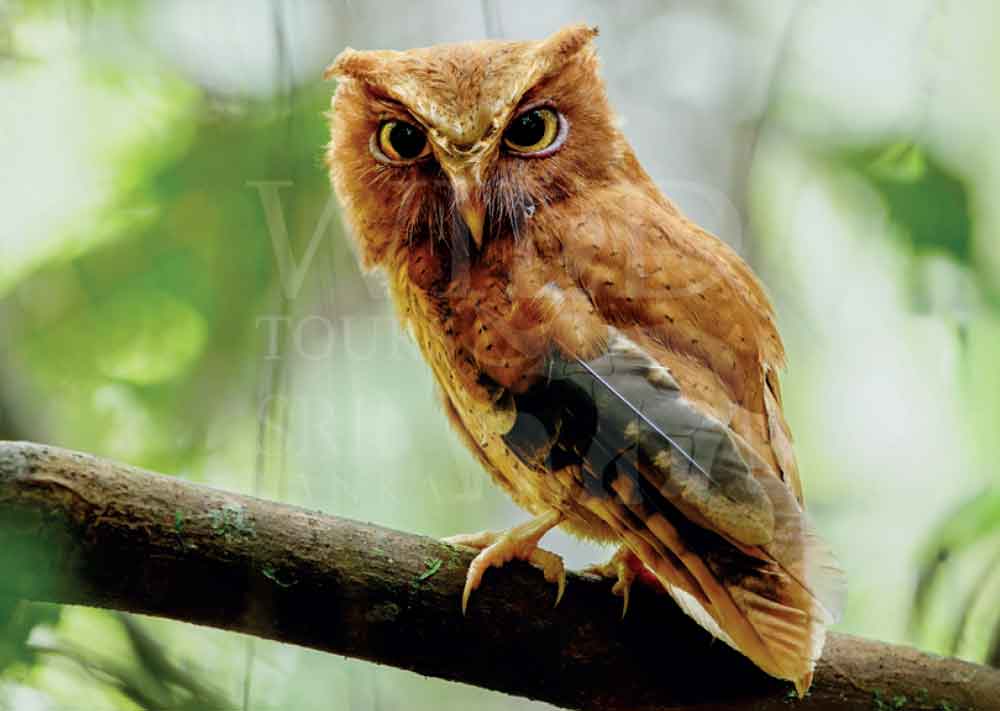
In the dense, shadowed understorey of Sri Lanka’s lowland rainforests, a quiet, almost ghost-like presence continues to evade scientific certainty. The Serendib Scops-Owl, one of only two owl species endemic to the island and a bird immortalised on the country’s Rs. 20 currency note, remains among the least understood avian species in South Asia.
First formally described to science as recently as 2004 by the renowned Sri Lankan ornithologist Deepal Warakagoda and the expert American ornithologist Pamela Rasmussen, the owl’s discovery itself was a remarkable event. Its existence had gone unnoticed for decades, largely due to its cryptic plumage, nocturnal habits, and a soft, easily overlooked call that blends into the forest soundscape.
More than two decades later, the species remains scientifically underexplored. Beyond the initial post-discovery expeditions, there has been no comprehensive long-term study examining its ecology and conservation needs. This gap is particularly concerning given its precarious conservation status.
According to the IUCN (International Union for Conservation of Nature) Red List assessment, the Serendib Scops-Owl is currently classified as Endangered, with an estimated population of just 400 to 1,000 mature individuals and a slowly declining trend. Its distribution is restricted to a handful of fragmented localities within Sri Lanka’s wet zone, including Sinharaja Forest Reserve, Kitulgala Forest Reserve, Morapitiya-Runakanda, Kanneliya, and Eratna-Gilimale, making it highly vulnerable to habitat disturbance.
Against this backdrop, a new undergraduate-led research initiative is seeking to bridge critical knowledge gaps surrounding the species. Conducted under the Department of Zoology at the Open University of Sri Lanka, the project brings together a team of young researchers led by final year undergraduate Lasal Rathnasooriya working under the supervision of Prof. Saminda Fernando and Dr. Sandun Bandara.
The study is supported by HawkWatch International, a US-based organisation dedicated to the conservation of birds of prey worldwide. Research permits have been formally issued by both the Department of Forest Conservation and the Department of Wildlife Conservation, underscoring the project’s national significance.
Fieldwork is currently centred in the Sinharaja and Kitulgala forest reserves, key habitats where the owl has historically been recorded. The researchers are investigating three primary areas, how the species interacts with environmental pressures, factors influencing its habitat selection , and its spatial ecology, including territory size and home range.
However, detailed empirical data on movement and habitat use of this species remain scarce.
A notable aspect of the project is its strong community engagement component. Researchers are working closely with local residents in the Runakanda - Athwelthota area, who play a vital role in facilitating fieldwork. Villagers assist in navigating dense forest terrain, especially during nocturnal surveys and help locate the owls by following their distinctive calls.
In an effort to support breeding studies, the team has also installed a series of artificial nest boxes within the forest. The initiative reflects a proactive attempt to understand nesting preferences and reproductive behaviour, an area where virtually no published data exists.
Despite being found within protected areas, this species continues to face subtle but persistent threats. The researchers state that habitat degradation, even at low levels, poses risks to this bird as it shows some remarkable affinity to certain types of vegetation and habitat structures within the forest. They stress that without robust ecological data, it is difficult to design targeted conservation strategies.
Crucially, global assessments have identified the need for precisely the kind of research now being undertaken. The IUCN has explicitly called for improved data on population size, distribution, and habitat trends, highlighting the urgent need for systematic monitoring.
For Sri Lanka, a country celebrated for its rich biodiversity and high levels of endemism, the Serendib Scops-Owl represents both a symbol of discovery and a reminder of how much remains unknown. As this new generation of researchers ventures deeper into the island’s forests, their work may finally begin to illuminate the life of one of its most enigmatic inhabitants.
In doing so, they are not only advancing science but also reinforcing a broader message that conservation begins with understanding and that even in well-studied landscapes, nature still holds secrets waiting to be uncovered.




