Monday Sep 14, 2026
Monday Sep 14, 2026
Friday, 5 December 2025 01:44 - - {{hitsCtrl.values.hits}}

Colombo’s built-up areas have warmed by up to 4°C over the last two decades, according to a study published in the Journal of the National Science Foundation of Sri Lanka, emphasising the urgent need for more green spaces in the city. In response to this growing ecological and social challenge, Dilmah Conservation and the United Nations Global Compact Sri Lanka launched Grey2Green on 22 November—a transformative national movement inviting individuals, communities, organisations, and students to turn concrete “grey” areas into thriving green spaces.
Unlike traditional greening efforts, Grey2Green is not a tree-planting campaign; it is a grassroots, citizen-powered movement seeded by Dilmah. The initiative empowers the public, universities, environmental groups, and institutions to identify neglected rooftops, unused land, industrial sites, and degraded pockets of the city and convert them into ecological oases. To support participants, Dilmah will provide training in urban forestry, tree ecology, landscape planning, and ecosystem management through its expert network, ensuring that each site is restored using sound, sustainable science.
The launch event outlined the program’s vision, goals, and long-term roadmap, opening the door for widespread public involvement.
Grey2Green draws its inspiration from the success of the One Earth Urban Arboretum, where an industrial garment-waste dump was transformed into a green sanctuary, now home to more than 300 trees and shrubs. This pioneering project demonstrates how even the most degraded urban spaces can become biodiverse, restorative landscapes. Grey2Green aims to replicate this model in other parts of Colombo and its suburbs.
At the event, Dilmah Conservation presented its structured six-step method for community-led urban greening that will move from skill development, identifying locations, conducting baselines, greening, and long-term monitoring and maintenance. Speakers stressed that meaningful urban greening extends far beyond planting trees: it is a long-term, data-driven process integrating ecology, engineering, design, and community use.
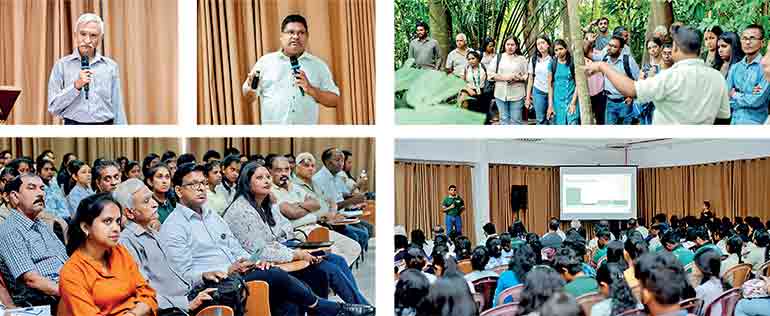
Environmental lawyer Dr. Jagath Gunawardana highlighted the ecological and human value of urban green spaces, describing them as vital refuges for wildlife in an increasingly fragmented city. Encouraging the public to treat urban gardens as “living laboratories,” he noted that four decades of his own observations—from migrant birds to invasive species to dragonflies—were simple yet powerful acts of citizen science. “If we stop seeing green, we will slowly lose our balance,” he reminded the audience. “Nature is not a luxury. It is a necessity.”
Plant taxonomist Dr. Himesh Jayasinghe emphasised the need for careful plant selection, community engagement, and the use of data to identify heat islands and low-canopy areas. “Everyone wants green spaces, but we must also protect them. Leave only footprints,” he advised.
Representing the Central Environmental Authority, Dr. Ajith Gunawardena emphasised that urban greening is now a national priority.
“This is not just planting trees. It’s science in action,” added, Dilmah Tea Manager, Conservation and Sustainability Rishan Sampath who highlighted opportunities for university students and citizen scientists to participate in monitoring, research, and long-term ecosystem management.
Speaking on the global significance of the initiative, United Nations Global Compact Sri Lanka Treshan Galappathy said: “Urban greening is deeply aligned with global sustainability priorities, particularly SDG 11: Sustainable Cities and Communities and SDG 13: Climate Action. Initiatives like Grey2Green demonstrate how collective action can reshape our urban future.”
Ultimately, Grey2Green invites the public to co-create and safeguard vibrant, restorative urban spaces that enhance both environmental resilience and community wellbeing. Dilmah welcomes all who wish to learn about urban greening and contribute to healthier, greener cities to join the movement.




