Friday Oct 16, 2026
Friday Oct 16, 2026
Thursday, 9 July 2026 03:50 - - {{hitsCtrl.values.hits}}
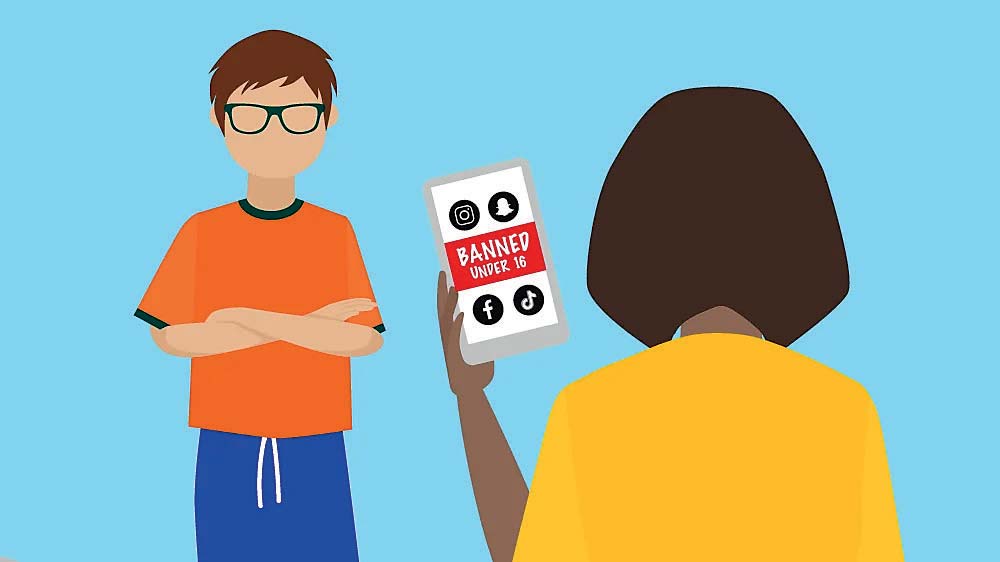

Australia’s decision to ban social media for children under 16 has struck a chord with anxious parents around the world. The concerns behind it are real. Cyberbullying, addictive algorithms, online predators, unrealistic body images, and endless scrolling have left many children less healthy, less happy, and less connected than we hoped the digital age would make them.
Meanwhile, about 73% of teens in Australia are still reported to be on social media and the government is planning tougher measures against social media companies, according to a New York Times report. Why is it so hard to get children off social media.
Loss of physical social space
The uncomfortable answer to why children love social media so much is that society has steadily taken away the physical spaces where young people once formed friendships, experimented with independence, and simply spent time together. Parents worry about safety. Organised activities replace free play. Schools close their gates shortly after lessons end, and homes may feel like isolated prison cells for some children. Whatever the reason, for many adolescents, particularly in cities, social media has become a substitute public square.
Friendships are maintained through Snapchat, Instagram, TikTok, WhatsApp, or Signal because these are the only places where everyone can meet after school. Social media did not create the disappearance of children’s public spaces; it filled the vacuum left behind.
That does not mean today’s platforms are suitable environments for children. They clearly are not. Many have been deliberately designed to maximise attention, encourage compulsive engagement, and reward outrage rather than genuine relationships. Their business model is built around advertising and data collection, not child development.
The solution is not to expel children from their social space but to rebuild the physical space that children have lost.
Schools as safe social spaces for children
Imagine if every public school became a genuine community hub from dawn until dusk. School playgrounds, sports fields, libraries, music rooms, art spaces, and halls could remain open after classes, supervised by community volunteers or youth workers, and supervised by a teacher or two. Children would once again have safe places to meet, play sport, study, rehearse music, build robots, read books, or simply spend time together.
The all-day school concept in some form already exists in elite schools where children have many after-school activities from which to choose. However, In Colombo for example, a school in a poorer part of town would be deserted after school hours, children having returned home often to constricted spaces without much to stimulate them.
Repurposing schools as community spaces would be one of the most cost-effective investments governments could make in children’s wellbeing.
Will more physical social spaces counter peer pressure?
The biggest reason why Australian children continue with social media despite ban is peer pressure researchers have found. The compliers are seen as less popular students. Whether peer pressure to not-comply reduces or increases with a better physical social space, we don’t know. But at least children won’t face pressure in isolation at home, and they will have more options to socialise in real space.
Media and Information literacy training for all is essential
A recent research study by LIRNEasia found that Media and Information literacy to be effective in helping children manage misinformation in any media. Don’t always trust what media tells you, share your doubts openly with somebody you trust, stay curious and explore together are some of the messages they delivered in their training for a sample of students. The study revealed that MIL training was indeed effective. LIRNEasia recommends 1. Integrating MIL into formal education curricula 2. Reinforcing learning through follow-up sessions and 3. Developing targeted MIL content for other parents or caregivers.
Adults should question their own addiction to social media
Training for parents and caregivers should make them question their own social media use.
Much of the discussion assumes that children’s digital habits are a uniquely youth problem. They are not. Children learn from what they see. If parents spend evenings scrolling through phones, watching streaming services, or constantly checking notifications, children receive a powerful lesson about what normal life looks like.
Perhaps the most effective screen-time policy begins not with children but with adults. Parents too should limit their social media activity during family time, and family time may be considered as time from 6pm-10 pm on school days with schools or other community spaces serving as social spaces for children until then.
The debate should therefore move beyond the false choice between unrestricted social media and outright prohibition.
The real challenge is rebuilding the social ecology of family and childhood. We need spaces where children can socialise safely while parents also get time to be themselves, and then parents and children can have quality family time together, in the evenings on school days, for example. (Some parents may feel different, and they should be free to spend as much time as they want with their children.)




