Wednesday May 27, 2026
Wednesday May 27, 2026
Thursday, 2 April 2026 01:30 - - {{hitsCtrl.values.hits}}

Two out of the four supposed crème sides were made to look like mere froths in front of their formidable opponents, to the total dismay of the rugby fraternity, as both semi-finals ended as one-sided affairs in a rather disappointing weekend of rugby here in Colombo. What negatives deemed these sides as “scum” instead of “crème” is the primary focus of this analysis.
Trinity vs Wesley – 28 March:
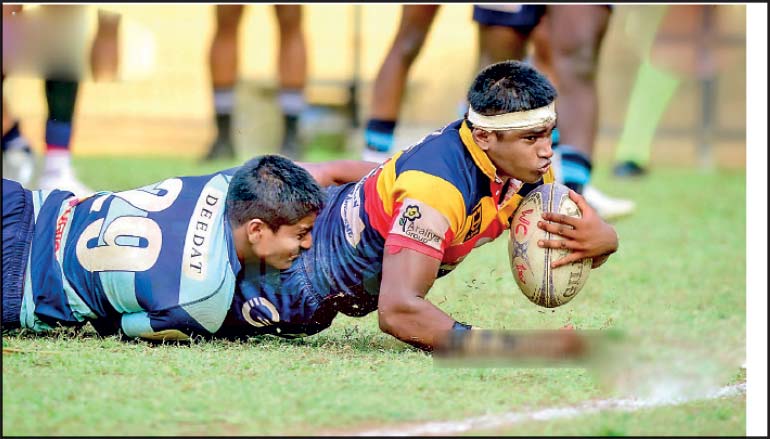
In an awe-inspiring wake up from the dead, Trinity College Kandy pulled their socks up and exhibited a magnificent, catapulting performance of rugby, to fold the Double Blues four times, and packed them home. It was a resurrection indeed, in comparison to the brand of Trinity rugby that we are used to, as opposed to what they had cobbled together in the past two weeks. Finally, spectators were able to witness an untainted version of Trinity Rugby at work, in its complete dominative implementation.
Surprisingly, Wesley’s semi-sluggish form from the weekend prior continued, as some players seemed to struggle in focusing, resulting in many handling errors that cost them dearly. Speedy Gonzales took full advantage of those, and many other shortcomings to zip past the Blue Sonic chanting “Ándale... Ándale... Arriba... Arriba...!” (hurry up, hurry up, and let’s go, let’s go!), to the orbit that was too far to follow.
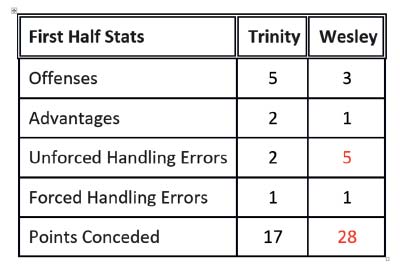
Although the stats are comparable, Wesley’s handling errors occurred at vulnerable points that were used against them to precision.
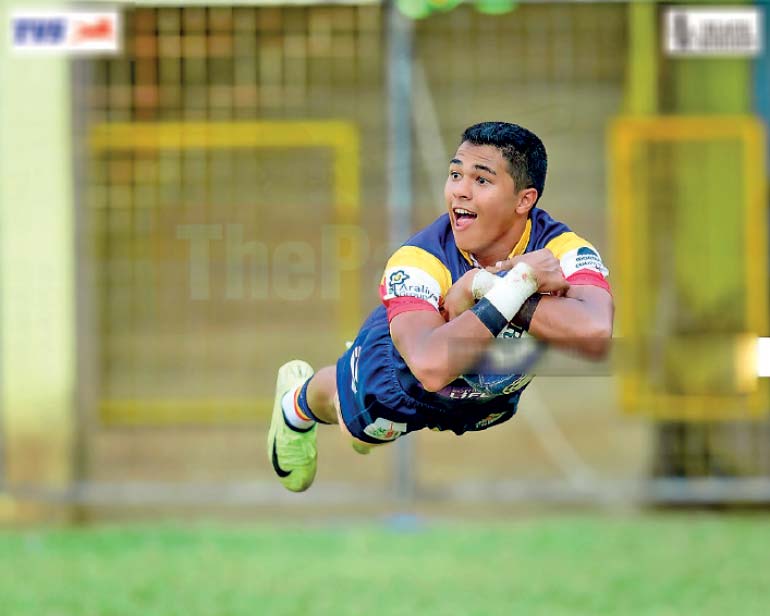
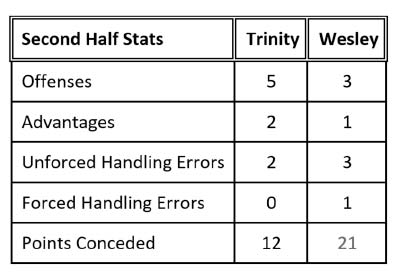
While both teams scored Tries also off spectacular breaks and runs, the game should have been mostly restricted to those plays, considering the high quality of rugby that both sides are capable of. As per the above highlights, we can conclude that Trinity scored two converted Tries by beating Wesley on sheer speed, and slow reaction time. However, four Tries as described above were scored owing to Wesley’s errors that made up 28 points, which made this encounter turn on its head and magnified Trinity to look like Super-Lions. A team can have one bad day, but having two consecutive bad days is something that requires immediate investigation and remediation, as many dedicated enthusiasts were rooting for the Double Blues this time, because they were solid all-round and the most pristine out of the lot.
The above assumption led us to suggest a few tactics for Trinity to adopt owing to their previous shortcomings. However, their League winning coaching crew obviously didn’t wish to form strategies based on their weaknesses, but instead overcame them immediately, and then formulated a new strategy based on their attacking strengths, and that’s how folks, our forecast for this encounter was also turned inside out. Nevertheless, Trinity exposed some critical weaknesses in this game that require further rectification.
Result: Wesley wobble to be knocked out 29-49
Royal vs Isipathana – 29 March:
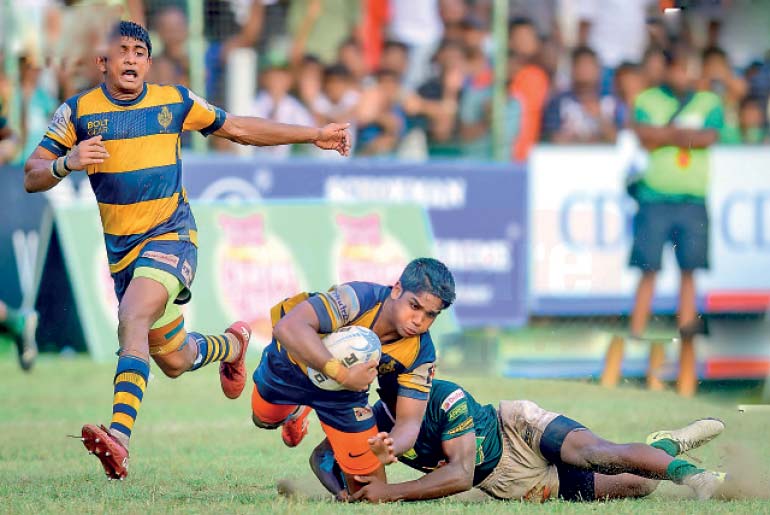
What started off as an intense brawl to reaffirm self-esteem and supremacy, turned out to be a disappointing and completely incompatible class of rugby being played by the two sides. Although the Green Panthers had the drive and passion to arouse their best beast, sadly they were massively underprepared to face an elite team. This is a great concern not only for the Pathana Rugby fraternity, but for all the rugby loving enthusiasts of the Country.
Both teams were under pressure since the game kicked off, as both tried desperately to get out of their grids, which led to a lot of kicking. In fact, the first two Tries scored by both teams were off under pressure clearance kicks, followed by long-haul Maul advances by the respective attacking sides.
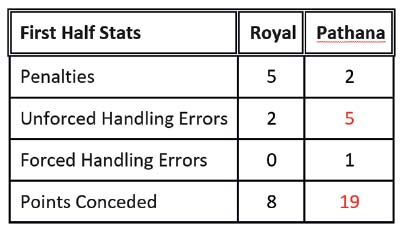
To start off with, the Greens faltered in their ball handling that prevented many Try scoring opportunities. While five unforced errors in the whole game against an elite side is deemed high enough, Pathana couldn’t make it stick in the opening half itself. A couple of knock-ons and passing / receiving errors spoiled at least two attacking opportunities inside Royal’s 22, into which they entered after much effort. One knock-on occurred while grounding a Try. The worst outcome of this for a team like Isipathana is that they lost faith in their ball handling, and settled for 3 points off a penalty that was awarded moments after the aforementioned lost chance. To make matters even worse, Royal attacked from the subsequent restart kick and scored a Try. In games like these, especially when you enter your opponent’s red zone amidst so much resistance, you must think twice if you really want to settle for 3 points, and then allow a fierce attacking outfit like Royal, to re-enter your redzone?
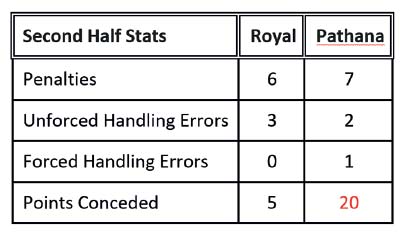
Although the stats are pretty much comparable in the latter half, we find a huge difference in the points conceded, that makes one wonder why? Royal continuously used short and long punts to get past Pathana’s primary defence, following them up with effective chases, that put the Greens’ last points of defences under tremendous pressure, with which the oppressors cake walked into multiple Tries. Other than on a solitary occasion when the Greens managed to collect the high ball, and worked it all the way from inside their 10m to score a Try, most of Royal’s punt kicks assisted their campaign. Moreover, the aforesaid Royal rampage commenced only after they opened scoring in the closing session, owing to a series of blunders by Pathana, that included 2 knock-ons (on Royal’s 25 and 50), and then a “Holding On” offence close to their 5m.
Several critical shortcomings that were noted in the Pathana camp underlines the notion that they were underprepared to face a top tier team.
Conclusion
Something is radically wrong at the higher up, and the Isipathana Rugby Management might have to investigate the cause and rectify ASAP. All of the aforementioned lack of skills and tactical planning is Child’s play for veteran Coach Sanath Martis, hence something is preventing him from executing his duties/plans to perfection. Is this another case of too many Master Chefs in the Kitchen?
Result: Pathana Rugby drops to a lower league 13-39
Pix courtesy www.thepapare.com
(The analyst can be reached at: [email protected].)




