Tuesday Jul 07, 2026
Tuesday Jul 07, 2026
Monday, 6 July 2026 02:10 - - {{hitsCtrl.values.hits}}
 As Sri Lankan schools rugby continues to flourish, the contribution of its commentators deserves greater recognition. Their voices have become part of our sporting memory. Long after the final whistle has blown, it is often a commentator’s words that remain etched in the minds of supporters.Players create the moments. Commentators preserve them for posterity
 For generations, Sri Lankan rugby has been celebrated through thrilling action on the field.
Yet, alongside the players, there has always been another group of individuals who have enriched the experience for thousands of rugby fans —the commentators. Their words have preserved unforgettable moments, educated newcomers to the game, and added colour, emotion and history to every contest.
For those who grew up following schools rugby in the 1960s and 1970s, few names evoke greater nostalgia than the legendary Bob Harvie.
His memorable commentary of Trinity College’s dramatic 1971 Bradby Shield heroics, led by the inspirational Sam Samarasekara, remains one of the defining broadcasts in Sri Lankan rugby. It is understood that transcripts of those commentaries are preserved within the Trinity College archives, standing as valuable historical records of one of the commentator’s greatest chapters. This is all the more significant as records of that era are scarce.
Bob Harvie represented an era when commentary was as much an art as it was a description of play. His ability to capture the rhythm of the game and the emotion of the occasion elevated rugby broadcasting to another level. If one reads that article from Trinity archives one would know how much life is there in that commentary. Any simple Sri Lankan interested in Sri Lankan literature who reads Vijayaba Kollaya will get so emotional to realise the commitment of the Lankan soldier against the Portuguese invader as a live commentary. Bob Harvie makes that commentary a live game in an era where SLBC was the only media available. As much as Vijayaba Kollaya describes the war against the Portuguese this commentator Bob Harvie describes the heroics of the Trinity captain of that year. The transcript alone gives goose bumps!! Sam Samarasekara heroics are extra ordinary that season.
He was followed by a distinguished generation of commentators including Chandrishan Perera, Ajith Abeyratne, S. W. Chang and Dr. Maiya Gunasekara. Each brought a unique style to the microphone.
Chandrishan Perera combined eloquence with an intimate understanding of the game as one of the greatest three quarters of that era.
Ajith Abeyratne’s voice became synonymous with many memorable school and club encounters.
S. W. Chang continues to grace the commentary box even today, demonstrating remarkable longevity and passion for the sport.
Dr. Maiya Gunasekara, respected both within rugby circles and the medical profession, continues to provide insightful expert analysis, enriching broadcasts with tactical observations and technical understanding.
Every generation has been fortunate to inherit commentators who understood that their role extended beyond merely reporting the game. They became teachers, historians and ambassadors for rugby.
Digital revolution and thepapare.com
Today, the digital revolution has transformed sports broadcasting. Live streaming and YouTube have made Sri Lankan school rugby accessible not only across the island but also to thousands of old boys and rugby enthusiasts living overseas. A Bradby Shield encounter or an inter-school league fixture can now be watched simultaneously in Colombo, Melbourne, London, Toronto and Dubai.
This transformation owes much to pioneering digital rugby platforms. Among them, BoaAthu’s Straight Up Rugby has established itself as a thoughtful voice in rugby discussion, offering previews, reviews, player interviews and informed debate. Equally commendable is the London-based rugby community in the vernacular that has a wider reach, whose podcasts and online discussions have helped maintain strong links between expatriate Sri Lankan rugby followers and the local game.
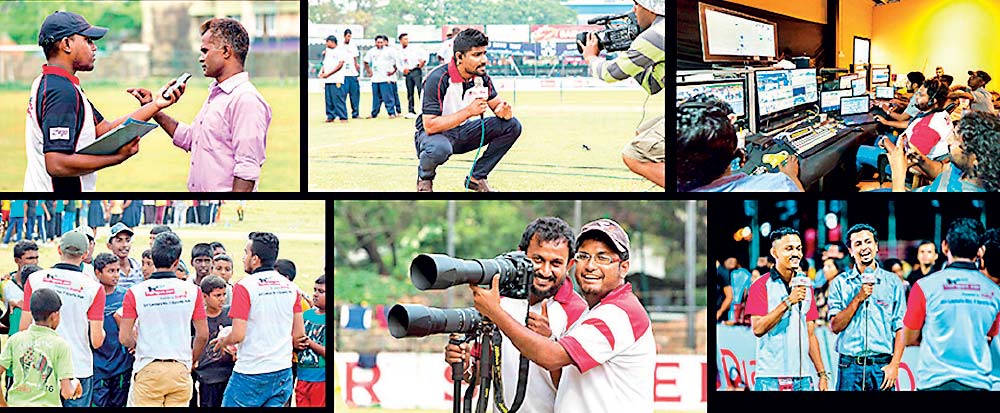
However, no organisation has done more to revolutionise rugby broadcasting in Sri Lanka than ThePapare. Through professional live coverage, multiple camera angles, statistics, highlights, feature programmes and extensive digital distribution, ThePapare has brought schools rugby into a new era, making matches accessible to audiences worldwide.
Central to that success has been its talented panel of commentators.
Shanaka Amarasinghe has become one of the most recognisable voices in Sri Lankan sports broadcasting. His command of English, smooth delivery and ability to build excitement without overwhelming the game have earned him widespread appreciation. He possesses the rare skill of explaining complex passages of rugby in a manner that engages both seasoned followers and first-time viewers. Down side!! No longer is Shanaka the S Thomas rugby captain. He represents the wider rugby community.
Alongside him, Abdella has emerged as a dependable broadcaster, combining clarity with an evident passion for the game. Absolutely independent he gives a balanced commentary of the game far superseding Shanaka.
Together with the wider Papare commentary team, they have developed a professional broadcasting culture that compares favourably with international sports coverage. Abdella is a cut above the rest. Despite his allegiances he is independent.
Behind every successful broadcast lies countless hours of preparation. Commentators study team sheets, research player backgrounds, understand tactical systems, verify statistics and familiarise themselves with school traditions before stepping into the commentary box. The best commentators make this preparation invisible, allowing viewers simply to enjoy the game while benefiting from their knowledge.
Good commentary
Good commentary does more than describe what is happening. It tells the story behind the match. It explains why a defensive pattern succeeds, why a captain chooses touch instead of goal, how rivalries have evolved over decades, and why certain fixtures carry emotional significance far beyond seventy minutes.
As Sri Lankan schools rugby continues to flourish, the contribution of its commentators deserves greater recognition. Their voices have become part of our sporting memory. Long after the final whistle has blown, it is often a commentator’s words that remain etched in the minds of supporters.
Players create the moments. Commentators preserve them for posterity.
From the unforgettable broadcasts of Bob Harvie to the distinguished voices of Chandrishan Perera, Ajith Abeyratne, S. W. Chang and Dr. Maiya Gunasekara, and now to the dynamic digital era led by BoaAthu, the overseas rugby community and the dedicated commentary panel at ThePapare, Sri Lankan rugby has been blessed with storytellers who have brought the game to life.
As another generation of young players write new chapters in the history of schools rugby, it is comforting to know that there will always be voices ready to ensure those moments are remembered—not merely as scores and statistics, but as stories that inspire future generations.



