Saturday Sep 19, 2026
Saturday Sep 19, 2026
Wednesday, 17 December 2025 00:16 - - {{hitsCtrl.values.hits}}
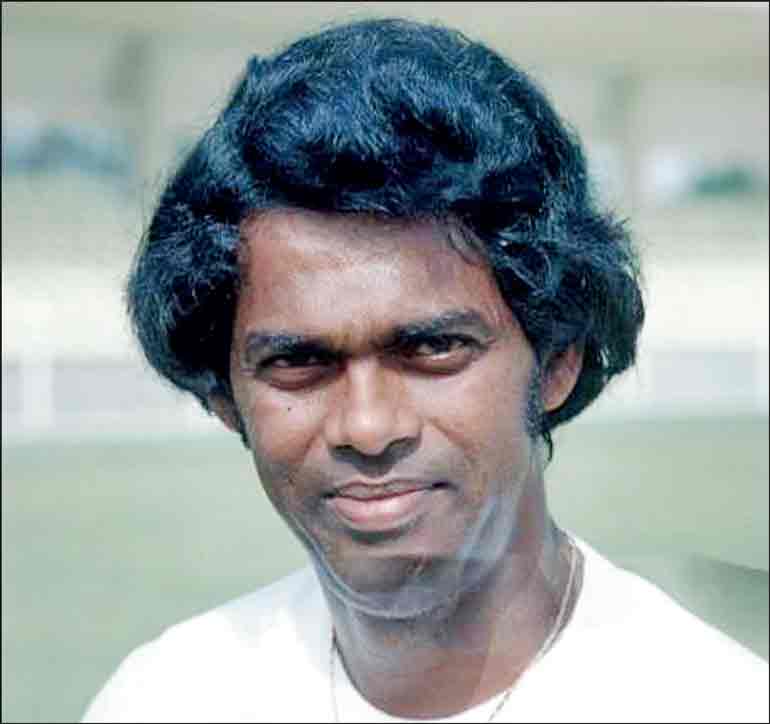
D. Somachandra de Silva
By Sa’adi Thawfeeq
Sri Lanka’s oldest Test cricketer and former Test Captain Dandeniyage Somachandra de Silva (popularly known as D.S. de Silva) has passed away after a brief illness in London at the age of 83.
A right-arm leg-spinner of repute, De Silva was the first Sri Lankan bowler to take a five-fer in a Test – 5/59 against Pakistan at Faisalabad in 1982. He had quite a few unusual records to his name in his career – being the eighth oldest player to take a maiden five-wickets in an innings (at the age of 39 years, 276 days), the seventh oldest Test Captain on captaincy debut (40 years, 266 days) – v New Zealand at Christchurch 1983 and eighth oldest ODI captain on captaincy debut (40 years, 264 days) – v New Zealand at Dunedin 1983.
De Silva was pushed into the captaincy during Sri Lanka’s tour to New Zealand in 1983 as regular Captain Duleep Mendis and his deputy Roy Dias were both injured. It is very unfortunate that by the time Sri Lanka got Test status De Silva was nearing his forties, which naturally shortened his career. He made his Test debut against England in Sri Lanka’s inaugural Test at the P Sara Oval in 1982 at the age of 39 years, 251 days and became the oldest ever Test debutant for his country. His Test debut came at a time when he was way past his prime years, but he managed to play in Sri Lanka’s first 12 Tests before retiring at the age of 42 with 37 wickets (avg. 36.40). With the bat he was more than useful making two half-centuries, both as captain during the series in New Zealand in 1983.
Born in Unawatuna and initially educated at Mahinda College, Galle and then Prince of Wales College, Moratuwa, De Silva was primarily a batsman before changing over to bowling leg-spin, the cricketing discipline with the most demanding apprenticeship. Along with his brothers D.H. de Silva and D.P. de Silva he played for Nomads SC in the P Sara Trophy domestic tournament for several years. He made his Ceylon debut in 1966-67 and played unofficial tests and also in the M.J. Gopalan Trophy, an annual first-class fixture initiated between Ceylon and Madras.
De Silva was part of Sri Lanka’s first World Cup team during the inaugural edition in England in 1975 where he made his ODI debut and was also part of the second World Cup edition as well in 1979 in England where he played a key role in Sri Lanka’s win against India taking 3/29 including the scalps of Dilip Vengsarkar, Mohinder Amarnath and Brijesh Patel. Sri Lanka won the match by 47 runs to become the first associate member country to defeat a full member country. On that tour De Silva returned his best first-class figures when he took 4/13 and 8/46 in the innings victory over Oxford University.
According to De Silva, the 1975 World Cup opened the doors for cricketers like Ashantha de Mel, Ravi Ratnayeke, Tony Opatha, Rumesh Ratnayake, and him, to play league cricket in England. De Silva developed into a thorough professional cricketer and played for Scunthorpe, West Bromwich and Middleton as the team pro and in the Minor Counties for Lincolnshire and Shropshire. He also played for Northshore Geelong and Ringwood in Australian grade cricket.
Two former Sri Lankan captains Michael Tissera and Anura Tennekoon under whom De Silva played paid glowing tributes.
“He was a very good, accurate leg-spin bowler. He was a decent all-rounder good in his batting and fielding but it was his bowling that got him into the Sri Lanka side,” said Tissera. “D.S. didn’t turn the ball much but he had a lot of pace off the wicket and was very accurate. He wasn’t the loopy type of leg-spinner, he bowled flat. He was never a great turner of the ball but with his accuracy he had that ability to skid the ball through that got many batsmen foxed. He had a very professional attitude towards cricket, a leg-spinner quite different to others.”
Anura Tennekoon under whose captaincy De Silva played in the first two Cricket World Cups (1975 and 1979) said, “DS was a very dedicated cricketer, he bowled the fastest leg-spin. He bowled so accurately that eventually most batsmen got tied down to him. As a batsman he was quite good and contributed at times to our cause. A great team man, always played for the team. What stands out is his dedication and being a useful cricketer to the side. He was a very disciplined cricketer.”
After retiring De Silva embarked on a coaching career taking over the Sri Lanka Under-19 team which made the World Cup final in 2000. That year he was appointed chairman of the interim committee to run Sri Lanka Cricket, a position he held till 2012. During his tenure, Sri Lanka were ranked third in the Test rankings and reached two limited-overs World Cup finals. He also served as a national selector.
De Silva’s time with SLC was not without controversy. Under his leadership SLC built stadiums in Pallekele and Hambantota that cost the sports body dearly and ended up with salaries being unpaid to SLC employees and the national cricketers. Although De Silva denied any political influence, at the end of his tenure as interim chairman he was appointed ambassador to Poland.
Sri Lanka Cricket in a statement said De Silva rendered yeoman service to the game of cricket first as a player and later as an administrator and the cricketing community will fondly remember and deeply appreciate his invaluable contributions to Sri Lankan cricket – both on and off the field.
De Silva who was married twice leaves behind two sons Niroshan and Rukshan from his first marriage to Rowena and son Dilshan (who is a Level 3 coach in England) to second wife Sharmini.




