Friday Sep 18, 2026
Friday Sep 18, 2026
Friday, 18 September 2026 00:25 - - {{hitsCtrl.values.hits}}
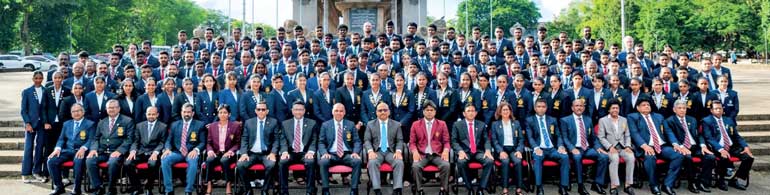
Sri Lankan contingent - 20th Asian Games
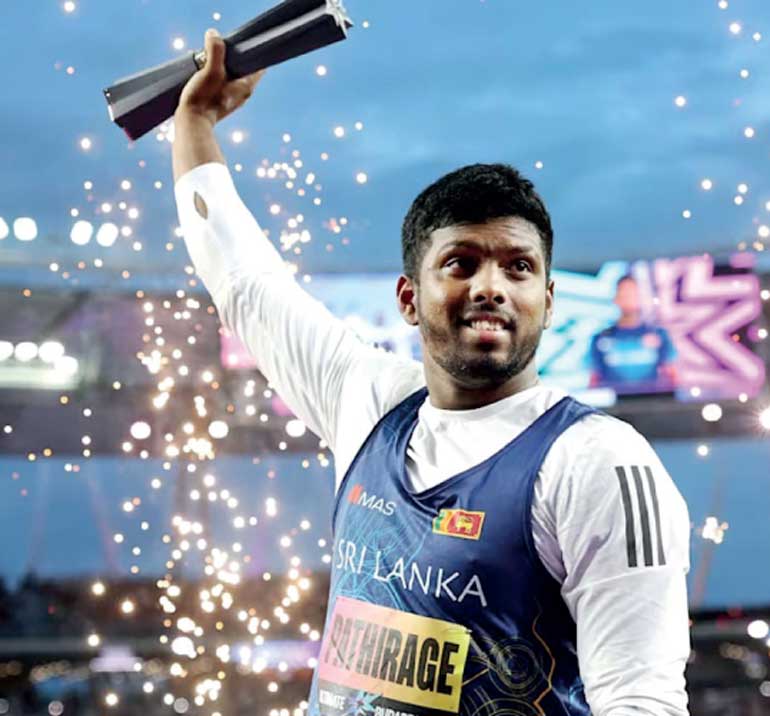
Rumesh Tharanga with The Ultimate Trophy
By Hishan Welmilla
Sri Lanka will send a 156-athlete contingent to the 20th Asian Games in Aichi-Nagoya, Japan, with 100 men and 56 women set to compete across 25 sports. The size of the team provides Sri Lanka with an opportunity to look beyond the traditional medal-winning disciplines and discover new heroes on one of Asia’s biggest sporting stages.
Team Sri Lanka will travel to Japan with a contingent of 156 athletes, comprising 100 male and 56 female athletes, who will compete across 25 sports disciplines.
The Sri Lankan contingent will compete across Aquatics – Swimming and Diving, Archery, Artistic Gymnastics, Judo, Rowing, Rugby Sevens, Table Tennis, Squash, Weightlifting, Wrestling, Basketball 3x3, Wushu, Kabaddi, Beach Volleyball, Athletics, Boxing, Karate, Sailing, Taekwondo, Surfing, Badminton, Cricket, Golf, Modern Pentathlon and Hockey.
The Asian Games begin on 19 September and run until 4 October, bringing together the continent’s strongest sporting nations. For Sri Lanka, the challenge will be considerable, but there are several areas where the contingent can realistically aspire to make an impact.
Athletics carries the biggest individual hopes
Athletics remains central to Sri Lanka’s Asian Games ambitions. Historically, it has been the country’s most successful sport at the Games, producing 11 of Sri Lanka’s 12 Asian Games gold medals. Cricket has supplied the other gold. Sri Lanka has won 51 medals overall at the Asian Games.
The spotlight, naturally, will fall on Rumesh Tharanga Pathirage.
The 23-year-old javelin thrower has emerged as one of the most prominent athletes in world athletics. His recent performances include throws of 92.62 metres in Rome and 92.07m in Zurich, while he also captured the Diamond League Final with 89.04m. World Athletics lists him as Sri Lanka’s leading javelin athlete.
His Asian Games campaign, however, has been complicated by an unusual setback. Three of his key competition javelins were reportedly damaged during air transportation. Those implements were associated with his 92.62m, 92.07m and 91.09m performances.
The equipment problem will therefore be an additional challenge, but Tharanga enters Nagoya with a formidable competitive record and considerable international experience.
Cricket remains a major medal opportunity
Cricket will again be one of Sri Lanka’s major medal avenues. The sport has already produced an Asian Games gold for the country, and the return of T20 cricket gives Sri Lanka an opportunity to use its depth and experience in the shortest format.
The cricket competition also has wider significance for Japan. The country is using the Asian Games to promote the sport, with Sri Lanka among the major cricket nations participating in the tournament.
Rugby Sevens can produce a surprise
Sri Lanka’s rugby Sevens teams have traditionally possessed the speed and attacking ability to trouble stronger Asian opponents. In a short tournament, the format can produce unexpected results, particularly when a team is able to maintain discipline and fitness across successive matches.
A strong start could put Sri Lanka into contention for the latter stages, although the Asian competition remains extremely demanding.
Rowing, badminton and squash
Rowing is another discipline where Sri Lanka will look for individual performances to translate into finals and potential podium opportunities. The sport demands exceptional preparation, and even a place among the leading crews would represent an important benchmark.
In badminton, Sri Lanka’s challenge will be particularly demanding given the strength of countries such as China, Indonesia, Japan, South Korea, India and Chinese Taipei. Nevertheless, the exposure gained by Sri Lankan players against this level of opposition could be valuable for the next generation.
Squash is another sport capable of producing competitive performances. Sri Lanka has a history of producing technically accomplished players, and the Asian Games provide an opportunity to measure that talent against some of the world’s strongest squash nations.
Combat sports and strength disciplines
Sri Lanka’s prospects should not be confined to the headline sports.
Boxing, judo, karate, wushu, wrestling and weightlifting all provide opportunities for athletes to progress through the draw and challenge established Asian competitors.
Combat sports can be particularly unpredictable. A single outstanding performance can change an athlete’s tournament, making these disciplines important to watch even when Sri Lanka enters without the same international profile as the continent’s leading nations.
Sailing also deserves attention. Sri Lanka has previously won an Asian Games silver medal in the sport, demonstrating that the country has the ability to compete at continental level.
The bigger picture
The significance of Nagoya should therefore extend beyond the final medal tally.
Sri Lanka is taking a sizeable group of athletes across 25 disciplines, giving many competitors the opportunity to experience a level of competition that cannot be replicated domestically.
For some, the target will be a medal. For others, reaching a final, establishing a personal best or defeating a higher-ranked opponent could become the foundation for future international success.
And above them all stands Rumesh Tharanga.
If the javelin star can reproduce anything close to his extraordinary 2026 form, his performance could become one of the defining stories of Sri Lanka’s Nagoya campaign. But Sri Lanka’s Asian Games challenge should not be reduced to one athlete.
The 156-member team represents 25 different sporting journeys — and Nagoya could reveal that Sri Lanka’s next generation of Asian Games heroes extends well beyond the javelin runway.




