Tuesday Jun 02, 2026
Tuesday Jun 02, 2026
Tuesday, 2 June 2026 07:43 - - {{hitsCtrl.values.hits}}
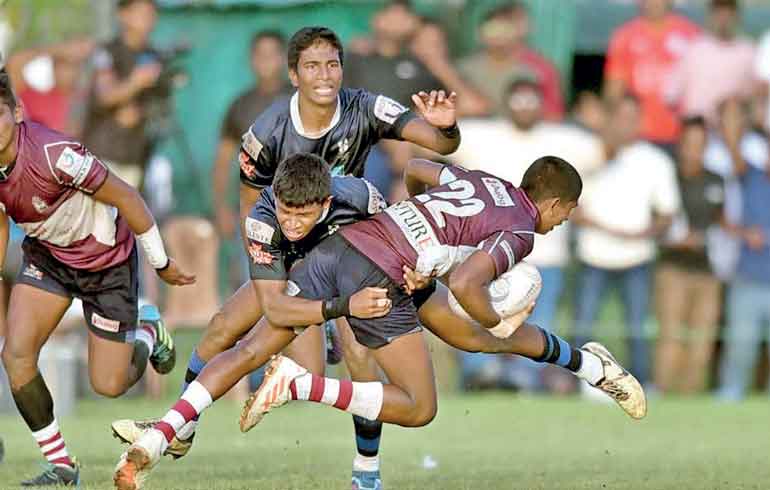
One of the strongest pillars of sporting culture
 School rugby in Sri Lanka has always been one of the strongest pillars of the country’s sporting culture. It has produced not only outstanding rugby players, but also disciplined leaders, professionals, and individuals who carried the values of teamwork, loyalty, sacrifice, and school pride throughout their lives. For generations, schools built their rugby traditions through hard work, long-term player development, committed coaching structures, and the passion of students and old boys who proudly represented their institutions.
The greatness of Sri Lankan school rugby was never built overnight. It was built over decades through dedication, identity, and community spirit. Young boys entered schools at junior level, trained for years, fought through difficult seasons, and eventually earned the honour of representing the senior first XV team. The emotional connection between schools, players, students, parents, and supporters made school rugby unique and special.
Foundation of school rugby under serious threat
Today, however, the very foundation of school rugby is under serious threat.
The increasing dependence on imported players and aggressive player recruitment between schools is slowly destroying the spirit and purpose of school rugby in Sri Lanka. What was once a platform for developing homegrown talent has now started turning into a system where some schools simply recruit ready-made players to build winning teams.
In recent seasons, there have been teams fielding 10, 12, and even 13 imported players in starting lineups, including captains. While such teams may achieve success on paper, many rugby followers now question whether these victories truly represent school rugby development or whether they are simply manufactured championships created through player acquisition.
This issue has become impossible to ignore.
The current trend is creating a dangerous culture where success is increasingly measured only by trophies rather than by development, loyalty, and the growth of young athletes within the school system. Some schools have become almost fully dependent on player imports instead of investing in their own junior rugby structures and long-term development pathways.
As a result, several traditional rugby schools that once produced excellent local talent are struggling to survive competitively because their best players are often attracted away before they even reach senior level. Smaller schools spend years developing players, only to lose them to larger rugby programs that possess greater financial influence and stronger recruitment networks.
This is not healthy for Sri Lankan rugby.
Transfer market
School rugby was never meant to become a transfer market driven by money, influence, and short-term ambition. It was supposed to be about representing your school, growing through the system, and earning success through development and commitment.
When teams become heavily dependent on imported players, genuine school identity begins to disappear. Supporters lose emotional connection because many players have little long-term relationship with the institution they represent. The traditional pride associated with wearing the school jersey weakens when success is built mainly through recruitment rather than development.
A strong and fair regulation should be introduced to limit imported or transferred players to a maximum of three on the field at any given time. Such a rule would not completely stop student transfers or prevent educational opportunities. Instead, it would restore balance and ensure that the majority of every school team is made up of players genuinely developed within that school system. This approach would encourage schools to invest more seriously in junior rugby, coaching, fitness programs, nutrition, and long-term player development rather than relying mainly on recruitment
Even more concerning is the impact this culture has on young players already within the school system. Many talented students lose motivation when they see opportunities blocked by imported players occupying key positions. Instead of inspiring young athletes, the system risks discouraging them.
The long-term consequences could be devastating.
Sri Lanka’s future rugby strength depends on strong grassroots development across many schools. If talent becomes concentrated within only a few institutions through aggressive recruitment, the national rugby ecosystem will gradually weaken. A healthy rugby structure requires broad participation and balanced competition, not domination through player imports.
This is why urgent regulations are now necessary.
Sri Lanka has already experienced similar challenges in club rugby. In the past, regulations were introduced to limit the number of foreign players participating in club competitions. Those rules were implemented to protect local player development and preserve competitive balance.
School rugby now requires similar protections.
A strong and fair regulation should be introduced to limit imported or transferred players to a maximum of three on the field at any given time. Such a rule would not completely stop student transfers or prevent educational opportunities. Instead, it would restore balance and ensure that the majority of every school team is made up of players genuinely developed within that school system.
This approach would encourage schools to invest more seriously in junior rugby, coaching, fitness programs, nutrition, and long-term player development rather than relying mainly on recruitment.
It would also protect smaller schools that currently lose talented players after spending years developing them. Rugby development should reward schools that invest in building players, not only schools capable of attracting finished athletes.
Critics may argue that students should have freedom to change schools. That point is valid, and no regulation should unfairly interfere with educational decisions. However, there is a major difference between normal student movement and organised rugby recruitment that turns school sports into a competitive marketplace.
Future of Sri Lankan rugby
School rugby cannot continue operating without proper governance and structure.
The objective of regulation is not to punish successful schools or stop competition. The objective is to protect the integrity, fairness, and future sustainability of school rugby in Sri Lanka.
Winning championships is important, but preserving the spirit of school rugby is far more important.
Throughout history, Sri Lanka produced legendary rugby players because schools focused on discipline, development, loyalty, and long-term growth. Those traditions built the strength of the game. Many of the country’s greatest rugby legends proudly represented the schools where they were developed from junior level.
That culture must not disappear.
If the current system continues unchecked, school rugby risks becoming heavily commercialised and disconnected from its educational purpose. Traditional rivalries, school identity, and grassroots development may slowly fade away. The game will become less about nurturing young athletes and more about assembling powerful squads through recruitment.
That is not the future Sri Lankan rugby should accept.
The time has come for school authorities, rugby governing bodies, principals, old boys’ unions, coaches, and stakeholders to take responsibility and act decisively. Clear eligibility criteria, transfer regulations, and limits on imported players must be introduced before permanent damage is done.
School rugby belongs to the students, the schools, and the communities that built the sport over generations. It should not become a system dominated by recruitment power and financial influence.
Sri Lanka still has enormous rugby talent across many schools and regions. With proper regulations and fair structures, the country can build a stronger and more sustainable rugby future that benefits everyone.
But action is needed now.
If Sri Lanka truly wants to protect the future of school rugby, regulations on imported players are no longer optional. They are essential to save the game before the true spirit of school rugby is completely destroyed.
(The author is a seasoned, vibrant, and results-oriented professional with over 30 years of rich experience covering digital, ICT solutions, marketing, innovation, development, integration, and market development in prestigious global organisations. An alumnus of Dharmaraja College, Kandy, he has excelled in both academics and sports. He represented Dharmaraja College in rugby, hockey, cricket, athletics, and table tennis, earning college colours in rugby and hockey)




