Thursday Nov 12, 2026
Thursday Nov 12, 2026
Tuesday, 20 October 2026 01:26 - - {{hitsCtrl.values.hits}}
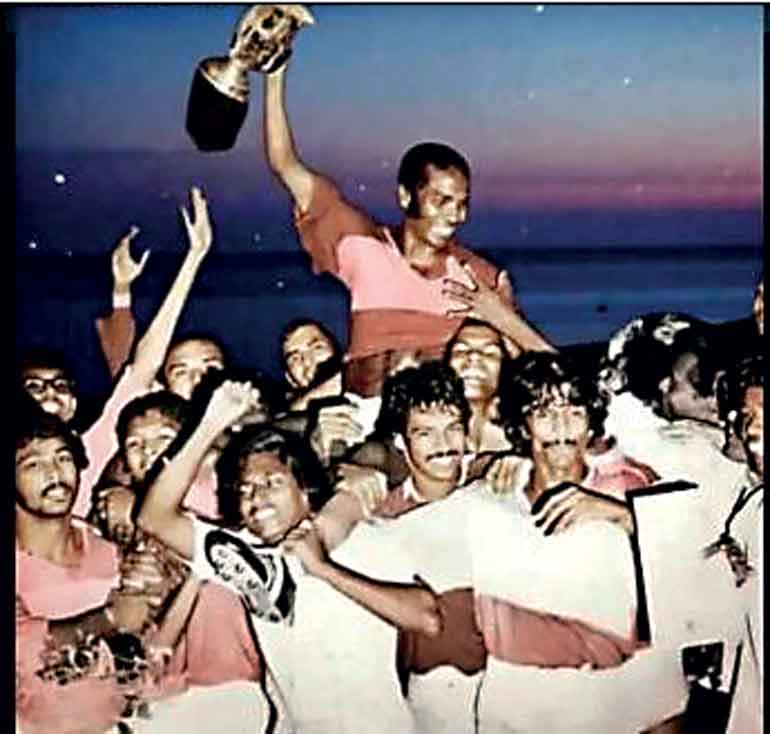
Thajone Savanghan chaired by the jubilant Havelocks team after winning the Clifford Cup in 1976
By Frankie Hubert
This October marks 50 years since the all-conquering Havelocks, led by the incomparable Thajone Savanghan, captured the blue riband of Sri Lankan rugby — the Clifford Cup.
For me, this anniversary is also an opportunity to remember and celebrate a remarkable man who encouraged me, inspired me and, above all, became a very dear friend.
When the great tales of Sri Lankan rugby are told, Thajone stands tall among the finest. In a country where rugby union has always held a special place, his exploits deserve to be revisited as we celebrate the 50th anniversary of that magnificent Havelocks team — the side that won the rare double of the league championship and Clifford Cup under his brilliant leadership.
I joined the Havies in 1975 while I was still at St Peter’s College. I played against S. Thomas’ on a Friday and, incredibly, played my first club match for Havelocks the very next day against the Air Force. We won both games.
By then, Thajone was already a legend. As a wing forward, he was renowned for his bone-crushing tackles — tackles that many of us would come to feel throughout our own careers. The famous sports writer TMK Samat aptly described him as “the boy with the 10-ton tackle.”
Thajone and his elder brother, Jurangan, were among the outstanding players who helped spark the renaissance of rugby at Isipathana College in the late 1960s. Thajone went on to skipper a Colombo XV against the mighty Bosuns from the UK.
When I first met Thajone, I was in awe of his ability to read the game. He seemed to see things developing before the rest of us had even realised they were happening.
In 1976, Thajone was appointed captain, and he immediately set the perfect example. Knowing that leadership demanded sacrifice, he gave up alcohol for the entire season — no small undertaking for someone who was known to enjoy a drink! That gesture earned the immediate respect of his teammates.
Thajone led from the front. He demanded discipline at practice and on match days, and he expected everyone to give their best for the jersey. Yet, despite his seriousness about rugby, he also had an extraordinary ability to lighten the mood.
His quick wit and mischievous smile were infectious. He could tell a completely believable story with the straightest of faces, leaving us hanging on every word, only for the punchline to reveal the joke and have the entire room in stitches. To this day, I have never met anyone quite like Thajone when it came to telling stories and jokes, and then completely cracking up himself as he delivered the punchline.
On the pitch, he was a superb leader.
I believe we won every match in 1976, capturing the Clifford Cup — the jewel in the crown of Sri Lankan rugby at the time — as well as the Knockout Cup, if memory serves me correctly, beating Navy 15–3 in the final at Longden Place.
But one match stands out above all others.
We travelled to Nittawela to play Kandy SC knowing that we had to win by 25 points to clinch the league title. On paper, it seemed almost impossible.
Kandy, playing on their home ground, were among the fiercest opponents in the country. Add a muddy pitch and some of the most passionate and boisterous supporters in Sri Lanka, and you can imagine the noise and hostility when we ran onto the field. Yet, despite the conditions and the atmosphere, we were quietly confident that we could do the impossible.
Before the match, Thajone gave us one of his typically brief but powerful team talks. He reminded us that every player was there on merit and that each of us had a responsibility to give everything for the team.
Then, almost immediately, the drama began. In the very first minute, I kicked a high up-and-under towards their fullback and chased it down, only to be decked by a punch from their wing forward, Viper Gunaratne Jr. I was left lying on the ground, bleeding.
Thajone rushed over to me, tears in his eyes, and told the referee, Colonel CS Fernando:
“Sir, Frankie’s career is over!”
The referee immediately sent Gunaratne off, sending shockwaves through the home crowd.
As it happened, his elder brother, Viper Gunaratne Sr., had also felled me in my very first game against the Sri Lanka Air Force!
Then Thajone looked at me, gave me that familiar wink and said:
“OK, now get up and play, Frankie!”
And play is exactly what we did. We went on to win 28–0 and secured the league crown.
What a man. What a captain.
The great Havies team of 1976 included: Thajone Savanghan (Captain/flanker); Jeyer Rodriguesz; Riztharin Morseth (hooker); Gavin Stevens; Stefan De Silva;; Royden de Silva; Anton Benedict (future 1978 captain); Jeffrey de Jong (future 1977 captain); Jeffrey Yu (future 1979 captain); Lanil Tennakoon; Hanzil Samad (Scrum-half); Frank Hubert (future captain 1980); Hazari Hameed; Hafi Abdeen; Chula Warusavitarne; David Nicolle; PL Moonasinghe; Marco de Silva; Coach: Dicky Jayatilleke.
Thajone retired in 1977, choosing to step aside to give younger players an opportunity. We missed him enormously, but his example remained with us. Many of us went on to continue the winning tradition at the Havies, inspired by the standards he had set.
The great forward Anton Benedict, who captained both Police and Havelocks to championships, remembers Thajone as the consummate professional on the field and recalled the unique character of that team.
“The 1976 squad was a happy blend of talented schoolboy ruggerites in their teens who had their initial exposure to club rugby as well as those who had loads of experience,” Benedict recalled.
“Thajone, our Captain Cool, led by example. If my memory serves me well, it was the first-ever Havies team rewarded with a couple of matches in Singapore. The architect of the travel arrangements by sea on board the passenger ship, Chidambaram, was the amiable and respected coach Nimal Maralande. May his soul rest in peace.”
Benna later skippered the Havies to the grand triple in 1978. Those memories capture something special about that era — the camaraderie, the characters and the friendships that made club rugby so much more than what happened on the field.
Our paths crossed less frequently after Thajone’s playing career, but in the mid-1980s our friendship was rekindled when I was living in Oman, and he was in Dubai. We shared many wonderful times over the years, enjoying great gatherings, laughter and friendship. Whenever I travelled to Dubai for the prestigious Dubai Rugby Sevens, I would often stay at Thajone’s home. Those were special times, and the memories remain incredibly precious to me.
I am writing this because I want to make sure the legend of Thajone — and the great Havelocks team of 1976 — is never forgotten. Thajone was dynamic and charismatic, both on and off the rugby field. He was a fierce competitor, a natural leader, a wonderful storyteller and, above all, a great friend.
And whenever we met, there was one song we would always sing together: “For the Good Times.”
Looking back now, I realise just how fortunate and blessed I was to have been not only his teammate, but also his close friend. The world lost a truly amazing man when Thajone passed away in September 2009.
To Noorani, his beloved wife, to his sons Dilshan and Romesh, and to their families, I send my love and deepest affection.
Thajone, thank you for the memories, the laughter, the lessons and the friendship. You will always be remembered.
(The author played for Havelocks 1975–1981)



