Friday Sep 18, 2026
Friday Sep 18, 2026
Saturday, 21 March 2026 00:00 - - {{hitsCtrl.values.hits}}
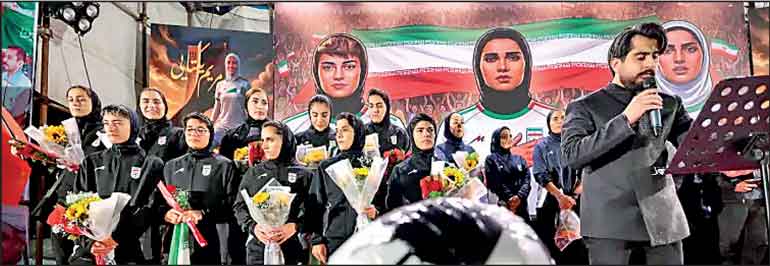
Members of Iran’s women’s national football team in Tehran on 19 March during the felicitation ceremony
The United States and Australia’s political tug of war against Iran over the fates of seven members of the Iranian women’s football squad appears to have ended with the depleted team returning home minus the two players who defected last week.
Critics now say politics trumped concern for the women’s best interests as the drama played out. The evidence is that of seven Iranian women who initially accepted asylum in Australia, five changed their minds within days and returned to their country for reasons undisclosed.
Critics argue the outcome might have been different had the women been provided with independent legal advice earlier and the process not been so rushed.
“We ended up with an outcome that is certainly far from ideal,” said Graham Thom, advocacy coordinator for the Refugee Council of Australia, a non-profit umbrella organisation representing asylum seekers.
“Hopefully, the two who are remaining get the protection they need, but we just hope that those who have returned are also safe,” he added.
Iran has claimed victory in the extraordinary public relations battle that played out since Immigration Minister Tony Burke released to the media on 10 March a photo of him posing with five women who had accepted protection visas.
He said the women, who all appeared without head coverings, were happy for their names and images to be released to the media.
Refugee advocates were alarmed, asking if women raised under an oppressive regime could be expected to question the Australian government’s media strategy.
Kylie Moore-Gilbert, a political scientist at Sydney’s Macquarie University who spent more than two years in Iranian prisons on spying charges from 2018 to 2020, said “winning the propaganda war” had overshadowed the women’s welfare.
“Had these women quietly sought asylum without that publicity around them, it’s possible that the Islamic Republic officials might have, as they have in the cases of other Iranian sportspeople in the past who’ve defected … simply allowed that to happen,” Moore-Gilbert told ABC media outlet this week.
Australia traditionally deals with asylum claims behind closed doors, conscious that the public spotlight can ramp up pressure and bring danger to potential refugees and their families.
Concerns for the team’s welfare were raised when players decided against singing the Iranian national anthem before their first match of the Women’s Asian Cup on the Gold Coast on 2 March.
The gesture attracted global attention and was not repeated at the women’s next match, at which they sang the anthem.
Iranian authorities on Thursday gave the national women’s football team a hero’s welcome after their return from Australia, where some had made and then withdrawn asylum claims, amid accusations Iran had pressured their families.
Six players and one backroom staff member who travelled to Australia for the Women’s Asian Cup sought asylum earlier this month after they prompted criticism from hardliners in Iran for failing to sing the national anthem before their first match.




