Friday Sep 18, 2026
Friday Sep 18, 2026
Thursday, 18 June 2026 00:04 - - {{hitsCtrl.values.hits}}
By Amira Cader
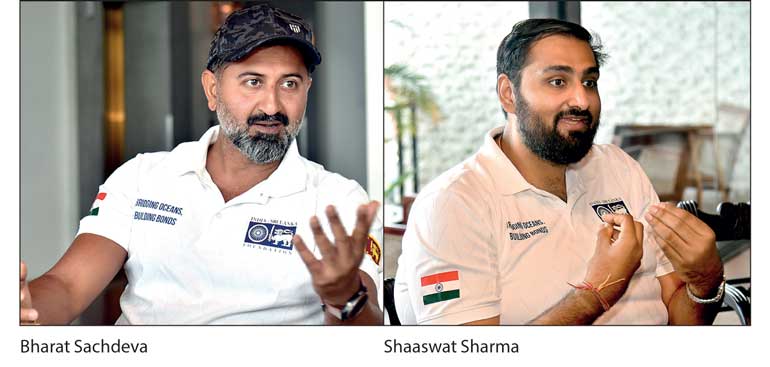
In 2024, endurance swimmers Bharat Sachdeva and Shaaswat Sharma completed a historic 32-kilometre open-water swim across the Palk Strait, crossing from Talaimannar in Sri Lanka to Dhanushkodi in India. Completed in 10 hours and 30 minutes, the expedition was far more than an extraordinary athletic feat. It symbolised resilience, friendship, and the enduring cultural ties that connect two neighbouring nations.
During their recent visit to Sri Lanka as part of the “Bridging Oceans, Building Bonds” initiative, the duo spoke to Daily FT about the inspiration behind their journey, the challenges they overcame and the lessons they hope will inspire future generations to dream bigger, persevere through adversity and build connections beyond borders.
Q: What inspired you to undertake the Ram Setu/Palk Strait swim expedition?
Bharat Sachdeva: One of the biggest inspirations was our desire to contribute positively to society. We strongly believe in the idea that the world is one family and that humanity should not be divided by borders, differences, or conflicts. We wanted to do something meaningful that reflected those values.
Shaaswat Sharma: For us, this swim was much more than a sporting challenge. It was an opportunity to promote friendship, peace and connection between people. We wanted to use our abilities as athletes to communicate a larger message of unity.
Q: Why did you specifically choose the Ram Setu route?
Bharat Sachdeva: The establishment of the Ram Mandir in 2024 was a significant moment and it inspired us to think about how we could make our own contribution in a positive way. The Ram Setu route carries deep cultural and historical significance.
Shaaswat Sharma: Many iconic swimming challenges around the world have been attempted numerous times. The Palk Strait remained a unique and relatively unexplored endurance challenge. We felt it was an opportunity to take on something meaningful while highlighting a route that connects Sri Lanka and India.
Q: How long did you prepare for the expedition?
Shaaswat Sharma: Specifically for this challenge, our preparation lasted close to a year. However, our foundation comes from many years of open-water swimming and endurance sports.
Bharat Sachdeva: The final swim was really just the result day. People see the achievement, but they do not see the months of preparation behind it. Like preparing for an examination, the real work happens long before the final day arrives.
Q: What did your training program involve?
Bharat Sachdeva: Every part of the body has to be prepared for a challenge like this. We focused on strengthening our shoulders, back, core and overall endurance through a very systematic training program.
Shaaswat Sharma: We trained for four to five hours every day. The program included swimming sessions, treadmill workouts, yoga, breathing exercises, strength training, visualisation and mental conditioning. Endurance swimming is as much a mental challenge as a physical one.
Q: Were there moments when you doubted whether the swim could be completed?
Shaaswat Sharma: Absolutely. Just two to three weeks before the expedition, I suffered a serious foot injury. The MRI showed a significant tear and doctors advised me not to put weight on it. Naturally, I was worried because we had invested so much time and effort into preparing for the swim.
Bharat Sachdeva: It was a stressful period, but we reminded ourselves that setbacks are part of any major challenge. We focused on staying calm, following medical advice and dealing with the situation one day at a time.
Q: What was the toughest moment during the actual expedition?
Shaaswat Sharma: Ironically, one of the toughest moments came before we even entered the water. The night before the swim, rough weather created heavy turbulence at sea. Our support vessel was rocking throughout the night.
Bharat Sachdeva: None of us could sleep. We had planned our nutrition carefully, but everyone was suffering from motion sickness. We were vomiting, unable to eat and unable to rest.
Shaaswat Sharma: The next morning we had to begin the swim despite being exhausted. At that point our mindset became very simple: one stroke at a time, one step at a time.
Q: How different is swimming in the ocean compared to training in a pool?
Bharat Sachdeva: The difference is enormous. In a swimming pool, conditions are controlled and predictable. In the ocean, you are dealing with currents, waves, heat, salt water and uncertainty.
Shaaswat Sharma: There were stretches where we swam for seven to eight hours under difficult conditions. You cannot fully prepare for that in a pool. The ocean constantly challenges you physically and mentally.
Q: Was there a particular moment during the swim that will stay with you forever?
Shaaswat Sharma: Yes. At one point our support team suddenly signaled for us to stop. We thought something was wrong. Instead, they told us to look towards a Sri Lankan Navy vessel nearby.
When we turned around, all the sailors were standing on deck applauding us and cheering us on. It was an incredibly emotional moment and gave us a huge boost.
Q: What was it like reaching the finish line?
Bharat Sachdeva: As we approached the shore, we could see our friends, families and supporters waiting for us with flags. After spending so many hours in the water, seeing them was a powerful feeling.
Shaaswat Sharma: Many local residents had gathered as well. They were curious about who we were and where we had come from. When we stepped onto the shore, we were welcomed warmly and honoured with garlands. It was a proud moment because we felt the journey had a larger purpose beyond sport.
Q: How do you define resilience?
Shaaswat Sharma: Resilience is the ability to keep going even when your body and mind are telling you to stop. It is recognising doubts and fears but choosing not to be controlled by them.
Bharat Sachdeva: There will always be uncertainty. There will always be challenges. The key is continuing despite them. That is what resilience means to us.
Q: Where do you find motivation?
Shaaswat Sharma: We read a lot. We are inspired by people who have achieved excellence in different fields, whether it is sport, art, business or science.
Bharat Sachdeva: One of my favourite stories is about Pablo Picasso. A woman once asked him to draw her portrait. He spent just a few minutes sketching it and then charged a large amount of money. When she questioned him, Picasso replied that he was not charging for the few minutes he spent drawing, but for the years it took him to learn how to do it in a few minutes.
That story reminds us that people often see the result but rarely see the years of effort behind it.
Q: What does “Bridging Oceans, Building Bonds” mean to you?
Shaaswat Sharma: It is both literal and symbolic. We physically bridged an ocean, but we also wanted to bridge the perceived separation between people.
An ocean is often viewed as something that divides countries. We wanted to show that it can also be something that connects them.
Bharat Sachdeva: At the end of the day, we all seek the same things—peace, happiness, purpose and human connection. We breathe the same air, drink the same water and share the same planet. There is far more that unites us than divides us.
Q: How can sport help strengthen the relationship between India and Sri Lanka?
Bharat Sachdeva: Sport has a unique ability to bring people together. It creates friendships, conversations and understanding that go beyond borders.
Shaaswat Sharma: Look at cricket. Whenever India and Sri Lanka compete, there is enormous excitement and interaction between people from both countries. Sport creates bonds that politics and geography sometimes cannot.
We hope our expedition contributes, in a small way, to strengthening those people-to-people connections.
Q: What message would you like young people to take away from your journey?
Shaaswat Sharma: Never underestimate what can be achieved through consistency. Small efforts repeated every day can lead to extraordinary outcomes.
Bharat Sachdeva: Dream big, but be willing to work hard. As Dr. A.P.J. Abdul Kalam said, “Whatever your mind can conceive and believe, it can achieve.” If our story inspires even one young person to challenge themselves and believe in their potential, then the journey has been worthwhile.
Q: Finally, what would you like people to remember about this expedition?
Bharat Sachdeva: That we have far more in common than what separates us.
Shaaswat Sharma: The ocean may separate our shores, but it does not separate our humanity. If we can build understanding, friendship and respect across that distance, then we are already building stronger bonds for future generations.
As their “Bridging Oceans, Building Bonds” initiative continues, Sachdeva and Sharma hope their story will encourage more young people to embrace challenges, pursue excellence and recognise the power of sport as a force for unity. Their journey across the Palk Strait may have concluded on the shores of Dhanushkodi but the message behind it continues to resonate on both sides of the ocean: that perseverance, friendship and shared humanity can bridge even the widest of distances.
Pix by Ruwan Walpola




