Friday Sep 18, 2026
Friday Sep 18, 2026
Monday, 23 February 2026 03:12 - - {{hitsCtrl.values.hits}}
Reviewed by Sa’adi Thawfeeq
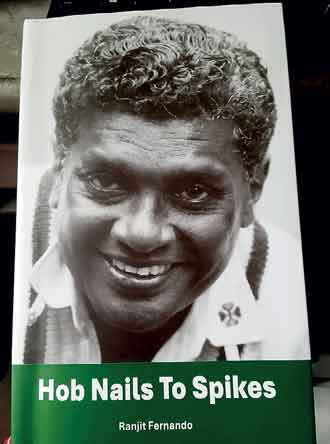 Ranjit Fernando belonged to an era in Sri Lankan cricket history when the country had yet to achieve Test status and relied heavily on visiting teams to showcase their skills to the rest of the world.
Anyone wanting to know the struggles Sri Lanka went through to gain Test status is clearly documented in Ranjit’s biography titled “Hob Nails to Spikes,” a 370-page hard cover edition that was launched on 14 February at Galle Face Hotel to a distinguished audience of past cricketers, administrators, and well-wishers.
Ranjit dwells on his days at St. Benedict’s College, Kotahena, where he was educated and began his career as a cricketer that was to take him to representing his school, club (NCC), and his country to become one of the most respected cricket commentators in the world. The road that Ranjit travelled has given him the opportunity to detail the progress of Sri Lanka cricket over the years, which, for any cricket enthusiast, is a must.
As a wicket-keeper cum opening batsman, Ranjit was understudy to Dr. H.I.K. Fernando, who then was regarded as the best wicket-keeper in Asia. Following Dr. H.I.K.’s retirement from the game, Ranjit succeeded to that position and served the country with distinction, becoming a member of the Sri Lanka team that took part in the inaugural Cricket World Cup in England in 1975.
Ranjit states in his book that wicket-keeping was what he loved most.
“I always believed wicket-keeping sharpened my batting. Some frontline batters avoid it like the plague, but for me, it offered an immediate reading on the pitch. By the time I walked out to bat, I already knew its moods and mischiefs. I never needed a second look.”
The book documents the matches Ranjit was involved in during his school days as well as with NCC and Sri Lanka, giving insights to incidents on and off the field which only a few are privy to. One of the most interesting chapters is how a tour to England in 1968 was botched due to disputes in selection. The opinion of many was that had that tour taken place, Sri Lanka’s push for Test status would have been enhanced by several years. Sri Lanka eventually gained full membership of the International Cricket Council (ICC) in 1981. The march towards gaining it is also well documented.
Ranjit’s career as a cricketer did not end with his playing days – he continued to serve both NCC and Sri Lanka Cricket in the role of Administrator, Coach, Manager, and Selector. When he broke into international cricket commentating, it diversified his knowledge on the game further and it is reflected in the book.
There is this famous phrase that behind every successful man is a woman. In this aspect, Ramani, his wife, has played a huge role in Ranjit’s success in life.
“In fact, meeting Ramani helped my cricket. I realised there was more to life than runs and stumpings. Ramani was simply the best thing that ever happened to me.”
The back flap of the book gives the author Ranjit’s biography, detailed by Lal Wickrematunge, a former Benedictine cricketer, Mano Ponniah, Ranjit’s teammate in the Ceylon side, has provided the Forward, and Rex Clementine, Sports Editor of The Island, has put down Ranjit’s thoughts down memory lane in simplistic style so that any ordinary layman will be able to understand.
For cricket enthusiasts, this is a book that will keep you glued as you would when watching a cricket match on television. It will be available at book stores priced at Rs. 7,000.




