Friday Sep 18, 2026
Friday Sep 18, 2026
Monday, 8 June 2026 03:34 - - {{hitsCtrl.values.hits}}
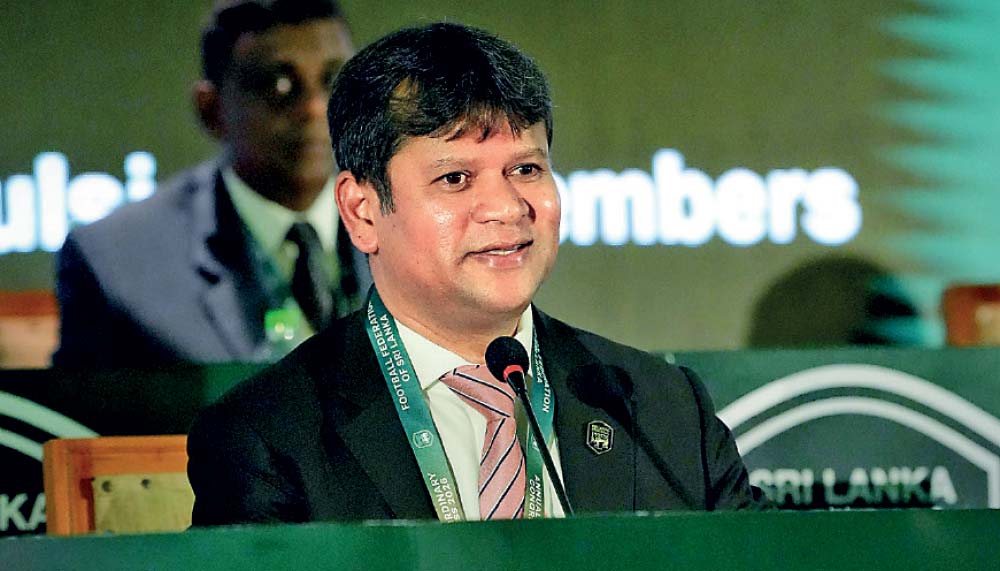
Football Federation of Sri Lanka President Jaswar Umar
By Althaf Nawaz
In what is being hailed as one of the most significant administrative reforms in the history of Sri Lankan football, Football Federation of Sri Lanka (FFSL) President Jaswar Umar has announced a groundbreaking initiative to establish a permanent office premises for every football league across the country, while taking steps to provide them a grant of Rs. 50,000 per month and allocating Rs. 1 million to each football league this year for the organisation of grassroots football competitions.
This was announced at the FFSL’s Annual Congress held in Nuwara Eliya on Saturday, where an initial payment of Rs. 500,000 was distributed among 60 football leagues. This event brought together representatives from all 61 member leagues, more than 250 delegates, invited guests, and members of the media. Widely regarded as one of the most vibrant, well-attended, and unified gatherings in recent football history, the Congress concluded with all resolutions being adopted unanimously.
The initiative forms a key component of ‘The Next Chapter,’ the new strategic development program unveiled by Umar to guide the future growth and modernisation of football in Sri Lanka.
Addressing the Congress, Umar emphasised the vital role played by regional leagues in developing the sport and stressed the need to provide them with facilities that reflect their importance and responsibilities.
“Every football league should have a permanent office from which it can serve its clubs, players, coaches, referees, and stakeholders. These leagues are the guardians of football in their respective regions. Providing them with a dedicated office premise will ensure dignity, professionalism, accountability, and accessibility,” he said.
At present, many regional leagues operate from temporary locations or the private residences of office-bearers, creating administrative challenges and limiting public access to football-related services. The lack of permanent facilities has often made it difficult for players, clubs, and stakeholders to engage with league officials and obtain essential information.
The proposed office premises will provide each league with a recognised administrative centre, strengthening governance structures and enhancing the professional image of football administration at the grassroots level. The initiative is also expected to improve record-keeping, communication, financial accountability, and service delivery throughout the football ecosystem.
Football observers and stakeholders have welcomed the announcement as a transformational step that will modernise regional football administration and leave a lasting legacy for future generations.
The program aligns with FFSL’s broader vision of decentralising football development and empowering regional institutions to play a greater role in the growth of the game. By strengthening leagues at the district level, FFSL aims to create a more robust and sustainable football structure capable of supporting players from grassroots participation to elite competition.
The initiative reflects Umar’s long-term vision of building a modern football administration that meets international standards while addressing the practical needs of local football communities. It is also expected to enhance the visibility and credibility of football leagues within their respective districts while strengthening relationships with local authorities, sponsors, schools, and communities.
As Sri Lankan football continues its journey of revival and progress, the establishment of permanent offices for every member league is being viewed as a historic milestone—one that marks the beginning of a new chapter of professionalism, accountability, and growth for the nation’s most popular sport.
With ‘The Next Chapter’ now underway, FFSL has signalled its commitment not only to improving performances on the field but also to building stronger institutions off the field, ensuring that football remains accessible, accountable, and sustainable for generations to come.




