Saturday Sep 19, 2026
Saturday Sep 19, 2026
Monday, 26 January 2026 03:15 - - {{hitsCtrl.values.hits}}
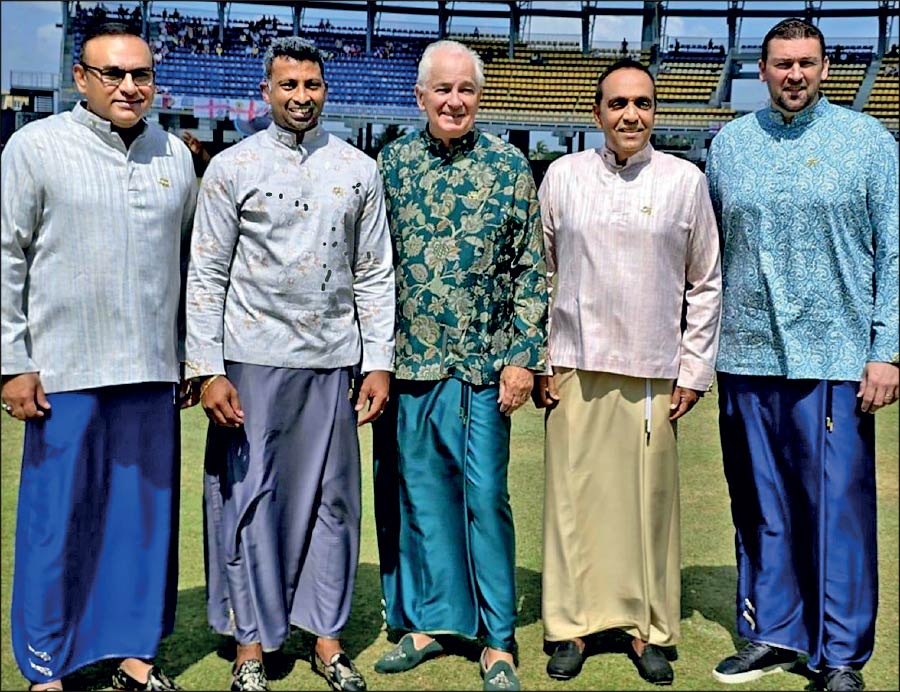
David Gower (centre) wears the national dress of Sri Lanka along with fellow commentators (from left) Aamer Sohail, Russel Arnold, Roshan Abeysinghe and Steve Harmison during the ongoing Sri Lanka-England ODI series
 Sri Lanka cricket coming through the eighties, not being a Test playing nation and a fully-fledged international nation to go so quickly to winning a World Cup was outstanding. The hard thing is keeping that momentum going. You’d have some great players. I particularly loved watching (Mahela) Jayawardene, (Kumar) Sangakkara, two of the greats of any era for any team
By Sa’adi Thawfeeq
|
David Gower |
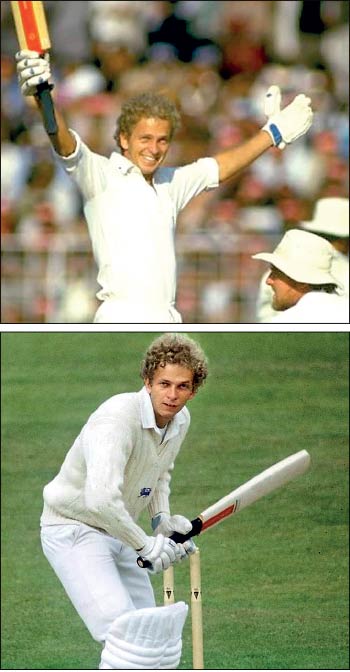 |
David Gower, a former Captain of England, was one of the most elegant and stylish left-hand batsmen of his era. His batting has been described as poetry in motion. He played 117 Tests and 114 ODIs scoring 8,231 and 3,170 runs respectively. He was a part of the English squad that finished runner-up in the 1979 World Cup. After retiring in 1993, Gower became a successful cricket commentator with Sky Sports. He is currently in Sri Lanka as part of the commentary team for the Sri Lanka v England ODI and T20I series and took time off from his duties to speak to Daily FT.
Q: You played in only two Test matches against Sri Lanka in 1982 and 1984, your memories of them?
The inaugural Test match was important (Sri Lanka v England 1982) because of the historic nature of it. Also, the first time in a Test at Lord’s was equally important for Sri Lanka cricket. The Test match here was interesting to say the least. I’ve been here five years before that (1977) with the DH Robins team and I’d seen a lot of those players who played in that first Test match in Sri Lanka. On that tour players like Roy Dias growing up, looking good and one or two others. Everyone knew it would be interesting.
Taking nothing for granted we had to play the 11 on the field. I was quite proud that we did win that game actually. Proud of myself, ‘cos it took a few runs here and there to get us across the line. But when you look back on that and the Lord’s Test, we already had five Tests against the West Indies and were beaten soundly. So, at the end of the summer, I think our heads were a bit frazzled. I remember it was Peter May who was the chairman of selectors. It was a classic morning when someone in the nets with an old ball polished up on one side saying it’s swinging this morning and thought it’s best to stick him in.
I was thinking that Sri Lanka for the first time at Lord’s we could take advantage of that. The ball did nothing, it was a very good flat pitch. One of the most amusing things was that (Ian) Botham for the second innings was bowling off spin, that’s what I hated about most. I didn’t mind his bowling pace and taking five wickets but bowling off spin and taking five wickets was taking a bit. Sidath (Wettimuny) played so well it was not quite what I had in mind. Obviously, as captain of the team you want to win, you’ve got to have a proper game. Looking back in the same way, it was two crucial games in the history of Sri Lanka cricket. We won the first one and you performed beautifully in the second and in no time at all winning the World Cup. It’s a great story.
Q: Botham, although bowling off-spin, got the wicket of Duleep Mendis, depriving him of scoring a rare century in each innings in a Test at Lord’s?
Obviously, the chance to make early history would have been fantastic. It would have been a great story to tell his children and his grandchildren. Great story to put into Sri Lankan cricket, but still you’ve got to do it.
The only gripe I have with these World Cups is that they come around too quickly. You sit down for 25 minutes and there is another World Cup, which I think is probably too much. I am sure it’s good for business for now. We spend so much time talking about workloads. There’s always been a sense of excitement when the original World Cup came around once every four years
Q: Sri Lanka’s rise in world cricket, your thoughts?
Given the context of that era, we didn’t see much of Sri Lanka at all. I guess once you get to the golden age of Sri Lankan cricket I was no longer playing. I watched it from a distance. That World Cup win was mind blowing in many ways. Earlier, a team deciding on a positive approach, is the way to win. Someone came in and gave it a go. Similar in a way to 30-40 years later with Afghanistan coming through from nowhere. Sri Lanka cricket coming through the eighties, not being a Test playing nation and a fully-fledged international nation to go so quickly to winning a World Cup was outstanding. The hard thing is keeping that momentum going. You’d have some great players. I particularly loved watching (Mahela) Jayawardene, (Kumar) Sangakkara, two of the greats of any era for any team.
Q: England’s cricket has been on a downward trend since winning the 2019 World Cup?
It’s been a mix. It took us a long time to get there, but once you reach the pinnacle the hardest thing is sustaining it. We had this contrast between 2015 where we were absolutely rubbish and Eoin Morgan taking over. He is one of the best captains I’ve seen in the one-day format who somehow put together a team that covered all the bases. It is all about fine margins. In a game like today (1st ODI), a lot of the innings it was pretty evenly balanced. Then we had one horrible over in the end which pushed the game beyond England.
When you look around the world there aren’t too many weak teams. The big 3 or 4 will be there at the closing stages of any World Cup 50-overs or 20 overs. In the T20I ranking England is there in the top 4, but for some reasons they seem to be down at 8 in the ODIs. It is a sort of trend which is hard to change. It just needs one, two or three good games and the confidence and suddenly people start to do the things they are meant to do as opposed to weak moments, where balls go astray and shots don’t work. The only gripe I have with these World Cups is that they come around too quickly. You sit down for 25 minutes and there is another World Cup, which I think is probably too much. I am sure it’s good for business for now. We spend so much time talking about workloads. There’s always been a sense of excitement when the original World Cup came around once every four years.
Q: How much has the game evolved from your time?
There are one or two exceptions if I was to go back to Mahela, if there was a touch player with timing to dream of who made runs in T20, you can still do that, obviously against the big guns literally out there to be seen all around the world with the help of big bats. The trend is for muscle and new techniques. We had our own tricks of the trade of making runs in the eighties backing away and making runs quickly over extra cover. We didn’t have stuff that goes over your shoulder involving dentists and new teeth. Things evolve. I guess there is still space for someone who can use timing to make runs. Jacob Bethell is not a muscleman but he is strong and he has timing as much as brute force. There has to be a place for both.
Crowds don’t necessarily come the same way for Test matches as especially at lots of grounds across the world like West Indies, India, Pakistan and here. Just because people don’t come physically to watch, people think there is no interest in Test cricket. I think that’s wrong. There is a lot of attention paid to it online, on television. It’s not easy to judge necessarily by the number of people sitting in the stadium. The fact is if the best players say that Test cricket is the best thing, we should listen to them
Q: Is Test cricket a dying breed?
What is reassuring is great players of the current era still rate what they do in Test matches above all else. (Virat) Kohli’s quotes not so long ago winning the IPL was good but not as good as playing for India in Test matches. Crowds don’t necessarily come the same way for Test matches as especially at lots of grounds across the world like West Indies, India, Pakistan and here. Just because people don’t come physically to watch, people think there is no interest in Test cricket. I think that’s wrong. There is a lot of attention paid to it online, on television. It’s not easy to judge necessarily by the number of people sitting in the stadium. The fact is if the best players say that Test cricket is the best thing, we should listen to them. One of the things is that the style of cricket played at Test match level now varies. England’s attempt to make it more exciting is laudable. It’s entertaining, win games dramatically, and score runs at a furious rate is fantastic to watch. It’s important to make Test cricket entertaining as well as it’s important to win. Fans and supporters travel to see teams win.
Q: Your views on Bazball?
For a long time now, people have been saying the intent is good and the culture is good. It needs to be smarter and that was proven in patches in Australia. Whatever your intent, if you don’t play according to the match situation, you don’t realise that you are under pressure, and if you don’t work out a way to deal with the pressure, then you end up losing games. People like myself, Mike Gatting, Graham Gooch care about English cricket. We want to see them do well. One of the misunderstandings about Bazball is it’s not just about trying to move the game ahead quickly, there is a culture in the room about supporting players, giving players the right environment to produce their best and there is a fine line between not fearing failure and not respecting the situation.