Friday Sep 18, 2026
Friday Sep 18, 2026
Friday, 22 May 2026 00:23 - - {{hitsCtrl.values.hits}}
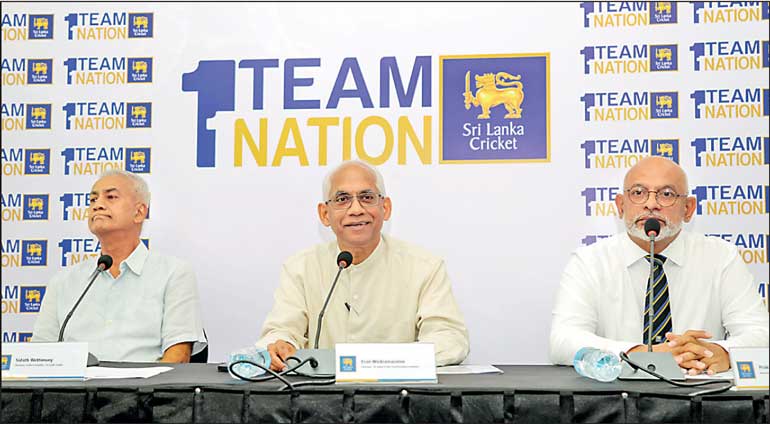
SLC Transformation Committee Chairman Eran Wickramaratne (centre) addresses the media in the presence of Committee Member Sidath Wettimuny (left) and Secretary Prakash Schaffter
By Sa’adi Thawfeeq
Sri Lanka Cricket (SLC) Transformation Committee Chairman Eran Wickramaratne, chairing his first meeting with the media since being appointed to the position three weeks ago, said the mandate given to the Committee was to change the structure of the management and to bring a new constitution to govern SLC.
Explaining the reasons why such a change is needed in the SLC constitution, Wickramaratne said: “There are lots of concerns that have come up about the current constitution. The voting system has been abused in a big way and it needs to be corrected. That’s not a conversation that has come up since we came to the Board, but it has been there for quite some time. Therefore, to correct it, you need to basically correct the framework and the legal framework in actually doing it. That has been the primary objective.”
“This change and a new Board has been appointed because, obviously, the prevailing situation has been deemed as unsatisfactory for various reasons. It could be performance in cricket, management, administration etc. Therefore, with the exit of the Board, a new Board has been appointed called a Transformation Committee. We are very happy that we have got eminent people in that Committee; some of Sri Lanka’s most celebrated cricketers Sidath Wettimuny, Roshan Mahanama, and Kumar Sangakkara. They will particularly focus on the cricket side. We got two President’s Counsels Dinal Phillips and Upul Kumarapperuma, who will focus on the constitutional and legal issues and matters. On the management and finance side, there is Prakash Schaffter, who has been involved in a lot of cricket administration, Avanthi Colombage, who is the Country Manager for Visa, and also Thushira Raddella, who’s been President of COYLE (Chamber of Young Lankan Entrepreneurs). They all bring different sets of skills which are very important and critical.”
Transformation Committee Secretary Schaffter, broadening the reasons for a new constitution, said: “If you look at how SLC has been run over the last 10-15 years, there is one thing that we all will agree on – that there is a lack of governance in the institution. That governance can be introduced only if we have a new constitution which will govern SLC in a better manner. The aspects of the existing constitution will be studied and those aspects which need rectification rectified. The voting system is one aspect which leads to governance. If you look, arising out of the elections and what happens, many decisions taken could have been taken in a more transparent manner, which would serve the interest of SLC in the medium to long term. Some of the decisions which are taken are not necessarily beneficial to the game or the administration of the game.”
Wettimuny, who has been on many past interim committees, said: “Do you realise that from 2000 onwards, we have had 11 interim committees? What does that tell you? There is chaos and we need to resolve it. I have been in 10 interim committees and that should tell you the story. There is a problem, that’s why we need to fix it.”
Speaking further, Wickramaratne stated they have started a process and opened it to the public to voice their opinions.
“Cricket is not owned by a committee or any group of people, not even by the Government; it’s owned by the spectators of a country. We are very conscious of that. We want all the stakeholders from cricketers, umpires, trainers, administrators to clubs, districts, provinces to all the associations, the window is open for them to send their proposals,” he said.
“It’s only been three weeks since we were appointed and we have been basically listening and trying to understand things in the constitutional process. After the constitution is drafted, it will be presented and will go through the regular Parliamentary process. We are going to get the support of everybody because cricket is apolitical, we are going to get all of Parliament to help us to put the structure in place. It’s a system correction that we are after.”
“On the other side, parallel administrative and financial matters. We want to make sure that every rupee that is spent is spent for the advancement of the sport. We are very conscious about the child, the student who is playing cricket. We want to make sure they have the infrastructure facilities and so forth, and also women’s cricket is also going to get a focus. We want to see it advance in addition to domestic and international cricket. This gives you a framework of what the Committee has been called upon to do.”
Wickramaratne said that it would probably take about six months to get the constitution in place after going through the required processes.
“Discussions with the International Cricket Council (ICC) have been extremely cordial and constructive. We have been very open and transparent in what we are doing and they would want us to pursue open and transparent methods in doing it,” he said.
Speaking on the side for the development of cricket, Wettimuny said: “Different aspects of the game have to come together for our game to flourish. Our focus is to try and see what those areas are and improve them. If you take our national team one vital area is the mental makeup. They need to have a positive mindset and think about the right things when you are going to play cricket. That’s something that we as cricketers have always felt, the right mindset.”
“We have got a very interesting and good coach in Gary Kirsten. In fact, he made a very interesting statement to me when I asked him what do you see as issues in our cricket. He said you have a lot of talent but they need to fly in formation. What it shows is teamwork, working together, and uniting as a team is the key. Our job as administrators is to make sure you support that system.”
Wettimuny also identified three key areas which are critical and need to be developed further – mainly standard of coaching at school level and below, umpiring and refereeing, and curating.




