Friday Oct 16, 2026
Friday Oct 16, 2026
Monday, 17 August 2026 16:39 - - {{hitsCtrl.values.hits}}
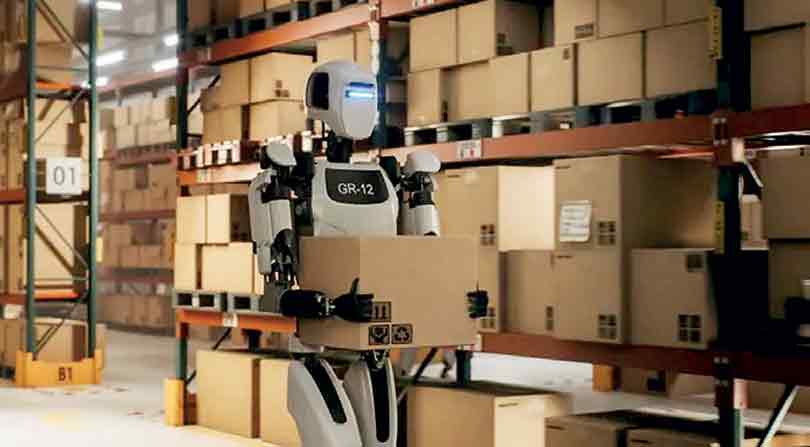
Walk into almost any large fulfillment centre today and the loudest thing you’ll notice isn’t the forklifts — it’s the quiet. Fleets of low-slung robots glide between shelving units, pause to let a human associate pass, then continue on to the next pick station without a word exchanged. That shift, from noisy manual material handling to coordinated robotic choreography, is no longer experimental. It’s becoming the default way modern warehouses operate.
The numbers back up the visual. The global logistics robots market was valued at $17.8 billion in 2025 and is on track to climb to $20.7 billion in 2026, before reaching an estimated $91.4 billion by 2035 — a compound annual growth rate of 17.9% over the forecast period. In physical terms, unit shipments are expected to jump from roughly 140,000 in 2025 to more than half a million by 2035. That’s not incremental adoption; it’s a structural rewiring of how goods move through warehouses, distribution centres, and last-mile networks.
Market growth and commercial opportunity
What makes this growth story compelling isn’t just the topline figure — it’s what’s funding it. Warehouse operators aren’t buying robots as a novelty; they’re treating automation as core infrastructure investment, on par with racking systems or conveyor belts a decade ago. The capital is flowing toward systems that can be deployed at scale, integrated with existing operations, and justified through measurable throughput gains. That’s a very different buying posture than the pilot-project mentality that characterised the industry just a few years back, and it’s part of why forecasts stretch out toward a near five-fold increase in market value over the coming decade.
Key forces accelerating adoption
Several pressures are converging at once. E-commerce and omnichannel retail continue to push order volumes higher while compressing delivery windows, forcing warehouses to process more SKUs, faster, with fewer errors. At the same time, warehousing labour has become harder and more expensive to source, pushing operators toward machines that can run continuously without breaks, shift changes, or turnover.
Layered on top of these operational pressures is a technology shift: robots are simply getting smarter. Advances in AI, computer vision, and autonomous navigation mean today’s machines can adapt to dynamic environments rather than requiring rigid, pre-programmed paths. And a financing shift is lowering the barrier to entry — the rise of robotics-as-a-service models lets companies deploy automation without the heavy upfront capital outlay that used to keep smaller operators on the sidelines. Together, these forces are less about replacing people wholesale and more about building resilience into supply chains that have proven, in recent years, how easily they can break.
Technology and application trends
Underneath the headline number sits a market with real internal texture. Hardware — the physical robots, sensors, and actuators — still dominates, holding roughly three-quarters of market value in 2025, simply because meaningful automation requires deploying many machines at once. But software and services are where the growth curve is steepest. Fleet management platforms, integration middleware, and warehouse execution systems are becoming the layer that actually makes multi-robot deployments work, and services — installation, integration, and ongoing optimisation — are expanding even faster as companies need expert help stitching robotics into legacy operations.
By robot type, autonomous mobile robots have overtaken older automated guided vehicles as the segment to watch, growing at more than 21% annually as their sensor-driven flexibility proves more valuable than the fixed-path reliability of traditional AGVs. Robotic arms, meanwhile, continue to anchor palletising, depalletising, and case-picking tasks where precision and repeatability matter most. Medium-capacity systems, built for pallet-layer and case-level picking, represent the largest share of the market by payload class, reflecting how much of real-world logistics still happens at that mid-range scale rather than at the extremes.
Regional and industry opportunities
Asia Pacific leads the world in both market size and growth rate, anchored by China’s manufacturing scale and an e-commerce ecosystem built around companies like Alibaba and JD.com. What makes the region matter beyond its size is the density of investment: government-backed automation initiatives, a deep domestic robotics supplier base, and rapid warehouse expansion are compounding each other’s effects. North America follows closely, driven by high labour costs and an entrenched e-commerce infrastructure, with the United States leading regional demand. Europe’s growth is shaped less by cost pressure and more by regulation — safety, traceability, and sustainability mandates are nudging operators toward automated, auditable systems. Smaller but fast-emerging markets in Brazil and the UAE show that automation demand is no longer confined to the traditional logistics powerhouses.
Challenges and market constraints
None of this is frictionless. High upfront capital costs remain the single biggest barrier, particularly for mid-sized operators trying to model an uncertain return on investment. Integration is the other persistent headache — bolting modern robotics onto legacy warehouse management systems, older facility layouts, and inconsistent connectivity infrastructure slows deployments and inflates costs. These aren’t dealbreakers, but they explain why adoption, while accelerating, hasn’t happened overnight.
Future outlook
The next phase of this market looks less like isolated robot deployments and more like fully orchestrated logistics ecosystems, where AI-driven fleet management, predictive maintenance, and real-time inventory systems operate as a single connected layer. Expect deeper movement into specialised use cases like cold chain and temperature-controlled storage, along with growing experimentation in last-mile automation.
Retrofitting older, “brownfield” warehouses with modular robotics — rather than building automation-first facilities from scratch — is likely to open the next wave of demand, especially among smaller operators who’ve watched automation from the sidelines.
Conclusion
The logistics robots market’s trajectory toward $91.4 billion by 2035 reflects something more fundamental than a hot technology cycle. It marks a rethinking of how warehouses and supply chains are built — not around human labour scaled up, but around a hybrid model where robots handle the repetitive, high-volume work and people manage the exceptions. The companies that figure out that balance first won’t just move goods faster; they’ll define what competitive logistics looks like for the next decade.
(Source: Globaltrademag.com)




