Saturday Sep 26, 2026
Saturday Sep 26, 2026
Monday, 17 August 2026 16:26 - - {{hitsCtrl.values.hits}}
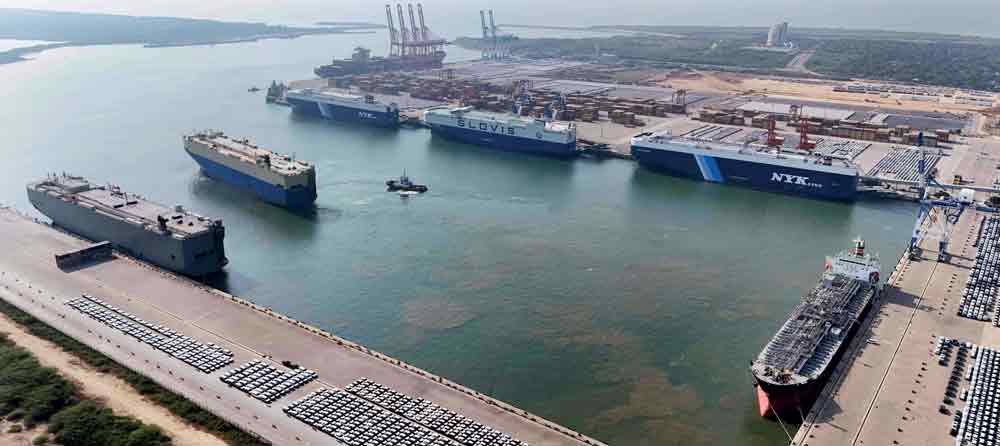
Hambantota International Port in Full Operation
Hambantota International Port (HIP) is entering a new phase of growth, with record cargo volumes, expanding industrial activity and significant infrastructure investment strengthening its role as a multi-purpose maritime and logistics platform serving Sri Lanka’s southern region and the wider national port network.
The clearest indication came in July, when HIP recorded its best-ever monthly performance in both RoRo and containers, handling 104,620 vehicles and 86,989 TEUs. The dual record follows rapid growth in 2025, when total cargo throughput rose 175% to 8.24 million metric tonnes.
Vehicle transhipment remains one of HIP’s strongest international businesses, while container volumes have also grown significantly. Container throughput increased from 53,169 TEUs in 2024 to 428,036 TEUs in 2025, with volumes growing a further 58% year-on-year during the first six months of 2026.
HIPG sees this container capacity as complementary to Sri Lanka’s wider port network, providing additional support to the Port of Colombo when required while increasingly focusing on cargo generated through the development of Hambantota’s industrial park and the southern hinterland.
According to Hambantota International Port Group (HIPG) CEO Wilson Qu, the significance of the recent performance goes beyond higher volumes. “Ports today have to do more than provide infrastructure. They have to anticipate how trade is changing and create the capacity, flexibility and services customers will need next,” he said. “Our objective is not to develop Hambantota in isolation, but to strengthen Sri Lanka’s overall maritime and logistics offering. By complementing Colombo, supporting industries locating around Hambantota and improving the movement of local cargo, we can create a stronger logistics ecosystem while generating greater economic value and employment in the southern region.”
According to Hambantota International Port Group (HIPG) CEO Wilson Qu, the significance of the recent performance goes beyond higher volumes. “Ports today have to do more than provide infrastructure. They have to anticipate how trade is changing and create the capacity, flexibility and services customers will need next,” he said. “Our objective is not to develop Hambantota in isolation, but to strengthen Sri Lanka’s overall maritime and logistics offering. By complementing Colombo, supporting industries locating around Hambantota and improving the movement of local cargo, we can create a stronger logistics ecosystem while generating greater economic value and employment in the southern region”
Central to that strategy is the development of HIP’s industrial park, which is expected to become an increasingly important source of local import and export cargo. The first flour mill commenced operations in June, marking an important step in the park’s transition from infrastructure development to active industrial production. Several more enterprises are expected to enter the park during the second half of the year.
As more industries become operational, the objective is to create an industrial cluster around the port, where manufacturing, logistics, and maritime connectivity reinforce one another. Beyond generating cargo for HIP, this has the potential to attract further investment, create local employment and support broader economic development in the south.
Infrastructure investment is progressing alongside this industrial growth. Earlier in the year, HIPG committed USD 108 million for six quay cranes, 16 rubber-tyred gantry cranes and 40 trailers under the initial stage of its Phase II container terminal development. The equipment, scheduled to become operational in the first quarter of 2027, will provide additional capacity to support future demand and Sri Lanka’s wider container trade.
Another important component of HIP’s logistics development is the dedicated Container Cargo Inspection Centre being developed with Rank Container Terminals. Its functions are being further enhanced to provide a centralised facility for local import and export container inspections, working in collaboration with Sri Lanka Customs and other relevant government agencies.
Expected to become operational by Q1 2027, the facility is intended to streamline customs inspection and cargo clearance for businesses using Hambantota. Importantly, it can also provide additional inspection capacity within Sri Lanka’s port system, helping ease pressure on Colombo and contributing to a more efficient national shipping and logistics environment.
HIP’s location, approximately 10 nautical miles from the main East-West shipping route, remains central to its proposition. Recent geopolitical uncertainty affecting Middle Eastern shipping routes has highlighted the importance of available capacity, operational flexibility and route resilience across global shipping networks.
Anticipating potential disruptions as uncertainty around the Strait of Hormuz intensified, HIP moved early to ensure sufficient capacity and reassure customers of operational continuity. Targeted marketing and direct customer engagement reinforced that preparedness, contributing to the record volumes achieved this year.
The broader picture therefore extends beyond rising throughput. RoRo provides HIP with an established international business, while its container capability can supplement national capacity and increasingly serve industries developing within and around Hambantota. The industrial park and improved customs and logistics infrastructure add another dimension by creating stronger links between the port, local production and international markets.
For HIP, the next phase will be about converting this combination of port capacity, industrial development and logistics infrastructure into sustainable economic activity. As new industries establish operations and supporting facilities come online, Hambantota has the opportunity to complement Colombo while developing a distinct role of its own; facilitating local cargo, attracting investment and contributing to a more efficient and competitive maritime and logistics network for Sri Lanka.




