Saturday Sep 26, 2026
Saturday Sep 26, 2026
Monday, 17 August 2026 16:33 - - {{hitsCtrl.values.hits}}
|
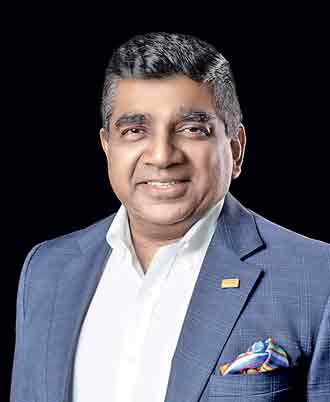
Advantis Group Managing Director Ruwan Waidyaratne |
In a conversation marking National Logistics Day, Ruwan Waidyaratne, Managing Director of Advantis Group, the transportation and logistics arm of Hayleys PLC, reflects on the company’s contribution to Sri Lanka’s logistics sector, its evolution from a shipping agency into a fully-fledged transportation and logistics group, and the investments shaping the next phase of the industry. He also discusses Advantis’ growing role in supporting renewable energy and infrastructure, while highlighting the Group’s focus on embedding ESG into its operations and creating a more sustainable future for the sector.
Q Advantis has been part of Sri Lanka’s logistics sector for decades. How would you describe its contribution to the industry?
A: Advantis has been part of Sri Lanka’s logistics journey since 1958, when we began as the shipping division of Hayleys. Over the decades, we have evolved alongside the needs of the Sri Lankan economy, expanding from shipping and freight services into integrated logistics, marine and energy, project logistics and travel and aviation solutions.
Our contribution has always been about more than moving goods from one point to another. Logistics is an essential enabler of trade, manufacturing, exports, investment and infrastructure development. Our role has been to build the expertise, infrastructure and solutions that allow businesses to operate efficiently and connect Sri Lanka with regional and global markets.
Today, our end-to-end offering allows us to support customers across multiple stages of their supply chains, while our regional presence gives Sri Lankan businesses access to wider markets. Our focus remains on strengthening this foundation while developing the specialised services Sri Lanka will need as its economy and industries evolve.
Q How is Advantis’ role evolving as Sri Lanka’s logistics requirements become more complex?
A: The logistics industry is moving beyond traditional transportation and warehousing. Customers increasingly require specialised solutions that bring together freight, customs, transportation, storage, engineering and project execution.
We have therefore continued to invest in specialised infrastructure, equipment and expertise. A good example is our Project Logistics business, where we handle complex and oversized cargo for infrastructure, industrial and energy projects.
Our latest investment is a significant step in that direction. Through our joint venture with Sarens, we have introduced Sri Lanka’s first and only 900-tonne crawler crane, the largest crane of its kind in the country. Together with a 280-tonne crawler crane and specialised equipment including wind blade adaptor trailers, tower trailers and prime movers, this expands the scale and complexity of projects that can be executed locally.
The first deployment is supporting the 50MW wind power project of Haywind One Limited, where our teams are involved across port handling, transportation, unloading and turbine erection. This demonstrates how logistics can directly support the country’s transition towards renewable energy.
Q What does this new heavy-lift investment mean for Sri Lanka?
A: It means that projects which previously required significant reliance on overseas equipment or expertise can increasingly be executed here, supported by local teams and infrastructure.
For us, the 900-tonne crane is not simply a piece of equipment. It represents an investment in Sri Lanka’s project logistics ecosystem. Large renewable energy, infrastructure and industrial projects require specialised lifting, transport and engineering expertise, and developing these resources locally helps improve the country’s readiness to undertake projects of greater scale.
It also creates opportunities for knowledge transfer and skills development. As we take on more complex projects, our teams gain experience in advanced planning, engineering, heavy transport and lifting operations. We intend to continue building on this foundation and expanding our lifting capacity and equipment portfolio as future project requirements evolve.
Q Sustainability is becoming increasingly important for the logistics industry. How is Advantis approaching ESG?
A: Sustainability cannot be treated as a separate initiative from the business. For a transportation and logistics company, ESG has to be integrated into how we operate, invest and grow.
Our ESG roadmap, HELIOS, provides the framework for this, with six pillars covering Energy Emissions, Biodiversity, Employee Engagement, Community Engagement, Safety and Governance. Under the environmental pillar, we have committed to reducing our absolute greenhouse gas emissions by 45% by 2030, with a longer-term ambition of achieving net-zero carbon emissions across the business by 2045. This is being supported through greater use of renewable energy, alternative fuels, improved energy efficiency and lower-carbon transportation solutions.
For us, the important point is that these commitments are translated into action across the business. We are looking at how we can reduce our environmental footprint while also creating positive impact through our people, communities and the ecosystems around us. Initiatives such as Advantis Blue C and Green C are examples of this broader approach.
Q Advantis Blue C and Green C are two of the Group’s environmental initiatives. What impact are they creating?
A: Both initiatives reflect our belief that the private sector can play a meaningful role in protecting and restoring Sri Lanka’s natural ecosystems.
Through Advantis Blue C, we are supporting Blue Carbon restoration in important ecosystems including Anawilundawa and Pubudugama. At Anawilundawa, a Ramsar wetland of significant ecological importance, Advantis serves as the technical partner, working with the Department of Wildlife Conservation, Wayamba University and the Wildlife & Nature Protection Society. Our contribution has included supporting research and restoration activities, as well as providing infrastructure such as a research laboratory. The second stage of this project is taking place in Pubudugama.
Advantis Green C extends this focus to terrestrial ecosystems. Through the initiative, we are supporting the restoration of 15.26 hectares at Frocester Estate in Govinna, in partnership with Horana Plantations, through the planting of native tree species.
Together, these initiatives demonstrate that our ESG agenda goes beyond reducing our own environmental footprint. We want to use our resources, expertise and people to contribute to restoring ecosystems and supporting the communities that depend on them.
Q Advantis has also recently launched the 100 for 100 rider safety initiative with the National Council for Road Safety. Why was this important to the Group?
A:As a transportation and logistics company, we have a responsibility to contribute to safer roads for the people and communities connected to our operations. Road safety is therefore an important part of our social responsibility.
Through 100 for 100, we are working with the National Council for Road Safety to encourage organisations to take a more active role in promoting safer riding practices among their employees, operational riders and wider networks.
We are starting with our own operations through Citypak and, more importantly, hope to encourage other organisations to join the initiative. For us, this is about creating practical impact. ESG is not only about environmental targets; it is also about how we contribute to the social wellbeing and safety of the communities in which we operate.
QAs logistics becomes increasingly technology-driven, how is Advantis preparing for the future?
A: Technology is changing the way logistics is planned, managed and delivered. Customers today expect greater visibility, faster response times and more efficient supply chains, and we need to continuously evolve to meet those expectations.
At Advantis, we are investing in digital solutions, data analytics and systems that improve visibility, efficiency and decision-making across our operations. Technology is helping us manage supply chains more effectively and give our customers greater visibility and responsiveness.
However, technology is only one part of the equation. The future of logistics will also depend on people with the skills to work with new technologies, understand increasingly complex supply chains and solve problems in real time. That is why we continue to focus on developing our people alongside our technology and infrastructure.
Ultimately, our objective is to create more efficient, responsive and sustainable logistics solutions for our customers and strengthen Sri Lanka’s competitiveness in the region.
Q Looking ahead, what do you believe Sri Lanka’s logistics industry needs to focus on?
A: We need to continue investing in infrastructure, technology and people, while ensuring that growth is sustainable.
Sri Lanka has an important role to play in regional trade, but competitiveness will depend on how efficiently and reliably we can move goods, support industries and respond to new areas of growth. Renewable energy, advanced manufacturing, e-commerce, specialised logistics and infrastructure development will create new requirements for the sector.
At Advantis, our focus will be on anticipating these needs rather than simply responding to them. Our investments in project logistics and heavy-lift capabilities are one example. Our ESG strategy and environmental initiatives are another.
National Logistics Day is therefore an opportunity not only to recognise the contribution of the sector, but also to look ahead. After more than six decades in logistics, we remain focused on strengthening the services, expertise and infrastructure that Sri Lanka needs to grow, compete and build a more sustainable future.