Monday Nov 16, 2026
Monday Nov 16, 2026
Monday, 16 November 2026 03:28 - - {{hitsCtrl.values.hits}}
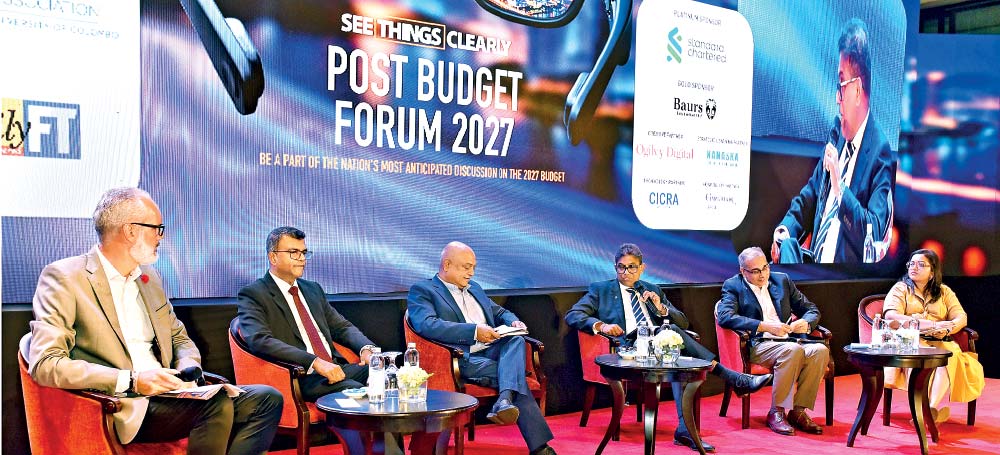
Top private sector leaders shared their insights, analysis and concerns about the implementation and their interpretation of Budget 2027, at the 16th post-Budget forum organised by the Daily FT-University of Colombo MBA Alumni Association last Friday.
The business leaders praised Budget 2027, as one of the ‘best’ fiscal blueprints in years, but warned that the country’s real challenge is whether a bureaucracy-bound Government can deliver it. They opined the 7% medium-term growth projection looks out of reach against current growth of about 4.5%, insisting that implementation will make or break Budget 2027 amid global uncertainties, foreign investors pulling money out rather than bringing it in and that tax reform still leans heavily on indirect taxes.
The panel comprised Advocata Institute Chairman Murtaza Jafferjee, Standard Chartered Bank Sri Lanka CEO Bingumal Thewarathanthri, who is also Vice Chairman of The Ceylon Chamber of Commerce, Small and Medium Enterprise (SME) and export champion Selyn Group of Impact Companies Chief Growth Officer Selyna Peiris, and A. Baur and Co. Ltd., Managing Director/CEO Rolf Blaser. They were joined by Treasury Secretary Dr. Harshana Suriyapperuma, who outlined the Budget’s key proposals, rationale and responded to the panellists' concerns and audience questions. The discussion was moderated by Daily FT Chief Editor/CEO Nisthar Cassim.
Below are excerpts of the panel discussion:
By Charumini de Silva
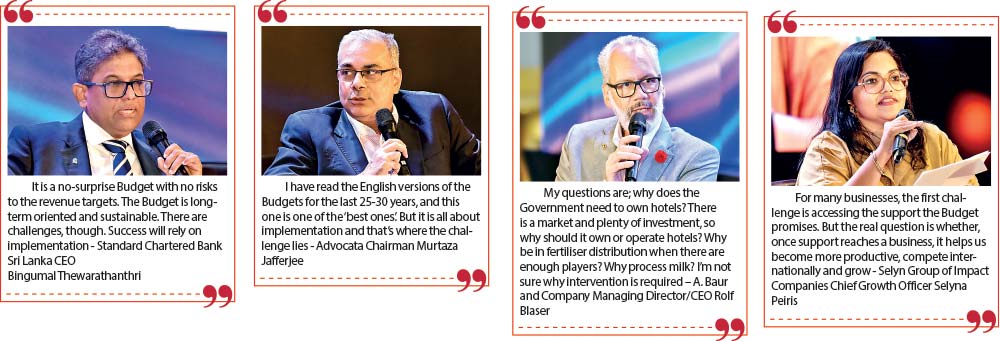
Bingumal: It is a no-surprise Budget with no risks to the revenue targets. The Budget is long-term oriented and sustainable. The Government is also trying to fix some legacy issues, such as the Norochcholai, be it infrastructure, the education sector. On infrastructure, there are highways, rural roads and airports. On the social side, there is a lot on the health sector, the planned clinics and bringing some hospitals under Central Government control. There is also a plan to provide data access in rural areas, which has long been a concern. It isn’t new, but it has not worked because of land and connectivity issues and I think they now have a plan. On investment, there is an investment protection and promotion agency. The Government is planning to staff it with talent drawn in, which sounds optimistic because it is very difficult to attract private sector people into Government and the current service structure, so it might help. Investment protection laws are something the Ceylon Chamber of Commerce has been advocating, so that is a positive too, as are the increased capital thresholds for FDI. We can also see the Government staying strictly within the IMF program, given all the targets.
There are challenges, though. Success will rely on implementation. This is a continuation of what the Government said when it came to power, so there is no surprise between the first Budget, last year’s and this one. Execution by the Government bureaucracy will be the biggest challenge.
We are less optimistic about FDIs. We did not see much change in investment policy. The previous Budget had some measures, such as the zones and this one continues some of those, but there is little on tax treatment for large projects.
We are also less optimistic about retaining talent in Sri Lanka. Mid-level professionals were expecting somewhat better Advance Personal Income Tax (APIT) rates. The total APIT collection is about Rs. 150-200 billion at most, in my view, and the band where we see people migrating is roughly Rs. 300,000 to Rs. 1 million.
I am less optimistic about the 7% growth rate. Current growth is around 4.5% and part of that is revenue net of subsidies. After rebasing, we are looking at perhaps 4-4.2% and getting from there to 7% with the current economic model will be a challenge in the short term, even though we are building the country for the long-term.
Murtaza: Let me start with fiscal policy and tax. The forecast is that 22% of tax collection will come from direct taxes and 78% from indirect taxes. Governments over the last 10-15 years have said they want to change this balance, but figures show little movement. Take the APIT changes. About 22-24% of the benefit comes from changing the threshold and 76% from changing the brackets. And unlike in other countries, Sri Lanka does not asses tax on a household basis, so a husband and wife can file separately. It is a very generous system in which very few people get caught in indirect taxes.
Second, the double capital allowance of BOI companies above $ 3 million is ‘misdirected’. Why BOI, and what is wrong with everyone else? Why just $ 3 million? When there is a size threshold, there is invariably a lot of capital investment and much of that money goes out of the country. The target should never be value, but wherever new jobs were created. All our tax incentives are based on value, which is the wrong way to do it.
I believe there is a new tax policy unit, a tax research unit, so I was expecting better tax design, including on vehicles, which gave us 18% of tax revenue last year. We must be the only country with such a bizarre system, based on engine size and motor power, which creates winners and losers in the market. We should move towards a market-based system where price and quality win, not tax policy. The pent-up demand for vehicles is now gone, and going forward it will get harder and harder.
I welcome the removal of the Cess. These taxes benefitted only a handful of families who made monopolistic profits at the cost of millions of people building houses and other construction. On the VAT removals, I can understand the politics, but what we need is broader VAT coverage, not more and more exemptions. Ideally, we should take out the SSCL and merge it into VAT. It would have been better to raise the VAT rate and remove the SSCL because it is a cascading tax. Tax administration was also not addressed. Tax papers have rights and there is a lot of harassment.
On expenditure, there are many interest subsidies and I don’t agree with that approach. Credit guarantees would be better. In a market system, the interest rate reflects the supply of money. If there is market failure because financial institutions won’t lend to a segment, the Government already has a credit guarantee scheme which is a better instrument for ensuring credit reaches the right places.
On growth policy, the planned investments in transport, electrification and highways are all very welcome and I hope they can be executed. The single biggest binding constraint in the economy is land. The organisation I represent has worked on Bim Saviya, which we have been at since 1998 and only 18% is done. Allocating Rs. 800 million is an ‘under allocation’. It is vital to digitise land records, which also clog up the Court system and I believe it deserved a larger allocation.
More generally, the commitments on free trade agreements, SOE law and PPP law are again music to my eats I worked on this when I was in the SOE restructuring unit, so I hope they come into place.
I have read the English versions of the Budgets for the last 25-30 years, and this one is one of the ‘best ones’. But it is all about implementation and that’s where the challenge lies.
Rolf: I think I’m the only foreigner in this group, so perhaps I bring a slightly different point of view. On FDI, we represent a large number of foreign companies in Sri Lanka and the trend we see is, investment going out, not in. Our partners are reducing their presence, taking other focus areas and regions and money is flowing out. People are trying to change that trend, but it isn’t really happening. One specific point is that foreign companies are no longer allowed to buy land. Investment normally starts with property, a building, a factory and it is difficult to build a factory on a short-term lease. We would need 30, 40, or maybe 50 years to depreciate the investment. That is a deterrent.
Attracting talent is another challenge. From a foreign perspective, we are not using foreign talent. With a designated visa concept, we could easily attract it. We have a shortage of doctors in the country and our neighbours have many. That is how Switzerland became wealthy, by inviting foreigners to close gaps where we never had enough people. Initially, it was skilled labour, and foreigners built the Swiss tunnels. Today, it is doctors in hospitals. If I go into a hospital in Switzerland, the chances are very high I will meet a German doctor, because we don’t have enough of our own.
My questions are; why does the Government need to own hotels? There is a market and plenty of investment, so why should it own or operate hotels? Why be in fertiliser distribution when there are enough players? Why process milk? I’m not sure why intervention is required.
Selyna: For many businesses, the first challenge is accessing the support the Budget promises. But the real question is whether, once support reaches a business, it helps us become more productive, compete internationally and grow.
I come to this as a manufacturer and exporter. This is a woman-led enterprise with a 35-year legacy, growth means market access, winning repeat orders, producing or servicing competitively and earning enough to reinvest and retain our workforce. That requires equipment, skills and working capital. In Sri Lanka, it also requires us to pay our people for their prosperity because with this workforce we cannot grow and that is a fundamental issue for most businesses today.
There are useful commitments in the Budget and I welcome them. To make the most out of them, we should learn from existing initiatives what worked, what held businesses back, and what should change. This is not to nit-pick, but to go to the second level. Because Sri Lanka has faced so many crises one after the other. We are constantly stuck at the larger macro problem. With the stability this Government has afforded us, we have an opportunity to go deeper.
For example, two Industry Ministry programs; SMILE III and E-Friends, which were allocated Rs. 5.5 billion. The underspent is about 53.8% meaning actual spending was roughly Rs. 2.5 billion. At the same time, a further Rs. 7.5 billion was approved by the Cabinet at the President’s request for the MSME Plus loan disbursement facility. The two programs have different purposes and are not in direct competition, but both offer lessons. What support got used? What held it back; agencies, banks or businesses? Why was there an underspend, and why an overspend? This is the time to let, so that the allocation promised in this Budget go to the SMEs that need them. Those learnings should inform clear medium and long-term sector priorities and measures of productivity, investment, exports and employment. Where work is underway, greater visibility would help us plan and invest with confidence.
Now, to something I often speak about, which I call the ‘missing middle’. Established manufacturers, regional producers and women-led enterprises that have products, innovations, workers, and customers but gaps in the capabilities needed to grow. The Budget’s ambition is sustainable growth of 7% or higher over the medium term. Businesses like ours, can help deliver that through more production and exports, better-paid jobs and opportunities for local suppliers. But investment, skills and market access need to come together around us.
Imagine a buyer offers a large order subject to certification. This is happening to me right now. We are trying to crack the Indian market and need BIS certification. It is a $ 20,000 order, with a Rs. 3 million blanket risk attached to the certification. I am willing to take that risk, but we also need efficiency gains, better equipment, access to testing laboratories, trained officers and working capital, all within a ‘buyer’s tight timeline’. The buyer needs the order by the end of January. Each requirement may be manageable on its own, even at my scale, but unless they come together, we will lose the opportunity. And all we are talking about is export diversification, entering India.
I welcome the nearly Rs. 68 billion for interest subsidies and refinancing intended to support Rs. 174 billion in concessionary lending. The practical test is whether we can access finance on time, in terms that fit our investment, production and payment cycles. The Rs. 4 billion for industrial estates and infrastructure could provide dependable utilities, suitable facilities and room to expand. But we also need accessible testing laboratories, certification services and technical expertise, at costs and timelines that let us meet buyers’ requirements. The Rs. 750 million for export activities should help turn market opportunities into sustained business. Trade fairs and expos may have opened doors before COVID, but the world has changed. We now need ‘targeted’ buyer engagement, digital channels and partnerships with international supply chains, followed through with samples, standards and production readiness. Success should be measured by orders and repeat business, not just investment going into market access.
I also welcome the National Single Window for trade pilot and the nearly Rs. 2 billion for its rollout, but a single digital entry point needs coordinated decisions behind it. We still have to go to Provincial Councils and Grama Niladhari offices for approvals and documentation with uncertain timelines. We need to resolve this, while we look at technology.
The coordination must extend to trade negotiations. Can manufacturers and exporters, even at our level, be involved early enough so that negotiations on tariffs, rules of origin and recognition of standards address the barriers we face? Once agreements are in place, largely driven by the bigger companies, the bus is gone. Where are we consulted? We should also bring the same focus to support from development partners, including the ADB, World Bank and IFC. How can their grants, funding, guarantees and technical assistance help us de-risk and enter the markets we are targeting? These also apply to training, R&D, innovation and skills development. The point is, a great deal of work is going on at the macro level, but we don’t see much cascading down to those who can take the economy’s growth to the next level. We are ready to invest as medium scale businesses and take responsibility for our commercial decisions. We are definitely not here with a ‘begging bowl’. We are asking for a partnership that makes viable growth opportunities achievable, with commitments from business and measurable benefits in supplier development, skills, exports and employment.
The key question is how these allocations, plans will and institutions come together around an actual growth opportunity? How do we help entrepreneurs identify products with market potential, rather than ideas that are merely seed-funded? And where an opportunity already exists, who will coordinate and support the delivery?
This is a conversation we need to have in the coming days and weeks, as the Budget has come out. Let’s agree on clear medium and long-term priorities. By next year’s forum, we should be able to show what changed, which businesses took their next step and how we turned these commitments into better livelihoods.
Murtaza: The way to stop benefitting a privileged class is to move towards a market system and Rolf was alluding to that as well. The fundamental premise of a market is competition. The most important premise is that price signals the allocation of scarce resources. If you don’t allow free market prices to operate, you distort the market and that benefits a few.
Take some of the examples like fertiliser. We have a very successful cash transfer program. Now there is a mention of a voucher. Are you trying to move away from the cash grant? Advocata has done a lot of research on agriculture, and the fertiliser cash grant has been very successful, because people can look for alternatives, such as slow-release fertiliser and different applications.
Second, fuel subsidies. The diesel price is something we cannot control, because it is an international price and it is unfair to tell the oil companies to take the loss. The fundamental issue, as the Treasury Secretary said, is competitive bidding. Look at the difference. We are all electricity users, so this moves towards the benefit of all.
Then there are the Cesses. I hope most of the Cess is removed, but unfortunately most of it only comes out on 1 April 2029, and only a small amount on 1 April 2027. That will reduce the tariffs that benefit a few producers in Sri Lanka, who I don’t think are competitive, who are inefficient and who make supernormal profits. It will allow most people who want to build a house, to build a better one. That is how inequality is reduced. With more competition you get more productive firms, as the Secretary alluded to, which then create better jobs and higher-paying salaries. That is why I will cheer them on, if they keep doing this.
Bingumal: Multinationals move between markets based on their own aspirations, not because they dislike Sri Lanka. But before asking what is good for the country, we should understand the wider trends.
There is a massive geopolitical shift underway. Power is shifting and the Global South is gaining momentum. South-South trade is about 30% of global trade. There is Industry 4.0 and companies are concentrating their resources in one place and consolidating operations. These are trends we cannot ignore. So what are we offering a company that is looking at, cybersecurity? Port City is one proposition. There is also a big shift in how we do business, because we can do business from anywhere.
I would bet on logistics. We have already seen Colombo Port ranked among the 20th best ports globally. The Budget talks about it, with the new breakwater and bringing more investors in, but it will take time.
It is not just about adding another 10 million TEUs. We are already about a quarter of Singapore’s size. They handle roughly 39-40 million TEUs. But shipping and logistics across the whole ecosystem contribute about 7% of Singapore’s GDP and for us it is less than 3%. This shows that the entire ecosystem around shipping is missing in Sri Lanka, including warehousing, supply chains, value addition and in my view bunkering, which is also restricted. We have to open up and bring in capacity. So shipping is one big ticket.
Tourism is another key sector. The destination was ranked among the best islands in the world, best beaches. So why not invest more?
Another shift is in energy. Globally, renewables are about 33% of energy, and the President mentioned during the Budget speech that Sri Lanka’s share is 62%. Growth in renewables is very high and we are also seeing a shift to electric vehicles (EVs), which hovers around 20-25% of the market. This is a trend we have to monitor.
The third is the ageing population. The ageing population will be something like 1.4 billion by 2030, from about 1.1 billion in 2023 and by 2070, the elderly population will exceed the population under 18 years. There are both challenges and opportunities in this segment.
The fourth is technology under the new economy. Playing in the new economy with AI and cyberspace, I think Sri Lanka has scope. Mongolia is now positioned as a data-centre country, because it has a lot of green energy and it effectively exports energy through data centers. We have a lot of greenery too.
Then the wellness, spiritual and cultural tourism. With an ageing population globally, if we open Sri Lanka to elderly people who want to come and settle, and bring in global investors to set up wellness and elderly-care centres, people will come. There is a huge issue with migration policy, but these people come when they are old and do not compete for jobs or assets. This is something we can seriously look at, because elderly care creates jobs that retain people in the country.
The last is niche manufacturing. There is a view that Sri Lanka should not get into manufacturing because we are 60% services. But if you look at what we have done so far, the larger part of that 60% is banking and insurance. We have done very well in niche manufacturing in areas like automobile component manufacturing, high-end apparel and now value addition in agricultural products like coconut. Sri Lanka can be a niche manufacturer for certain things, not everything and supply the world. Our problem is that we made one product, intimate apparel and sent it to the US and worked for a long time. We never thought about diversifying the apparel sector or investing more. The same apparel sector, but the numbers have come down now. Overall, there are plenty of industries we can focus on.
Rolf: On the availability of land, we have a somewhat different philosophy. Productivity in almost all crops in Sri Lanka is below our neighbours’ and below the standards in similar environments. This may be because for over 50 years, we have lived in chemical fertiliser used to maximise the short-term harvest. To reach perhaps 80% of the potential productivity you need 50 kilos of fertiliser, to reach 90% you need 100 kilos and to reach 100% you need 200 kilos. So the question is whether we want to spend the money and material on that last 20%.
We can see what is happening because we always maximised productivity and alongside the soil degraded. It is washed out and empty, there is hardly any biological activity left, and even with the fertiliser is difficult for the plant to absorb; it washes out or evaporates. Productivity at the maximum level is now going down over time. The only option to raise productivity is bio-material, such as bio-compost, bringing life back into the soil. So when we give a subsidy, even a cash grant, we might consider attaching conditions to it. As an example, the farmer would have to follow the recommendation of the National Fertiliser Secretariat, which currently is 30% organic and 70% chemical fertiliser. Right or wrong; it is a good condition. The subsidy rewards the behaviour we want.
Selyna: SMEs face a maze of institutions that cannot deliver. The SLSI is under capacity. The EDB is prioritising a trade expo, with no clear focus on what we can do in this country. At the bank, we are told, “sorry a 100 people came before you and the refinancing loans are gone.”
What the Government can do is prioritise. Tell us, with money and energy behind it. “These are your winning horses, come and bet on them.” Young entrepreneurs, women-led businesses and established businesses are putting in enormous money and effort to grow this country’s economy and create jobs. Priorities must be set and monitored. We need a different approach to how the billions of rupees allocated and spent. Otherwise, we will be back here next year, talking only about the macro, with no impact on the micro.
Bingumal: The sector is doing very well with double-digit growth, with return on equity (RoE) of around 14%. It is a lucrative sector with many banks ranked among the top 10 companies in Sri Lanka. There is no special support for banking in the Budget, and are happily paying close to 55% or more in taxes. We can debate that, but if I had a choice, I would support APIT for the junior levels, not for the banking sector taxes. We have to play a larger role in how we lend. Private sector lending growth is about 24%. Working with the local banks, I think we have a job to ensure the money goes into the right sectors. Of what was lent in the last nine months, about Rs. 200 billion went into gold loans (pawning), about 100% consumption loans and another Rs. 200 billion went into service and a large part of it to NBFIs to buy vehicles. We are happy about credit growth, but where the credit goes concerns us because as an industry, we also compete.
Murtaza: I think it’s a futile exercise. I was once called to the Industry Ministry, where they were doing research study. I do think there is a case for encouraging electrification and we should start with two-wheelers because the market is large enough. Around 30,000 two-wheelers are sold monthly with roughly 360,000 per year, which is sufficient scale to do something. Assembly for re-export to the Indian market is just a dream.
Bingumal: India is definitely not an option for full vehicle assembly operations. Interestingly, Laos has set up a Toyota factory, starting with 5,000 cars. I don’t know what the business proposition is. It is a market of about 8.5-9 million and they are going to do double-cabs for it. But you have to start somewhere. I don’t think we have the capacity to do a full assembly, but we can debate. However, we definitely can do component manufacturing for the Indian supply chain. At a recent forum, the Japanese Ambassador himself said they are asking the private sector to join, because India needs that support, and some Indian investors we have spoken to have also agreed. There is an opportunity for us to be part of a supply chain. We have also spoken to brands like Toyota and they have an appetite to start something in Sri Lanka. Markets like Kenya are doing it too. Seeing what BYD is doing and how India is growing in the automotive industry, competing outside Sri Lanka would be tough.
The post-Budget Forum’s strategic partner was Standard Chartered Bank; Baurs served as the Gold Sponsor, with Nanaska as Strategic Learning Partner, CICRA as the Technology Partner, Cinnamon Grand as Hospitality Partner and Ogilvy Digital as the Creative Partner.
– Pix by Upul Abayasekara and Ruwan Walpola






