Monday Nov 02, 2026
Monday Nov 02, 2026
Monday, 2 November 2026 04:43 - - {{hitsCtrl.values.hits}}
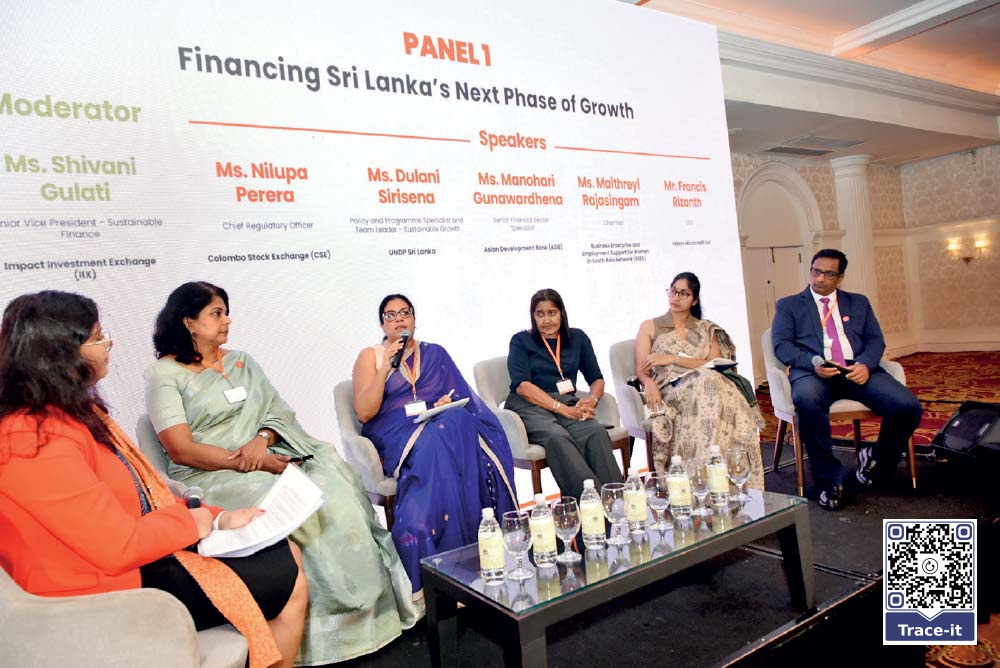
Panel 1 on ‘Financing Sri Lanka’s Next Phase of Growth through Orange Capital.' From left: IIX Senior Vice President Shivani Gulati, CSE Chief Regulatory Officer Nilupa Perera, UNDP Policy and Program Specialist and Team Leader – Sustainable Growth Dulani Sirisena, ADB Senior Financial Sector Specialist Manohari Gunawardhena, Business, Enterprise and Employment Support for Women in South Asia Network Chairperson Maithreyi Rajasingam, and Sejaya Micro Credit CEO Francis Rizanth
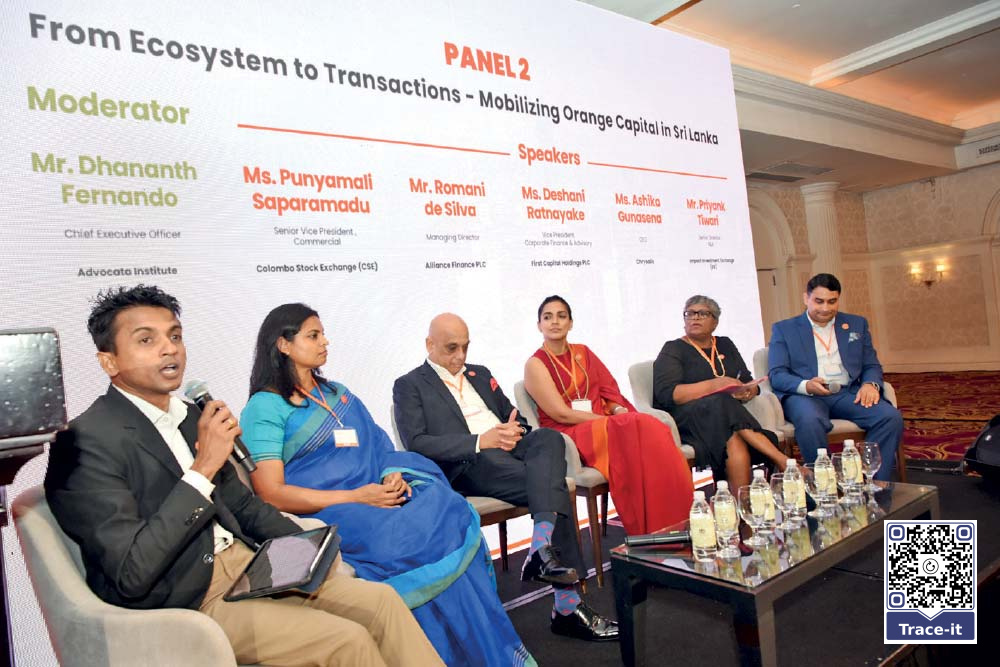
Panel 2 on ‘From Ecosystem to Transactions: Mobilising Orange Capital in Sri Lanka.' From left: Advocata Institute CEO Dhananath Fernando, CSE Senior Vice President Commercial Punyamali Saparamadu, Alliance Finance Company Managing Director Romani de Silva, First Capital Research Senior Vice President Deshani Ratnayake, Chrysalis CEO Ashika Gunasena, and IIX Senior Director Priyank Tiwari
 Sri Lanka has capital, and through its banks and non-bank lenders it has the reach to put that capital to work. Speakers at the Orange Economy Summit 2026 in Colombo last week argued that what it lacks is a connection between the two. That connection has three parts: data that makes women-led enterprises visible, readiness that turns them into investable propositions, and pricing that lets investors back them on merit rather than sentiment.
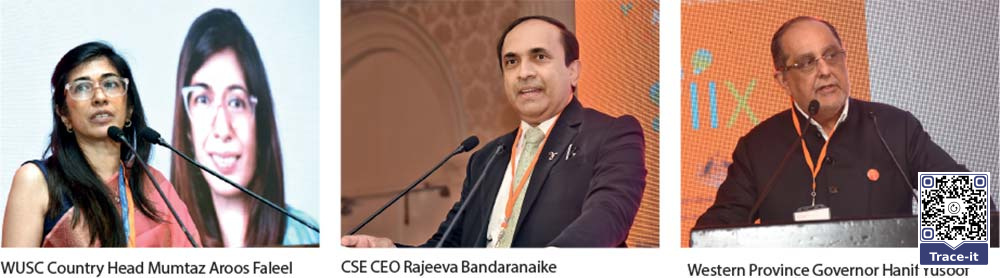
World University Service of Canada (WUSC) Country Head Mumtaz Aroos Faleel distilled the day’s discussions in her closing reflections. “Capital exists. The lending reach exists. What has been missing is a connection between them,” she said. She pointed to the data that makes enterprises visible and the deals that turn businesses into transactions.
The Impact Investment Exchange (IIX) convened the summit with the Lanka Impact Investing Network (LIIN) and the Colombo Stock Exchange (CSE). CSE CEO Rajeeva Bandaranaike and Western Province Governor Hanif Yusoof also addressed the gathering. It was built around one question: how to finance Sri Lanka’s next phase of growth through Orange Capital, which is private finance channelled to gender equality and climate resilience.
Its most visible instrument, the Orange Bond, now has a home in the CSE’s regulatory framework, and the first local issuer has declared its intention to come to market. Yet speakers were notably measured about what a single instrument can achieve. The harder work, they said, lies in building a market around it and in confronting barriers no Bond can remove.
IIX Senior Vice President Shivani Gulati opened the first panel by asking about the cost of leaving the last mile behind. In her framing, it is paid twice. It is paid today, in lost export competitiveness across value chains such as apparel, agriculture and tourism. It is paid again tomorrow, in greater reliance on State welfare when climate shocks strike vulnerable communities.
Who creates value?
IIX Founder and CEO Prof. Durreen Shahnaz set this against a harsher global backdrop. Fiscal space is tight almost everywhere and aid budgets are shrinking. Climate commitments made only a few years ago are being rolled back, while conflict in the Middle East is pushing up costs and pulling capital away from emerging markets. Her prescription was what she called financial sovereignty: countries using their own markets, institutions and people to finance their own future, rather than relying on a handful of global powers or top-down models.
Prof. Shahnaz drew the point from a cup of tea. Dilmah founder Merrill J. Fernando, she noted, built the brand on the conviction that Sri Lankan tea should be packed and sold as Sri Lankan, so its value stayed at home instead of accruing to blenders abroad. Behind every cup, however, is a woman plucking leaves by hand, often from dawn until after dusk. She built that industry, Prof. Shahnaz said, but seldom shared fairly in what it yields. Recognising who creates value, and who shares in it, was what the summit was about.
Along the coasts, Prof. Shahnaz said, women process and sell much of the catch, farm seaweed and lead community groups restoring the mangroves that protect the shoreline from storms. “These women are not charity cases. They are a climate solution in their own right,” she said. She recalled a lesson from her early career at Grameen Bank in Bangladesh: the poor had never been the problem; it was capital that had been ‘too timid’ for them.
Not charity
That reframing, from charity to commercial opportunity, ran through the day. CSE Chief Regulatory Officer Nilupa Perera said the exchange did not regard the initiative as a social undertaking. It saw it instead as the next evolution of sustainable capital market infrastructure, building on the CSE’s Green, Blue, Social, Sustainability and Sustainability-Linked (GSS+) Bond framework.
Gulati said institutional investors were beginning to recognise that inclusion was not merely a concessionary need. It was directly linked to resilience, trade stability and long-term growth. How sustainability disclosure standards are shaping that investor case is examined separately (see box).
IIX Sri Lanka Country Director Jonathan Abeywickrema made the case to companies in market terms. Buyers in export markets are now asking who makes products and how they are made, he said, and Orange offers a route both to capital and to those markets. IIX’s $ 500 million pool for South Asia, which Sri Lanka can access, adds to that pull. IIX, he said, will work on an investment readiness standard so more enterprises and issuers can come to market under the framework, and will help make impact measurement central to raising capital.
Market architecture
IIX Senior Director Priyank Tiwari said Orange operates at the level of market architecture, not as a single instrument. IIX had often been told that capital markets cater to the top 1% and do not reach the last mile, he said. Most impact finance flows through closed-ended or private vehicles. IIX has instead used public markets, drawing in more capital through data-rich evidence.
Investors, Tiwari said, assess the whole system. They look at whether a market has the right frameworks and incentives, and whether it offers transparency and trust. They check whether data is generated and verified from the last mile, and whether institutions have the capacity to adopt these instruments. They also want reporting and monitoring rigorous enough to show proceeds are used effectively. All of these, he said, have to be built at the same time.
Indonesia is IIX’s reference case. There, it worked with the Ministry of Finance, the market regulator and the stock exchange on policy and frameworks. It then built capacity among banks and lenders to design, deploy and report on instruments, and worked on the absorption capacity of SMEs receiving the funds. A large State-owned entity anchored the market with what Gulati described as the world’s largest Orange issuance by a quasi-sovereign issuer, in both conventional Bonds and Sharia-compliant sukuk.
Japan, Gulati said, has seen the world’s first Orange corporate Bond for inclusion in value chains. Tiwari added that Orange is extending into blue and green financing, where projects affect communities, and into guarantees and loans.
At home, the first hurdle was viability. CSE Senior Vice President Commercial Punyamali Saparamadu said the exchange’s biggest task over the past two years had been making the instrument workable for issuers. That meant persuading IIX to bring its cost structures down. Orange Bonds are a subset of social Bonds, for which a framework already existed. GSS+ issuances have so far been taken up by domestic investors. The exchange now wants foreign investors and hopes the recent upgrade in Sri Lanka’s sovereign rating will help draw them.
First mover
Alliance Finance Company PLC announced its resolution to issue on the day of the summit, becoming the first company to step forward. Saparamadu cautioned that the issue has not yet been approved. Managing Director Romani de Silva said the decision followed from the company’s history. It was founded in 1956 to serve underserved and unbanked communities, and in 2012 it added an environmental dimension to become what de Silva described as Sri Lanka’s first triple bottom line financial institution. It also issued Sri Lanka’s first social Bond about a year ago.
de Silva said Orange’s distinct value lies in bringing granularity to the UN’s Sustainable Development Goal on gender equality, with defined, measurable outcomes. The gender component of the company’s inclusion work was not yet at a level it was satisfied with, de Silva said, hence the interest in an Orange Bond.
de Silva was candid that pricing has not been settled and that rates remain somewhat high. The company has scaled the issue down to Rs. 1 billion, with a larger Bond possible later. It first wants to show it can deploy the proceeds competently and meet the instrument’s transparency and use-of-proceeds requirements. It will price off market rates and keep the differential as low as possible.
de Silva attributed the company’s 521% share price return over five years to an impact-first ethos, describing the return as an outcome rather than a design. “When you create immense value, it usually transforms into financial value as well. But you can’t do it the other way around,” de Silva said.
Priced on merit
First Capital Holdings Senior Vice President Deshani Ratnayake, who has been working on the transaction for several months, said the first challenge was pricing that both issuer and investors could accept on merit. The instrument should not have to be pitched to issuers as concessional or sold to investors on goodwill. Investors report to investment committees, must meet their return thresholds and benchmark everything, she said, so the pricing has to make sense.
Her message to both sides was that an Orange Bond is an investment instrument open to investors, not a grant. The second challenge is the investor base. The first movers are mid-sized non-bank financial institutions rated in the BB and BBB range, Ratnayake said. That rating range rules out pension funds, unit trusts and insurers, which narrows the pool of target investors considerably. The third is data. Ratnayake said issuers must be ready with the data needed to withstand verification and assurance before they commit to an Orange, green or social Bond.
The most promising source of demand, Ratnayake said, lies in sustainability reporting. IFRS S1 and S2 are global standards issued by the International Sustainability Standards Board. S1 requires companies to disclose sustainability-related risks and opportunities that could affect their prospects, and S2 does the same for climate-related matters. Listed companies moving to sustainability reporting under these standards face requirements that extend to the sustainable instruments they hold, Ratnayake said, which has made the conversation easier. Bringing those companies on board first, as champions, has been one way to overcome resistance.
The invisible enterprise
Readiness on the supply side is only half the equation. UNDP Policy and Program Specialist and Team Leader – Sustainable Growth Dulani Sirisena said the burden of investment readiness invariably falls on the enterprises themselves. These are the same businesses bringing innovation to market and creating jobs, she noted, and they operate in an ecosystem not yet equipped to support them. Even the basic question of which sectors are women-led has no straightforward answer. Women micro and small entrepreneurs are largely invisible in a predominantly informal economy, so capital cannot easily be directed to them.
“We cannot invest in what is invisible,” Gulati said.
Sirisena also warned against pushing capital into the wrong places. Agriculture employs about a quarter of the population but has stagnated, and funnelling finance there risks adding to the burden on women micro and small entrepreneurs rather than lifting it. She pointed instead to technology, STEM, climate-smart infrastructure and agri-tech as avenues to de-risk lending to women. She added that global value chains are shifting towards services, an area where Sri Lanka could gain. Even eco-tourism, she said, has to account for climate shocks.
Sirisena argued that readiness must be built through multiple channels. These include commercial banks, a partnership with the Central Bank, and the Government’s own network of rural development and women development offices, which she described as an underused asset.
Listing presents its own gap. Perera said most women-led enterprises are not driven by capital markets. Many hesitate to go public, and their financial reporting has yet to reach the standard required of listed companies. The CSE is working with sponsors to educate potential issuers, and a women-led company recently listed on the exchange.
Banks’ quantum leap
Banks face a different constraint. ADB Senior Financial Sector Specialist Manohari Gunawardhena said the problem is not access to finance as such. It is access at the right price, in the right amount and for the right period. Many small businesses borrow at exorbitant rates and keep going without much success, and some wind up. Banks are regulated and responsible for safeguarding public deposits, Gunawardhena said, so lending to such entrepreneurs is a quantum leap for them.
The ADB’s approach has been to channel concessionary credit lines with targets attached, without disturbing banks’ competitive pricing, because banks shy away from such funds otherwise. Field monitoring revealed a disproportionately high number of women entrepreneurs who had never heard of these credit lines, suggesting they had not reached bank branches. The ADB is now looking to include non-bank financial institutions, which Gunawardhena said are better geared to reach such borrowers, though their products may not suit them.
The data problem runs deeper. The ADB helped set up the National Credit Guarantee Institution and monitors how many guaranteed loans go to women. That raises the question of who the woman borrower really is, since men are sometimes the ones benefiting behind the woman’s name. At financial literacy workshops, women wanted their husbands present, so the ADB let them attend to ensure the women came.
Gunawardhena said a private bank’s branch in the Northern Province is reportedly staffed entirely by women, which Gunawardhena is verifying. The lesson, however, is not that only women can serve women; male lending officers must be trained too. Gender-disaggregated reporting, which the ADB championed in Sri Lanka, was difficult at first but now leads to gender-focused products and processes.
Dignity and opportunity
At the last mile, the barriers become personal. Business, Enterprise and Employment Support for Women in South Asia Network Chairperson Maithreyi Rajasingam said the question is not only whether a woman has access to capital but whether she has the right kind. It also extends to her access to assets, markets and skills, and to whether she has agency in economic decisions.
Rajasingam recalled a meeting at which bank officers, presenting their products, told women entrepreneurs they were not investable. The officers suggested the women hand a significant share of their businesses to a child or another young person so they could qualify for youth loan products. The women stood up and asked whether the choice on offer was ‘between my dignity and opportunity’.
Rajasingam proposed three tests. The first is whether finance is intentional in reaching women, noting that during the COVID-19 pandemic none of the hundreds of women her network reached could secure the MSME loans then on offer. The second is whether it is equitable, which may require blended packages rather than conventional terms. The third is whether it applies a creative lens.
In the North and East, Rajasingam said, women contend with the legacy of war, militarisation, land rights and displacement, leaving many several steps behind. The network’s research on women-headed households found nearly a quarter had not completed formal education because of conflict. Some women affected by the war fall outside formal disability categories yet face significant challenges. Rajasingam said the system must cater both to women running businesses to sustain households and to those seeking growth. Aggregators, incubators, accelerators and service providers need incentives to reach them.
Chrysalis CEO Ashika Gunasena called for a mindset shift: recognising that women are worth investing in, not as social good but on the strength of their contribution. That contribution, including unpaid care, has never been fully counted, Gunasena said. “When we ask whether women are ready, we also have to ask whether the system is ready to support them,” Gunasena said.
Gunasena also stressed that women entrepreneurs are not a single group. Location, language, age, disability and gender identity all shape what products will work. Household norms weigh heavily. Women’s businesses are often treated as secondary income, started when the household is in crisis and abandoned once the risk passes. When women try to grow, family pressures intensify, and some prefer to keep their businesses small to manage their household responsibilities.
Gunasena also cited economic violence: husbands holding women’s bank cards and passbooks, and women facing violence when they earn more than their partners. The intention behind the Bond is sound, Gunasena said, but without understanding these dynamics it risks falling short of its reach.
Last-mile lenders see both sides. Sejaya Micro Credit CEO Francis Rizanth said Orange Capital allowed the company to revive a project supporting young people that had stalled for lack of funds. Sejaya is now working with insurers and technology firms to help clients withstand shocks and digitalise. It is also moving into SME lending, Rizanth said, because banks are slow to back women entrepreneurs and often doubt their skills. Rizanth’s advice to other lenders was not to stop at loans. They should track clients’ growth, challenges, use of funds and household income. “Data is wealth,” Rizanth said.
Patient, affordable capital
LIIN Chairman Chandula Abeywickrema, drawing on four decades in banking, said an enterprise must be commercially viable, scalable and sustainable over the short, medium and long term. Finance, in his view, needs its own ‘triple A’. It must be available to more people in more places, and accessible, because a branch on its own is not enough. It must also be affordable.
“What is important is the investor readiness of entrepreneurs and, at the same time, the courage of conviction of investors,” Chandula Abeywickrema said. He added that returns on such capital are sometimes not short term, and financing has to allow for longer tenures.
For development partners, the question is permanence. Canadian High Commission Counsellor (Development) Kiril Iordanov said Canada’s Feminist International Assistance Policy underpins its funding of a six-year project, implemented by WUSC, that is building an ecosystem to help women entrepreneurs start, grow and sustain their businesses. The project co-sponsored the summit.
For many women, Iordanov said, a good business idea is only the beginning. Access to finance, markets, networks, business support and appropriate investment instruments determines whether an enterprise stays small or scales up. “Economic growth is more sustainable when everyone has the opportunity to participate in it,” Iordanov said.
Projects, however, have a life cycle, Iordanov said. The more important question is how their results can be sustained beyond the life of any single initiative. Canada’s aim, he said, is not to replace local capacity or direct the economy but to create an enabling environment and a model that can be replicated. The summit’s value lay in moving beyond discussion to building a pipeline of investment opportunities and connecting it to capital.
Beyond the Bond
None of the speakers suggested Orange Bonds alone would close the gap. Gunawardhena reminded the room that the Orange Bond is still a debt instrument. “Women, as well as men, need not only debt. They need equity financing as well,” Gunawardhena said. Saparamadu said the CSE wants to promote equity, including transition equity, and to broaden its frameworks to cover transition finance and circularity. Many businesses that failed during the economic crisis were too highly leveraged, she added, and entrepreneurs need to understand the right balance of debt and equity.
Insurance against climate shocks emerged as a parallel need. Rajasingam described a parametric insurance pilot for women in agriculture run by a member of her network in India. It pays out automatically once a set trigger is crossed, such as a temperature threshold or a rainfall level. Gunasena described a climate resilience revolving fund that Chrysalis is piloting with business consortiums of women entrepreneurs, who govern it themselves. After a cyclone, one woman running a mushroom cultivation business received funds within two days, restarted within a week and repaid within weeks. Members repay, Gunasena said, because they know another woman’s business depends on it.
Speakers also pointed to infrastructure, education and attitudes. Rajasingam noted that food producers in the Northern Province lack testing facilities that would let them sell beyond nearby towns. In India, subsidised testing services for women micro-entrepreneurs have opened wider markets. Gunawardhena called for capacity building among lenders as much as borrowers. Rizanth called for affordable rates.
Prof. Shahnaz’s measure of success for 2030 was modest in form and demanding in substance. An entrepreneur who has repaid her small loans should be able to borrow what her business needs to grow and to withstand the next shock, in any district of the country. Getting there, the day’s discussions suggested, will take far more than a new class of Bond.
“All women have their growth journey at different levels. Can the system cater to that?” Rajasingam asked.
-Pix by Shehan Gunasekara